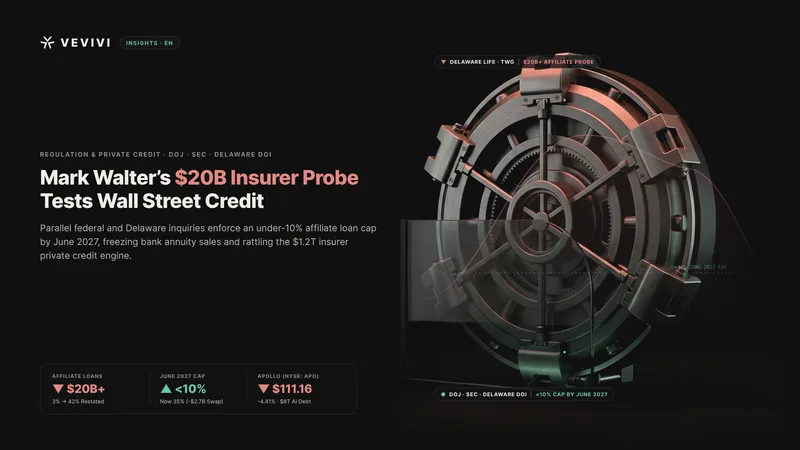
The widening Mark Walter insurance probe conducted in parallel by Manhattan federal prosecutors, the Securities and Exchange Commission, and the Delaware Department of Insurance has placed more than $20 billion in related-party private credit loans under intense regulatory scrutiny. What surfaced after grand jury subpoenas in February 2026 as a statutory reporting restatement at Delaware Life Insurance Company and Clear Spring Life and Annuity Company has escalated into a structural stress test for Wall Street's $1.2 trillion insurance-backed private credit machine.
On November 19, 2026, Delaware Insurance Commissioner Trinidad Navarro's department confirmed its own parallel investigation, stating publicly that state supervisors, company boards, internal and external auditors, and credit rating agencies were intentionally misled regarding the true affiliation of roughly $21 billion in investments tied to entities within billionaire Mark Walter's TWG Global and Group 1001 ecosystem. No criminal indictments or civil enforcement complaints have been filed against Walter, Guggenheim Partners, TWG Global, or the two insurers as of November 22, 2026, and TWG Global maintains that annuity payments remain current with zero policyholder losses.
Why the Mark Walter Insurance Probe Escalated From Subpoenas to State Remediation
Federal scrutiny initially began with a revenue-recognition inquiry at Guggenheim Partners, where Walter serves as chief executive officer overseeing roughly $345 billion to $350 billion in assets, including a September 2025 federal search warrant executed at Chicago Midway International Airport. While Guggenheim's external auditors stood behind its accounting, documents gathered via subsequent subpoenas directed investigators from the U.S. Attorney's Office for the Southern District of New York and the SEC toward Group 1001's Delaware-domiciled annuity carriers.
According to Delaware Life's statutory financial statements filed with the SEC on June 26, 2026, the insurer held $64.70 billion in total admitted assets at year-end 2025—including $45.90 billion in general account assets and $3.84 billion in capital and surplus—before expanding toward roughly $69 billion to $71 billion alongside $16 billion at sister insurer Clear Spring. Prior to the February 2026 subpoenas, Delaware Life reported that only about 3%, or $1.4 billion, of its invested portfolio consisted of related-party assets. Restated statutory disclosures revealed more than $17 billion in related-party and affiliate-contingent investments at Delaware Life alone—lifting its affiliated share to 39% under statutory coding and 42% under AM Best's methodology, the highest concentration among large U.S. insurers outside Berkshire Hathaway.
Inside the $20 Billion Affiliate Loan Web and Rolling Short-Term Capital Arbitrage
Note 3 of Delaware Life's restated 2025 statutory filing details $16.37 billion in private credit investments whose returns are predominantly contingent on affiliate performance—comprising $12.62 billion in bonds, $3.24 billion in short-term investments, and $509.7 million in other invested assets—alongside $871.1 million in direct affiliate holdings and $634.5 million across separate-account funding agreements and trust notes. Combined with Clear Spring, more than $20 billion to $21 billion flowed through hundreds of opaque limited liability companies into ventures connected to Walter's broader corporate network.
Forensic reviews also exposed a regulatory capital arbitrage built around short-term reverse repurchase agreements. Under National Association of Insurance Commissioners risk-based capital formulas, volatile long-term equity or unrated credit exposures can require up to a 30.0% capital buffer, whereas qualifying short-term assets carry charges as low as 0.39%. By year-end 2025, Walter's insurers held $5.0 billion in short-term investments—roughly 9% of invested assets versus an industry average below 1%—rolling $2.3 billion across consecutive year-ends at annualized yields of 6% to 9% and trimming required risk-based capital by an estimated $600 million or more.
Bank Distribution Freezes and the $14.55 Billion Sports Deleveraging Wave
Although S&P Global Ratings, AM Best, and Fitch Ratings affirmed Delaware Life's A- financial strength rating, all three shifted their outlooks to negative or rating watch negative, citing internal control weaknesses and execution risk. Under a remediation plan overseen by Delaware regulators, Delaware Life must slash its affiliated asset ratio from 42% to below 10% by June 2027. TWG Global proposed swapping up to $6.5 billion of related-party holdings for independent assets, winning partial regulatory approval for $3.8 billion and completing an initial $2.7 billion exchange—alongside a $90 million reduction at Clear Spring—that brought affiliated exposure down to roughly 35%.
Commercial repercussions hit distribution channels immediately. Regional banking partners Truist Financial and Fifth Third Bancorp paused sales of Delaware Life annuities in late August 2026, contributing to a drop of more than 30% in third-quarter new annuity sales. Because Walter's estimated $16 billion net worth on the Bloomberg Billionaires Index is heavily concentrated in illiquid franchises rather than cash, rapid portfolio restructuring followed: Walter agreed in August 2026 to sell majority control of the Los Angeles Lakers to Josh Kushner and Bob Iger at a record $12.5 billion valuation just 14 months after buying in at $10.0 billion, exited his Chelsea FC stake for $1.3 billion in September, and neared a record $750 million sale of the Los Angeles Sparks—totaling $14.55 billion in sports divestitures while exploring options for his Cadillac Formula 1 team valued above $3.0 billion.
Systemic Fallout for Wall Street Private Credit and the $8 Trillion AI Buildout
The episode strikes at the core funding architecture of modern Wall Street. Since the pandemic, private equity and alternative asset managers have acquired roughly 50 U.S. insurers to lock in long-duration annuity float. In a September 2026 inquiry to the NAIC, incoming Senate Banking Committee Chair Elizabeth Warren highlighted Chicago Fed data showing life insurers' private credit holdings more than doubled from $386 billion in 2014 to $849 billion in 2024, while the NAIC's September 24, 2026 response estimated broader insurer private credit exposure at roughly $1.2 trillion—13% of the sector's $9.6 trillion in total assets, alongside $409 billion in pension risk transfer liabilities—while pointing to Delaware's stretched supervision of $1.2 billion in life premiums per staff member.
Alternative asset leaders are moving aggressively to ring-fence their own platforms from contagion. Apollo Global Management—whose shares closed at $111.16 on November 20, 2026, down 4.41% amid a 3.70% S&P 500 retreat to 6,910.39, a 5.04% U.S. 10-year Treasury yield (4.76% 2-year yield and 3.88% effective federal funds rate), and Bitcoin consolidating near $60,112—relies on its Athene annuity arm to originate investment-grade private credit. Chief Executive Officer Marc Rowan warned that financing global AI data centers, power grids, and semiconductor fabs will require $6 trillion to $8 trillion—offering 200 to 300 basis points of spread pickup on five-year chip-backed structures while $60 billion neocloud borrowers face 15% debt yields—and publicly faulted regulatory arbitrage around Delaware Life for threatening institutional trust in insurance capital.
Key Questions Investors Are Asking on Insurer Private Credit Risk
Are Delaware Life and Clear Spring annuity holders facing immediate payout defaults?
No payment defaults have occurred, and Delaware Life continues to hold $3.84 billion in statutory capital and surplus alongside an affirmed A- rating from S&P, AM Best, and Fitch. However, early contract exits remain costly due to surrender charges of up to 6% and market value adjustments, while state guaranty associations typically cap annuity protection near $250,000 to $300,000 in an insolvency scenario.
Why have no criminal or civil charges been filed while remediation proceeds?
Federal prosecutors in Manhattan, the SEC, and the Delaware Department of Insurance are conducting active fact-finding investigations to determine whether the omission of related-party codes stemmed from actionable concealment or complex intermediary structuring. Regulatory asset-swap mandates can proceed administratively under state holding-company statutes well before federal authorities decide whether to close an inquiry, negotiate a settlement, or bring charges.
Could state regulatory reform restrict private credit funding for AI infrastructure?
Tighter NAIC enforcement—including the 45% risk-based capital charge on structured residual tranches, 2026 standardized private-rating disclosures, and Actuarial Guidelines 53 and 55—will penalize opaque affiliated conduits and unrated rolling loans. Investment-grade senior equipment and data-center debt backed by hyperscalers should retain insurer demand, whereas lower-tier AI borrowers reliant on private letter ratings face steeper capital charges and wider credit spreads.
Disclaimer and Risk Warning
This article is provided strictly for informational and educational purposes based on publicly available on-chain metrics and macroeconomic data. Nothing in this publication constitutes financial, investment, legal, or tax advice, nor should it be construed as a solicitation, recommendation, or offer to buy or sell any digital asset or financial instrument. Digital assets are subject to high market risk and extreme price volatility, and you may lose part or all of your invested capital. Historical market cycles and past performance referenced herein do not guarantee future results. You are solely responsible for your own investment decisions and should conduct independent research and consult a qualified financial advisor before making any financial commitments.