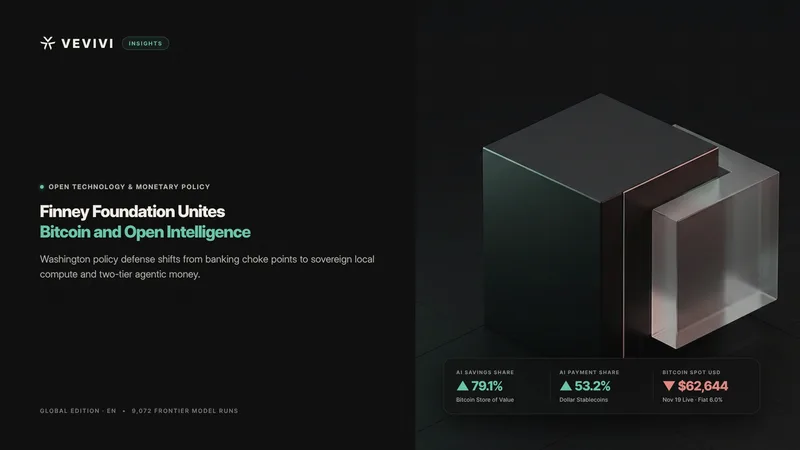
Bitcoin open-source AI policy entered a decisive institutional phase in Washington on November 17, 2026, when the Bitcoin Policy Institute formally expanded into the Finney Foundation for Open Technology. Named after cryptographer Hal Finney, who helped build Pretty Good Privacy encryption in the early 1990s and received the first peer-to-peer Bitcoin transaction from Satoshi Nakamoto in January 2009, the Washington nonpartisan 501(c)(3) research organization is broadening its Capitol Hill mandate while spot Bitcoin trades near $62,644 per Google Finance live market data on November 19, 2026, and global dollar stablecoin supply stands at $284.1 billion per DefiLlama. Rather than pivoting away from sound money, the foundation links monetary self-custody directly to user-controlled machine intelligence, encrypted communications, robotics, biotechnology, and commercial space policy.
Why Bitcoin open-source AI Defines the Finney Foundation Mandate
Led by President David Zell, Executive Director Conner Brown, and Head of Strategy Andrew Bailey, the Finney Foundation retains the Bitcoin Policy Institute as its dedicated monetary division while launching an inaugural cohort of Finney Fellows across machine intelligence, constitutional free speech, national security, biotechnology, and space exploration. Alongside the organizational expansion, the group published its Open Technology Declaration titled For Us, Not Over Us, framing user sovereignty over local hardware as a unified civil liberties question that cuts across partisan lines on Capitol Hill.
From Running an Independent Node to Sovereign Local Compute
Within digital asset markets, running an independent verification node allows households and institutions to validate transactions and custody reserves without asking permission from commercial intermediaries. Bailey and the foundation apply that exact architectural principle to machine intelligence: computers and neural weights should answer directly to their local owners rather than operating exclusively via remote application programming interfaces controlled by hyperscale technology executives. Extending this framework into private messaging and open-weight models builds a broader legislative coalition among lawmakers who may be skeptical of speculative token markets yet strongly oppose centralized surveillance of personal devices.
First Amendment Code Defense and Software Developer Liability
Building institutional legal shields early reflects hard-won lessons from recent U.S. software prosecutions. In August 2025, Tornado Cash co-founder Roman Storm was convicted on an unlicensed money-transmitting conspiracy count under Title 18, Section 1960 of the United States Code, followed in November 2025 by four-year and five-year federal prison sentences for the founders of Samourai Wallet. Whereas Bitcoin advocates spent years constructing nonprofit litigation funds and congressional fellowships after enforcement actions were already underway, open-weight artificial intelligence developers currently lack comparable policy infrastructure. Engaging incoming members of the 120th Congress early aims to establish that publishing open model weights and cryptographic source code constitutes protected expression under the First Amendment.
From Operation Choke Point Debanking to Cloud De-Computing Risks
During the regulatory squeeze widely documented in House Committee on Financial Services oversight reports and unredacted Federal Deposit Insurance Corporation pause letters as Operation Choke Point 2.0, federal banking supervisors pressured depository institutions to sever account access for lawful digital asset businesses. Foundation strategists warn that the next structural choke point targets computation rather than commercial bank rails—a phenomenon Bailey characterizes as de-computing.
Offline Open-Weight Inference Against Centralized Data Honeypots
Drawing on computer scientist Nick Szabo's maxim that trusted third parties function as security holes, relying exclusively on proprietary cloud clusters exposes enterprises and individuals to both state licensing mandates and corporate liability filters. Hyperscale cloud providers can impose mandatory identity verification on inference queries, throttle access, or route prompts through opaque classifier models shaped by internal corporate risk committees. By contrast, executing near-frontier open-weight models locally on personal workstations with wireless connectivity disabled guarantees verifiable data isolation. Sensitive financial spreadsheets, legal filings, and proprietary research never aggregate inside centralized cloud servers that act as high-value honeypots for external cyber attackers.
Local Repository Auditing as Critical Cybersecurity Infrastructure
Policy debates in Washington remain heavily influenced by fear—ranging from strategic competition with China to autonomous cyber intrusions such as the July 2026 Hugging Face infrastructure breach involving rogue evaluation agents, as well as zero-day vulnerability discoveries highlighted by Anthropic's Project Glasswing coalition. Yet empirical engineering practice demonstrates that open-weight models serve as indispensable defensive cybersecurity tools. Security teams can point self-hosted open-weight models directly at internal GitHub source code repositories to identify memory-safety flaws, patch décennie-old bugs, and harden critical infrastructure without transmitting confidential codebases to external cloud vendors.
Empirical Machine Monetary Split Between Bitcoin Savings and Stablecoin Payments
As autonomous software agents increasingly execute commercial workflows, purchase application programming interface calls, and manage digital treasuries, monetary policy intersects directly with machine intelligence. In its landmark Money for AI empirical study, researchers conducted 9,072 neutral, unprompted economic experiments across 36 frontier models from six providers—Anthropic, OpenAI, Google, DeepSeek, xAI, and MiniMax—without suggesting predetermined currencies. Over 90% of model responses rejected traditional bank-intermediated fiat in favor of digital-native instruments, with Bitcoin capturing 48.3% of total selections, stablecoins 33.2%, and traditional bank fiat just 8.9%.
Why Autonomous Agents Pair Bitcoin Reserves With Dollar Stablecoin Checking
Disaggregating the 9,072 experimental runs by classic monetary function reveals a striking two-tier architecture that held across model sizes and temperature settings. Across 2,268 long-term store-of-value scenarios, frontier models selected Bitcoin in 79.1% of responses—1,794 selections—compared with just 6.7% for stablecoins, 6.0% for fiat currency, and 4.2% for other crypto tokens, citing fixed twenty-one million supply and absence of institutional counterparty risk. Conversely, across 2,268 everyday payment and cross-border settlement scenarios, dollar-pegged stablecoins led at 53.2% versus 36.0% for Bitcoin and 5.1% for fiat. Even as provider alignment created dispersion—Anthropic's Claude Opus 4.6 favored Bitcoin in 76.6% of total prompts compared with 18.3% on OpenAI's GPT-5.2, which favored stablecoins at 38.9%—autonomous reasoning converged on a checking-versus-savings split. Agents treat liquid dollar stablecoins, backed by a $284.1 billion global market led by Tether at $175.2 billion and USD Coin at $69.3 billion per DefiLlama, as programmable checking accounts while isolating long-term purchasing power in unfreezable, self-custodied Bitcoin reserves.
Post-Midterm Congressional Oversight and Strategic Scenarios Through 2028
Following the November 3, 2026 U.S. midterm elections, incoming Democratic committee majorities are preparing robust investigative dockets for January 2027. On November 18, 2026, Representative Robert Garcia, poised to chair the House Oversight Committee, issued formal document preservation notices targeting 13 administration allies and family-linked ventures, explicitly naming World Liberty Financial alongside broader conflict-of-interest inquiries reported by National Public Radio and Senate Banking Democrats. Distinguishing verified legislative actions from forward-looking policy projections clarifies two primary institutional scenarios through 2028. Under a constructive differentiation scenario, congressional investigations concentrate on politically affiliated token issuers, issuer-controlled stablecoin conflicts, and centralized intermediaries, reinforcing Bitcoin's distinct legal standing as a commodity network with no issuer, executive board, or political sponsor, while younger bipartisan lawmakers advance developer protections. Under an adverse regulatory spillover scenario, heightened national security anxiety over autonomous cyber incidents or broad anti-money-laundering bills could sweep open-weight model distribution and self-custodial fiat on-ramps into restrictive licensing regimes, compounding macro valuation pressure while spot Bitcoin consolidates near $62,644 amid elevated U.S. Treasury yields.
Frequently Asked Questions on Open Technology Policy and Agentic Money
Institutional allocators, software enterprises, and policy analysts evaluating the convergence of decentralized monetary networks and local artificial intelligence frequently raise two structural questions.
Does the expansion into the Finney Foundation dilute Washington advocacy for Bitcoin?
No contraction in Bitcoin programming is occurring under the new parent structure. Dedicated Bitcoin Policy Institute fellowships, congressional staff briefings, and annual summit allocations remain fully funded for 2027, while recruiting allied technologists from open-weight artificial intelligence and encrypted communications expands Capitol Hill receptivity to self-custody principles.
How does de-computing affect enterprise security and autonomous financial agents?
De-computing arises when regulatory licensing or cloud provider restrictions gate access to remote model inference through identity checks and content classifiers. Enterprises that deploy open-weight models on internal hardware preserve operational continuity, protect proprietary code audits from external exposure, and retain sovereignty over autonomous agents managing stablecoin liquidity and Bitcoin reserves.
Disclaimer and Risk Warning
This article is provided strictly for informational and educational purposes based on publicly available on-chain metrics and macroeconomic data. Nothing in this publication constitutes financial, investment, legal, or tax advice, nor should it be construed as a solicitation, recommendation, or offer to buy or sell any digital asset or financial instrument. Digital assets are subject to high market risk and extreme price volatility, and you may lose part or all of your invested capital. Historical market cycles and past performance referenced herein do not guarantee future results. You are solely responsible for your own investment decisions and should conduct independent research and consult a qualified financial advisor before making any financial commitments.