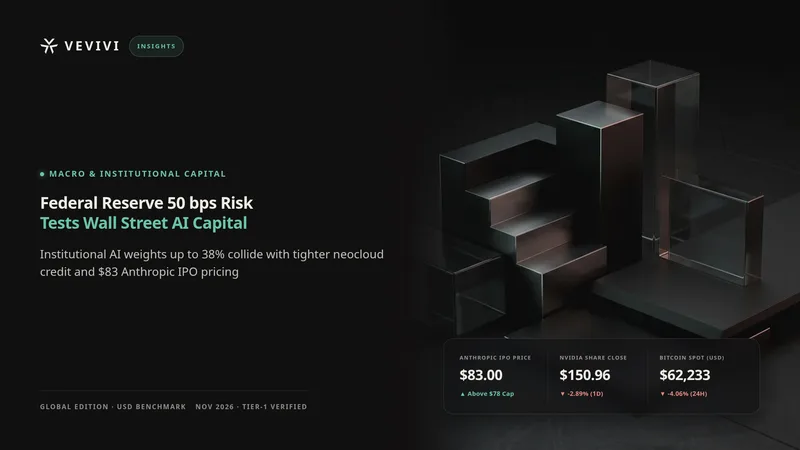
A fresh Federal Reserve rate hike warning from Governor Christopher Waller ahead of the December policy meeting is forcing global allocators to reassess record artificial intelligence portfolio concentration and private credit underwriting. As sticky inflation above 3% elevates the structural cost of capital, pension funds, private banks, and buyout sponsors are pivoting away from unconditional growth multiples toward collateralized lending, verifiable enterprise productivity, and uncorrelated cash flows.
Federal Reserve Rate Hike Debate and the Five Percent Yield Regime
Policy divergence inside the central bank widened sharply ahead of the December 8–9 Federal Open Market Committee meeting, where the benchmark federal funds target range currently stands at 3.75% to 4.00%. Speaking on November 18 following his earlier monetary policy remarks, Federal Reserve Governor Christopher Waller warned that recent three-month inflation data imply an annualized pace near 3.5% and cautioned that household and corporate inflation expectations risk becoming entrenched around 3%. Unless the committee delivers a credible forward signal committing to a follow-up increase in January, Waller argued policymakers should actively consider a 50-basis-point increase in December to tighten financial conditions decisively.
Federal Reserve Bank of New York President John Williams offered a measured counterpoint, noting that while disinflation has stalled, a solid labor market allows officials to pursue gradual rate adjustments without resorting to an outsized half-point shock. Under Chair Kevin Warsh's move away from rigid unanimous forward guidance, fixed-income desks must now price live vote-tally dispersion across individual governors. Consequently, even amid intraday haven buying, the benchmark US 10-year Treasury yield remained anchored in the 5.07% to 5.12% range—keeping long-end borrowing costs above 5% and reinforcing positive stock-bond correlation during inflation bouts.
Institutional Artificial Intelligence Concentration Surpasses Cash and Bonds
Higher discount rates carry amplified systemic weight because institutional balance sheets are already heavily tilted toward the artificial intelligence buildout. Portfolio research highlighted by Fortress Investment Group Chief Strategist Elizabeth Burton shows that US public pension plans and institutional allocators hold between 13% and 38% of their total portfolios in artificial intelligence exposures across public equities, private funds, and infrastructure credit. Global private wealth accounts carry 14% to 30% exposure, while family offices hold 10% to 25%. Crucially, across a wide share of US public institutions and private wealth mandates, aggregate artificial intelligence exposure now exceeds combined fixed-income and cash holdings.
Portfolio Asymmetry and K-Shaped Infrastructure Credit Spreads
When inflation volatility causes equities and sovereign bonds to sell off simultaneously, carrying more thematic artificial intelligence risk than liquid fixed income transforms the sector into both the market's primary return engine and its largest single point of concentration risk. Credit desks are already pricing a pronounced K-shaped divergence: spreads remain tight for cash-generative hyperscalers backed by contracted backlog, whereas single-asset data center developments and sub-investment-grade compute borrowers face widening risk premiums and stricter debt-service scrutiny.
Nvidia Post-Earnings Reversal and the $32 Billion Neocloud Financing Gate
That heightened selectivity explained Nvidia's sharp intraday reversal on November 18 despite an objectively historic operational print. Per its US Securities and Exchange Commission Form 8-K filing, Nvidia delivered fiscal third-quarter 2027 revenue of $115.84 billion—up 103% year over year—led by $107.6 billion in Data Center sales, while guiding fourth-quarter revenue to $130.0 billion assuming zero China data center compute revenue. Interim Chief Executive Officer Colette Kress raised fiscal 2028 revenue growth guidance from 70% to roughly 75%, and Board Chair Harvey C. Jones confirmed the board unanimously accepted Jensen Huang's resignation and will not reinstate him. Yet Nvidia shares erased a 3.6% after-hours gain to close down 2.89% at $150.96, valuing the chipmaker at $3.64 trillion—roughly 38% below its 52-week peak of $243.37.
Investors zeroed in on balance-sheet capital discipline rather than headline top-line growth. While Nvidia expanded multi-year supply and memory commitments from $279 billion to $390 billion and reported $118.0 billion in maximum guarantee exposure, management trimmed financing commitments to emerging GPU cloud providers—known as neoclouds—from $36 billion to $32 billion. Kress emphasized that backing activates strictly on a selective basis once counterparties secure independent financing and bring facilities online on schedule, sending CoreWeave shares down 4.13% to $47.83. Simultaneously, pending December congressional hearings into Southeast Asian export channels and Commerce Department oversight of Singapore-linked Megaspeed kept governance risk premiums elevated.
Bilateral Private Credit Versus Verifiable Enterprise Productivity
As artificial intelligence infrastructure graduates from hyperscaler free cash flow to debt and equity capital markets, institutional lenders are redefining where they sit in the capital stack. J.P. Morgan Private Bank Head of Alternative Investment Strategy Sitara Sundar noted that private credit lenders strongly favor bilateral direct lending to neoclouds over broadly syndicated public high-yield bonds. Bilateral structures allow private lenders to negotiate bespoke collateral protections over GPU clusters, affirmative cash-sweep covenants, and counterparty lease step-ins—capturing equity-like yields with senior credit downside protection as public debt markets pull back.
On the private equity side, buyout sponsors are demanding measurable operating leverage alongside non-correlated diversification. Viral Patel, Chief Executive Officer of Blackstone Private Equity Strategies Fund—which manages roughly $30 billion in assets with an annualized net return near 18% since inception—reported that enterprise artificial intelligence token spending across Blackstone's more than 280 portfolio companies surged over 20x during the past year. Real-economy deployments cut client intake labor by 50% at accounting firm Citrin Cooperman and reduced healthcare call-center handling times by 30% at 98% accuracy at Allied Benefit Systems. To insulate portfolios against rate and inflation correlation, Blackstone simultaneously committed up to $1.5 billion through 2028 to co-fund Pfizer's monthly GLP-1 obesity drug candidate berobenatide, pairing frontier tech productivity with uncorrelated life-sciences cash flows.
Anthropic $83 IPO Pricing, Bitcoin Liquidity Drain, and Market Scenarios
In public equity capital markets, frontier model developer Anthropic priced its initial public offering above its $70 to $78 marketed range at $83.00 per share ahead of its November 19 Nasdaq debut. Based on the 825 million shares in its amended registration statement, the offering raises roughly $68.5 billion alongside a separate $26.0 billion strategic private placement from Google, Nvidia, Microsoft, AMD, Broadcom, Micron, and TSMC Partners, pushing Anthropic's fully diluted valuation above $1.4 trillion. Even so, investor focus is shifting swiftly to margin durability: Anthropic carries more than $900 billion in long-term compute commitments through 2045—including over $70 billion due within 12 months—while allocating roughly 75% of current compute capacity to model training rather than commercial inference.
The combination of institutional dry powder mobilization for Anthropic's mega-offering and hawkish central bank repricing weighed directly on liquid digital assets. Live market feeds showed Bitcoin retreating 4.06% over 24 hours to $62,233.10 and Ethereum falling 3.33% to $1,761.80, while the S&P 500 edged down 0.23% to 7,323.63 and the Nasdaq Composite gained 0.42% to 24,429.89. Looking into December, two conditional scenarios govern cross-asset positioning. Under a constructive stabilization path—where incoming inflation data cool enough to contain the December move to 25 basis points and post-IPO institutional cash rebalancing subsides—oversold Bitcoin liquidity and cash-rich semiconductor leaders could stage a relief recovery. Conversely, if lagging service inflation persists near a 3.5% annualized pace and validates Waller's 50-basis-point shock or back-to-back winter hikes, a higher terminal rate ceiling above 5.15% on 10-year Treasuries would intensify deleveraging across leveraged neoclouds and high-beta digital assets.
Key Institutional Questions on Rates, Credit, and Liquidity
Why did Governor Christopher Waller float a 50-basis-point move for the December meeting?
Three-month annualized inflation readings near 3.5% remain stubbornly above the central bank's 2% mandate, raising concern that 3% inflation expectations are becoming embedded in wage and pricing behavior. Waller argued that without formal forward guidance guaranteeing a follow-up hike in January, a standard 25-basis-point step may fail to tighten financial conditions sufficiently, whereas New York Federal Reserve President John Williams favors steadier quarter-point increments while evaluating labor resilience.
Why did Nvidia shares decline despite raising fiscal 2028 revenue growth guidance to 75%?
Equity markets looked past backward-looking beats to focus on 2028 terminal multiple risk, governance overhang following Jensen Huang's departure, and tighter ecosystem financing. Trimming neocloud commitments from $36 billion to $32 billion signaled that Nvidia will no longer act as an unconditional balance-sheet backstop for delayed or undercapitalized data centers, while institutional portfolio liquidation ahead of Anthropic's $68.5 billion public offering added near-term selling pressure.
How are institutional allocators repositioning across private credit and Bitcoin right now?
With US public pension and private wealth artificial intelligence weights already rivaling or exceeding cash and bond buffers, institutions are favoring senior bilateral private credit over public junk debt and pairing enterprise software productivity gains with uncorrelated real-economy and life-sciences assets. In digital assets, spot Bitcoin continues to act as a real-time liquidity barometer, absorbing near-term cash rotation from mega-cap equity offerings and hawkish Treasury yield repricing before directional flows stabilize post-December FOMC.
Disclaimer and Risk Warning
This article is provided strictly for informational and educational purposes based on publicly available on-chain metrics and macroeconomic data. Nothing in this publication constitutes financial, investment, legal, or tax advice, nor should it be construed as a solicitation, recommendation, or offer to buy or sell any digital asset or financial instrument. Digital assets are subject to high market risk and extreme price volatility, and you may lose part or all of your invested capital. Historical market cycles and past performance referenced herein do not guarantee future results. You are solely responsible for your own investment decisions and should conduct independent research and consult a qualified financial advisor before making any financial commitments.