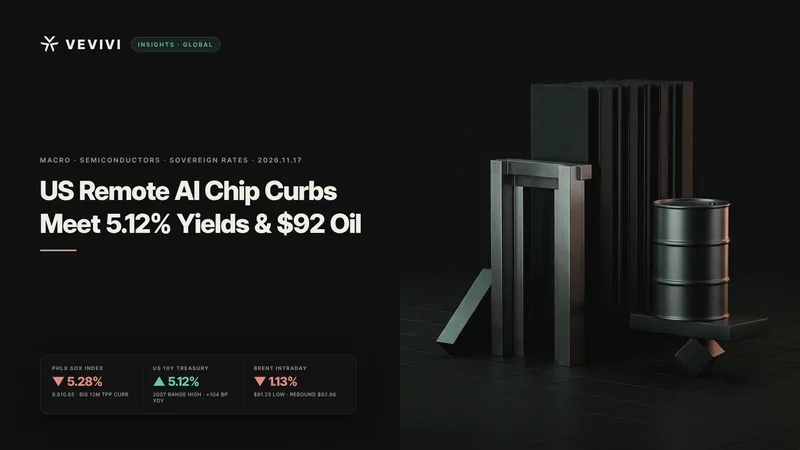
Global capital markets are simultaneously pricing three structural macro shifts: Washington's extraterritorial closure of the overseas AI cloud-rental loophole, U.S. long-end sovereign bond yields anchored above 5% in a range last witnessed in 2007, and a calibrated geopolitical timeline for the conflict with Iran. Following the U.S. Department of Commerce Bureau of Industry and Security (BIS) interim final rule targeting remote access to advanced American semiconductors through third-country data centers, the PHLX Semiconductor Index (SOX) plunged 5.28% on Monday to close at 9,610.65, dragging the Nasdaq Composite down 2.49% to 24,509.76 and the S&P 500 lower by 1.92% to 7,416.59. While U.S. Vice President JD Vance signaled that Washington will not allow the Iran war to extend even into a two-year military commitment—briefly pulling Brent crude futures down to an intraday trough of $91.25 per barrel before prices stabilized near $92.96—sticky 5.12% 10-year U.S. Treasury yields continue to enforce a punitive cost-of-capital hurdle across global risk assets.
Rather than a routine positioning shakeout, cross-asset price action reflects a fundamental reassessment of both the addressable geographic market for AI infrastructure and the real discount rate applied to multi-year capital expenditures. By shifting export enforcement from physical port-of-entry hardware shipments to remote compute customer verification, U.S. regulators have forced institutional investors to recalculate utilization assumptions across fast-growing Southeast Asian and Latin American data-center corridors right ahead of pivotal earnings and capital-markets tests.
US BIS Remote Compute Controls and Policy Friction Inside Pax Silica
The interim final rule issued by the Bureau of Industry and Security closes a critical regulatory gap that previously enabled entities in restricted jurisdictions to rent American-designed Super Intelligence (SI) compute clusters hosted in third countries via cloud agreements or intermediary brokers. Drafted in coordination with the U.S. Treasury Department and the National Security Council, the measure aligns remote cloud access governance directly with physical export controls.
The 12 Million TPP Compute Threshold and Five-Nation Licensing Mandate
Under official BIS parameters, export, re-export, and transfer licensing requirements now apply to any overseas data center or network supplying more than 12 million Total Processing Performance (TPP)—a compute density roughly equivalent to 750 Nvidia H100 or H200 accelerators—whenever compute may be accessed by entities headquartered in, or controlled by parent companies in, Country Group D:5 (including China, Russia, Iran, North Korea, and 18 other jurisdictions) or Macau. Existing third-country data-center operators subject to the rule face a strict 90-day compliance clock to secure BIS authorization and implement ownership-level customer screening, while commercial recommendation engines for e-commerce and social media remain exempt.
Following heightened regulatory scrutiny of Malaysia-based operator Megaspeed, the Commerce Department simultaneously imposed mandatory export licenses on advanced AI chips shipped to five countries cited for elevated diversion risk: Singapore, Malaysia, Thailand, Indonesia, and Brazil, exempting only shipments destined directly for U.S.-headquartered hyperscalers. The rule also formally rescinds the unimplemented January 2025 country-tier AI Diffusion Rule, replacing broad geographic quotas with targeted end-user compute containment.
Southeast Asian Data-Center Repricing and Singapore's Diplomatic Tightrope
The announcement landed just as President Donald Trump departed Washington for a high-stakes Asian tour spanning the ASEAN Summit in Manila and bilateral talks with President Xi Jinping in Shenzhen, creating immediate diplomatic friction across the Indo-Pacific. Only one day prior, on November 15, the United States and nine partner nations—including Singapore, the United Arab Emirates, Japan, South Korea, Australia, India, Israel, Qatar, and the United Kingdom—signed the San Francisco Declaration under the U.S. State Department's flagship Pax Silica AI supply-chain security coalition. Singapore's simultaneous inclusion in both Pax Silica and the Commerce Department's five-country license list underscores the tension between allied industrial integration and strict compute leakage enforcement, prompting Singaporean authorities to engage Washington on implementation scope as Malaysian power utilities (-10%) and regional colocation suppliers price in slower demand from Chinese AI labs such as Alibaba, Tencent, ByteDance, MiniMax, and Zhipu.
Global Semiconductor De-Rating, Post-Huang Nvidia Governance, and Anthropic's IPO Test
Expectations of a narrower non-U.S. AI compute market extended the MSCI Asia Pacific Index's losing streak to a fourth consecutive session—its lowest level since April—while driving a sharp divergence between slumping Chinese cloud hyperscalers and rallying mainland Chinese chipmakers betting on forced silicon self-reliance.
Nvidia's First Post-Jensen Huang Earnings Report and Sovereign Concentration Risk
According to live Google Finance market data, Nvidia (NVDA) shares traded at $157.65 (-3.20%) in Tuesday U.S. pre-market action following a 4.08% Monday slide, compressing its market capitalization to $3.76 trillion—down 35.2% from its 52-week high of $243.37 following former CEO Jensen Huang's resignation amid personal-conduct and customer-routing controversies. With Financial Times reporting confirming that Nvidia's board is not considering reinstating Huang despite external investor petitions, Tuesday evening's fiscal third-quarter report marks the company's first institutional guidance test without its co-founder.
While consensus estimates project quarterly revenue surging 91.3% year-over-year to roughly $109 billion, backward-looking shipment revenue functions largely as a lagging indicator of pre-booked hyperscaler orders. Institutional scrutiny is instead centered on forward supply-chain commitments, third-country licensing headwinds, and mark-to-market valuations on Nvidia's ecosystem financing and data-center lending guarantees following recent repricing across peers such as SoftBank. Meanwhile, official Israeli Central Bureau of Statistics figures showing third-quarter annualized GDP expanding 8.0%—yet dropping to 4.0% once overseas chip production booked by Nvidia's Israeli R&D operations is excluded—highlight how deeply even sovereign macro aggregates now hinge on single-vendor AI hardware cycles.
Anthropic's 6x-Oversubscribed $64.4 Billion Nasdaq Debut and Liquidity Absorption
Compounding near-term equity positioning pressure is Anthropic's landmark initial public offering, scheduled to price Wednesday, November 18, and debut Thursday, November 19, on the Nasdaq Global Select Market under the ticker ANT. Offering 825 million Class A shares at $70 to $78 per share—raising up to $64.4 billion at a proposed $1.3 trillion to $1.45 trillion valuation alongside a $26 billion non-voting private placement backed by Google, Nvidia, Microsoft, TSMC, AMD, Broadcom, and Micron—the roadshow has already drawn order coverage exceeding six times available shares. Although the oversubscribed book validates institutional appetite for frontier AI platforms, mega-cap primary issuance temporarily drains secondary-market dry powder across the broader technology complex.
Geopolitical Oil Relief Versus Sticky 5.12% US Treasury Yield Gravity
Beyond technology regulation, global asset allocators are navigating an unusual divergence between moderating Middle East war-duration fears and stubbornly elevated U.S. sovereign borrowing costs.
Vance's Sub-Two-Year Iran War Horizon and Gulf Critical Infrastructure Resilience
Speaking on Fox News, Vice President JD Vance stated unequivocally that the Trump administration will not permit the war with Iran—which began in late February—to become a 10- or 15-year entanglement, or even a two-year commitment. Brent crude futures responded during Asian hours by dipping 1.13% to an intraday low of $91.25 per barrel on supply-recovery optimism before rebounding to $92.96 in early Tuesday trade, illustrating that verbal de-escalation caps upside tail spikes without fully eliminating physical Strait of Hormuz transit premiums.
Across the Gulf, physical and sovereign technology operators are demonstrating rapid post-disruption normalization. Dubai International Airport (DXB) processed 50.4 million passengers across the first nine months of 2026 (-28.1% year-over-year following spring airspace disruptions), yet CEO Paul Griffiths reaffirmed full-year guidance of 70 million to 71 million travelers—compared with 95.2 million in 2025—as European carriers resume Origin-and-Destination routes, keeping DXB on pace toward 100 million passengers by late 2027 ahead of Al Maktoum International Airport's (DWC) 150 million-to-260 million capacity transition in the early 2030s. In parallel, Abu Dhabi-listed Space42 reported nine-month revenue of $404.2 million (+11.4% YoY), normalized EBITDA of $194 million (+30% YoY, 48% margin), net profit of $49.4 million (+31.2% YoY), and $6.2 billion in contracted backlog, expanding its Foresight Earth-observation fleet and advancing its Equatys direct-to-device satellite venture with U.S. partner Viasat.
2007-Era Sovereign Yields, Operational Tech Fragility, and Cross-Asset Rebalancing
In fixed income, Federal Reserve H.15 and St. Louis Fed (FRED) data place the benchmark 10-year U.S. Treasury yield at 5.12% on November 17 (after touching 5.15% on November 13, with 5-year notes at 4.91%), sustaining a yield corridor last observed in 2007 as persistent inflation keeps the Fed's terminal rate trajectory contested. With risk-free sovereign paper yielding above 5% and high-grade corporate credit offering compelling real carry, the hurdle rate for debt-funded AI CapEx has risen substantially—an environment also reflected in Bitcoin (BTC) consolidating at $64,878.54 under tighter dollar liquidity. Same-day operational disruptions on November 16—including an internal on-premise hardware software bug at JPMorgan Chase that delayed Zelle and interbank processing, alongside a separate departure-system outage at United Airlines delaying over 400 flights—further underscored single-point fragility across concentrated digital infrastructure.
Institutional allocators such as Standard Chartered's wealth strategy team characterize the current pivot not as wholesale de-risking, but as mid-cycle rebalancing away from single-sector semiconductor concentration toward investment-grade corporate bonds, financials, and utilities. Two conditional scenarios govern near-term direction: a constructive stabilization path if Nvidia demonstrates disciplined ecosystem credit exposure and resilient Western hyperscaler demand while Brent crude eases below $90 to temper inflation expectations; or a deeper valuation compression regime if 90-day BIS licensing stalls Southeast Asian server deployments while 10-year Treasury yields retest their 5.31% cycle high.
Key Questions for Global Institutional Investors
How does the US BIS 12 million TPP rule alter Southeast Asian data-center economics and Nvidia's addressable market?
By tying export licenses to the ultimate nationality of remote cloud users rather than physical server location alone, the rule curtails third-country GPU rental pipelines across Malaysia, Thailand, Indonesia, Singapore, and Brazil that previously served Chinese AI developers. While U.S.-headquartered cloud providers retain streamlined pathways, regional colocation operators reliant on non-U.S. compute brokers face lower utilization visibility and tighter project-finance underwriting.
Why did Brent crude rebound toward $93 per barrel despite Vice President Vance ruling out a multi-year Iran war?
Political assurances against a multi-year military commitment compress long-dated war-risk premiums, which triggered the initial drop to $91.25 per barrel, but physical crude balances still depend on verified maritime security, insurance clearance, and export infrastructure throughput. Until physical barrels demonstrably return to global spot markets without disruption, traders continue to defend a near-term floor in the low-$90 range.
How do 5.12% 10-year Treasury yields and Anthropic's $64.4 billion IPO reshape multi-asset portfolio positioning?
A 5.12% risk-free benchmark narrows the equity risk premium and raises the funding bar for capital-intensive technology issuers at the exact moment Anthropic's $64.4 billion offering absorbs institutional liquidity. Balancing core equity exposure across financials, utilities, and cash-generative sovereign infrastructure alongside investment-grade corporate credit offers stronger risk-adjusted resilience than concentrated single-sector AI bets.
Disclaimer and Risk Warning
This article is provided strictly for informational and educational purposes based on publicly available on-chain metrics and macroeconomic data. Nothing in this publication constitutes financial, investment, legal, or tax advice, nor should it be construed as a solicitation, recommendation, or offer to buy or sell any digital asset or financial instrument. Digital assets are subject to high market risk and extreme price volatility, and you may lose part or all of your invested capital. Historical market cycles and past performance referenced herein do not guarantee future results. You are solely responsible for your own investment decisions and should conduct independent research and consult a qualified financial advisor before making any financial commitments.