The Federal Reserve's formal abandonment of post-2008 forward guidance has fundamentally rewired how global fixed-income and risk-asset markets price monetary policy. Under the consensus-driven regime of the previous decade and a half, Federal Open Market Committee (FOMC) decisions were heavily telegraphed ahead of time, allowing interest-rate futures to lock in a 95% to 98% probability days before each meeting and culminating in routine 12-to-0 unanimous votes. Since Chair Kevin Warsh took office in May 2026 and dismantled pre-committed rate signaling, institutional desks have entered an era of active vote-tallying—tracking individual speeches from Governor Christopher Waller, New York Fed President John Williams, and Vice Chair Philip Jefferson to tally whether a 50-basis-point hike, a 25-basis-point hike, or a hold commands a committee majority.
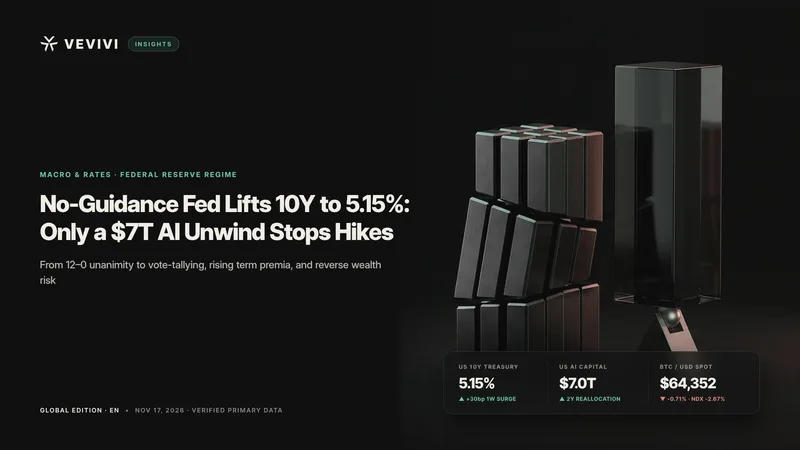
This structural shift in central bank communication is colliding with sticky above-target inflation to reprice the long end of the sovereign curve. According to official U.S. Department of the Treasury par yield curve data, the 10-year Treasury yield surged 30 basis points in a single week—one of its steepest weekly climbs in roughly eighteen months—to reach 5.15% on November 13, 2026, before trading near 5.12% to 5.13% on November 16. With consumer inflation failing to break below the 3% threshold, macro diagnostics from Bianco Research President Jim Bianco and testimony from the Federal Reserve's Productivity and Jobs Task Force point to a stark macro asymmetry: neither gradual disinflation nor organic economic cooling is currently on deck to stop rate hikes. Instead, only an unwind in the $7 trillion U.S. artificial intelligence capital cycle—and the resulting reverse wealth effect across household and corporate balance sheets—carries sufficient macro force to halt Federal Reserve tightening.
The Death of Forward Guidance and the Rise of FOMC Vote-Tallying
The most consequential institutional shift under Chair Kevin Warsh is the transition from chair-centric pre-announcements back to genuine committee deliberation. Official Federal Reserve policy statements illustrate how rapidly unanimity has fractured: while the September 16, 2026 FOMC raised the federal funds target range by 25 basis points to 3.75%–4.00% on a 12-to-0 vote, the subsequent October 28, 2026 decision to hold rates at 3.75%–4.00% passed on a split 10-to-2 vote, with Governor Lisa D. Cook and Cleveland Fed President Beth M. Hammack dissenting in favor of an immediate 25-basis-point increase. Because the chair no longer pre-scripts the upcoming meeting, competing FOMC voices fill the vacuum, forcing swap markets to enter blackout windows with 30%–40% versus 60%–70% probability splits.
Why Unanimous 12-to-0 Decisions Have Given Way to Bank of England and Bank of Japan Norms
Viewed globally, divided central bank ballots are an international norm rather than an institutional malfunction. In August 2025, the Bank of England Monetary Policy Committee recorded an unprecedented three-way 4–4–1 initial split—four members voting for a 25-basis-point cut, four voting to hold at 4.25%, and one member voting for a 50-basis-point cut—requiring a tie-breaking second ballot that passed 5–4, followed by additional 5–4 splits in November and December 2025. Similarly, the Bank of Japan Policy Board has a long history of 5–4 votes, alongside 6–3 and 7–2 dissents during its 2026 tightening cycle toward 1.25%, while the European Central Bank does not publish individual governing council votes at all. For U.S. rates traders conditioned over seventeen years to expect top-down Fed unanimity, however, adjusting to multi-faction committee voting imposes acute repricing friction.
Two-Way Policy Probabilities Heading Into the December FOMC
Without a pre-committed policy glide path, every inflation print and governor speech triggers immediate duration repricing across the front and belly of the Treasury curve. Rather than converging toward 1% or 99% certainty ahead of the December FOMC meeting, institutional rate desks must simultaneously weigh a hold, a standard 25-basis-point hike, and tail-risk 50-basis-point tightening discussions. That persistent dispersion elevates implied interest-rate volatility and raises funding and hedging costs across leveraged macro portfolios and corporate credit facilities.
Structural Drivers Behind the 10-Year U.S. Treasury Term Premium Surge
Decomposing nominal Treasury yields into expected short-rate paths and the term premium—as modeled by the Federal Reserve Bank of New York Adrian, Crump, and Moench (ACM) framework—reveals that investors are demanding substantially higher compensation for duration risk. The term premium measures the extra yield required over expected inflation and policy rates to buffer against macro and monetary uncertainty. When central bank officials reiterate an uncompromising commitment to a 2% inflation target while realized price gauges remain stubbornly above 3%, fixed-income markets embed a structural uncertainty surcharge into 10-year and 30-year maturities.
Sticky Above-Three-Percent Inflation Dynamics Versus the Two Percent Mandate
Official data released by the U.S. Bureau of Labor Statistics on November 10, 2026 underscore why disinflation optimism has faded. Headline Consumer Price Index (CPI-U) inflation rose 0.4% month-over-month in October 2026 on a seasonally adjusted basis after jumping 0.6% in September and 0.4% in August, while core CPI excluding food and energy rose 0.3% month-over-month for three consecutive months—an annualized pace approaching 3.7%. Shelter rose 0.3% in October to account for over 30% of the headline monthly gain, electricity prices climbed 0.9% on the month, and the U.S. labor market remained firm with October unemployment at 4.1% and nonfarm payrolls adding 165,000 jobs. Conflicting signals between inflation persistence and Fed rhetoric have directly fueled term-premium expansion.
Why a Five-Percent-Plus Long Yield Functions as a Market Feature Rather Than a Policy Bug
Remarkably, during the exact week that 10-year Treasury yields leaped 30 basis points toward 5.15%, the S&P 500 advanced 2.5%, looking straight through the bond selloff. Robust nominal GDP growth, resilient household spending, and massive capital expenditure have enabled U.S. equity and housing markets to absorb 5% long-term borrowing rates without immediate systemic stress. Consequently, elevated term premia operate as a rational pricing feature of an uncertain, unscripted macro regime rather than a communication bug—one that would compress naturally only if incoming inflation data cooled decisively and consistently.
The Seven Trillion Dollar AI Capital Reallocation and the Reverse Wealth Effect
Because inflation remains unvanquished and baseline economic activity has not stalled, the sole plausible catalyst capable of halting Federal Reserve rate hikes is an asset-led contraction in aggregate demand. This market thesis aligns directly with Chair Kevin Warsh's November 16, 2026 opening remarks at the Federal Reserve Board and San Francisco Fed Productivity and Jobs Task Force Conference. Outlining three structural scenarios for artificial intelligence, Warsh explicitly warned that expected returns could disappoint after massive capital investment and equity gains, driving stock valuations lower, slowing economic growth, and lifting unemployment—mirroring the Federal Reserve's November 13, 2026 Financial Stability Report, which ranked AI sentiment reversals and data-center leverage among the top near-term systemic vulnerabilities.
Why Only an AI Equity Unwind Can Derail Further Fed Tightening
During the San Francisco Fed task force fireside chat, Andreessen Horowitz co-founder and task force co-lead Marc Andreessen highlighted that the U.S. private sector and financial system recalibrated roughly $7 trillion toward AI over the past two years—a capital mobilization surpassing historical benchmarks such as the Apollo program. Because U.S. capex momentum and upper-tier household consumption have become heavily tethered to AI equity wealth, Monday's November 16 market action offered a real-time preview of that sensitivity: as AI valuation jitters surfaced, NVIDIA fell 4.12% to $156.14 ($3.76 trillion market cap), the Nasdaq-100 slid 2.67% to 27,197.15, the S&P 500 dropped 1.92% to 7,416.59, and 10-year Treasury yields edged down several basis points toward 5.12%. Only a sustained breakdown in the AI trade capable of triggering a broad reverse wealth effect would force policymakers to question further rate hikes despite above-target inflation.
Deflationary Tech Sectors Versus Regulated Service Inflation and Local Data Center Moratoria
Structural friction inside the U.S. political economy further complicates the AI growth thesis. Andreessen contrasted fast, competitive sectors such as consumer electronics—where rapid innovation drives steep price deflation—against slow, heavily regulated sectors including healthcare (already roughly 20% of U.S. GDP), education, housing, and government administration, where licensing cartels, supply restrictions, and demand subsidies legally block rapid technological displacement and keep service inflation elevated. Simultaneously, former U.S. Commerce Secretary Gina Raimondo warned that voter anxiety over potential displacement across 10 million to 13 million administrative roles and power-grid strain led voters to approve the vast majority of local data-center moratorium ballot measures in the November 3, 2026 elections—part of 47 local data-center ballot measures decided nationwide in 2026—compounding multi-year permitting bottlenecks and Washington debates over stricter AI chip export controls.
Cross-Asset Implications and Conditional Scenarios for Global Portfolios
Navigating a 5.15% 10-year Treasury regime alongside unguided FOMC meetings requires institutional allocators to evaluate two distinct conditional macro paths. Even as major upcoming AI initial public offerings price below earlier $2 trillion hype expectations—helping markets digest equity supply in the short run—medium-term discount-rate pressure remains acute.
Base-Case Tightening Continuation Versus the AI Valuation Reset Scenario
Under the baseline resilience scenario, corporate AI capital expenditure and high-income consumption continue to weather 5% long-end yields while core inflation hovers above 3%. In that environment, hawkish FOMC voters retain leverage to push through additional 25-basis-point tightening in December and early 2027, keeping Treasury term premia elevated. Under the alternative reverse-wealth-effect scenario, slower enterprise transition from basic search to agentic AI workflows, municipal data-center moratoria, and export-control supply distortions trigger a deeper de-rating across the $7 trillion AI complex, cooling aggregate demand rapidly enough to pull 10-year yields lower and stall the Fed's hiking cycle.
Liquidity Transmission Across Mega-Cap Equities, Sovereign Duration, and Bitcoin
Digital assets sit squarely at the intersection of sovereign real yields and technology equity liquidity. Trading at $64,352 as of November 17, 2026 (06:41 UTC), Bitcoin faces near-term headwinds from risk-free U.S. Treasury yields anchored between 4.88% on the 2-year note and 5.15% on the 10-year benchmark, which raise institutional hurdle rates for non-yielding dry powder allocations. Should an AI equity unwind trigger a macro reverse wealth effect, cross-asset correlations suggest an initial liquidity-driven drawdown alongside Nasdaq mega-caps, followed by a secondary regime test in which falling Treasury yields and an eventual Fed tightening pause re-open macro demand for scarce non-sovereign digital liquidity.
Key Questions Institutional Investors Are Asking
Why Does Abandoning Forward Guidance Push the 10-Year Term Premium Higher?
Forward guidance suppresses interest-rate volatility by committing the central bank to a predictable multi-quarter rate trajectory. Removing that anchor forces bondholders to price wide outcome dispersion—spanning holds, 25-basis-point hikes, and 50-basis-point hikes—across twelve independent FOMC voters at every meeting while inflation exceeds 3%. Because duration investors face sharper mark-to-market policy surprises, they require a larger term premium to hold 10-year and 30-year Treasury debt.
How Could an AI Stock Market Pullback Stop Rate Hikes Without Solving Inflation?
Monetary policy responds to forward aggregate demand and financial conditions as well as trailing price indices. With roughly $7 trillion channeled into U.S. AI equities and infrastructure over the past two years, capital spending and equity wealth gains have insulated the broader economy from 5% bond yields. A sustained breakdown in AI valuations would reverse household wealth effects, freeze corporate capital formation, and threaten payroll stability—compelling FOMC members to pause tightening due to growth contraction rather than completed disinflation.
What Do Local Data Center Moratoria and Chip Export Rules Mean for AI Supply and Demand?
Voter-approved municipal data-center moratoria across dozens of U.S. jurisdictions directly lengthen construction timelines and raise power-siting costs just as semiconductor fabrication already faces multi-year permitting hurdles. At the same time, overly restrictive export bans risk shrinking global revenue scale for U.S. chipmakers; once enterprise adoption graduates from simple chat queries to compute-intensive agentic workflows over the next several years, constrained domestic chip and power capacity could create severe compute bottlenecks.
Disclaimer and Risk Warning
This article is provided strictly for informational and educational purposes based on publicly available on-chain metrics and macroeconomic data. Nothing in this publication constitutes financial, investment, legal, or tax advice, nor should it be construed as a solicitation, recommendation, or offer to buy or sell any digital asset or financial instrument. Digital assets are subject to high market risk and extreme price volatility, and you may lose part or all of your invested capital. Historical market cycles and past performance referenced herein do not guarantee future results. You are solely responsible for your own investment decisions and should conduct independent research and consult a qualified financial advisor before making any financial commitments.