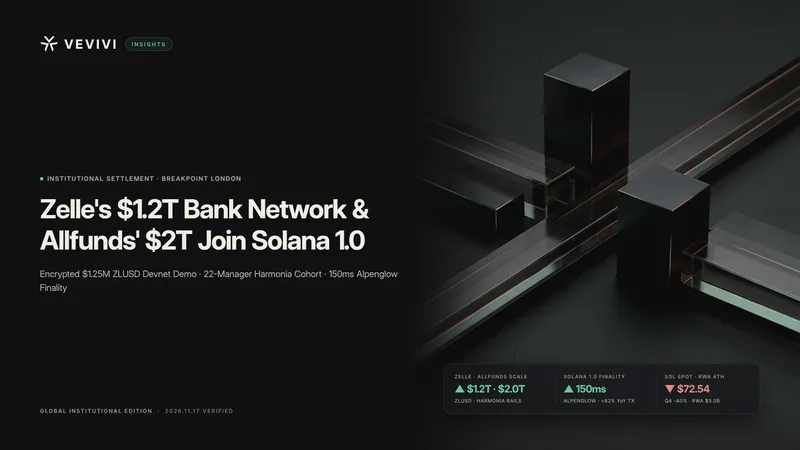
Keynote disclosures at Solana Breakpoint 2026 at Olympia London marked a structural transition for public blockchain infrastructure, shifting institutional engagement from isolated proof-of-concept pilots toward core cross-border banking rails and wholesale fund distribution. Zelle, the flagship U.S. peer-to-peer payments network operated by Early Warning Services and co-owned by seven of America's largest commercial banks including JPMorgan Chase, Bank of America, and Wells Fargo, announced that its dollar-backed stablecoin ZelleUSD will run on Solana to power international transfers, unveiling a live encrypted bank-to-bank settlement demonstration on stage. Simultaneously, Allfunds, the world's largest institutional wealth-tech and fund distribution marketplace administering roughly 1.9 trillion euros, or approximately $2.0 trillion in assets, revealed the inaugural asset-manager cohort for Project Harmonia alongside the Solana Foundation.
Yet a sharp divergence persists between accelerating institutional plumbing and near-term secondary market pricing. Even as the Solana Foundation officially retired its six-year mainnet beta label for Solana 1.0 and reduced transaction finality from roughly 13 seconds to approximately 150 milliseconds via the Alpenglow consensus upgrade, SOL trades near $72.54 as of November 17, 2026, reflecting a roughly 40% fourth-quarter drawdown alongside Bitcoin at $64,370 and Ether at $1,820 amid persistent 5.1% U.S. 10-year Treasury yields. Separating durable architectural milestones from speculative market narratives requires auditing primary reserve attestations, devnet versus mainnet deployment status, and on-chain stablecoin velocity metrics.
Zelle Cross-Border Banking Expansion and Confidential Stablecoin Architecture
Zelle's selection of Solana as the settlement layer for international peer-to-peer remittances illustrates how incumbent banking consortia are adopting high-throughput public ledgers to compress correspondent banking costs and multi-day FX settlement delays. Speaking at Breakpoint London, Zelle General Manager Denise Leonhard and Vice President of Digital Asset Partnerships Alexandra Lang emphasized that matching Zelle's domestic U.S. scale abroad required proven infrastructure capable of safeguarding consumer payment data while meeting strict regulatory oversight.
Early Warning Services Scale and Anchorage Digital Reserve Structure
Per Early Warning Services disclosures and tier-one financial reporting, Zelle is owned by a seven-bank consortium comprising JPMorgan Chase, Bank of America, Wells Fargo, Capital One, PNC Bank, Truist, and U.S. Bank, processing more than $1.2 trillion in domestic U.S. payment volume during 2025. Because Zelle's legacy architecture connects domestic U.S. demand-deposit accounts directly, the network previously lacked cross-border settlement capability—a gap Early Warning Services moved to close on June 11, 2026 by unveiling ZelleUSD alongside plans for an inaugural U.S.-to-India remittance corridor.
According to official reserve attestation filings from Anchorage Digital Bank, N.A., an Office of the Comptroller of the Currency chartered national trust bank, ZelleUSD trades under the ticker ZLUSD and is backed 1-to-1 by unencumbered U.S. dollar cash reserves held in segregated fiduciary trust accounts. Monthly attestation examinations conducted by a Big Four accounting firm under the 2025 AICPA stablecoin reporting criteria have been published since July 2026. Following enactment of the U.S. GENIUS Act federal stablecoin framework, pairing an OCC-regulated national trust issuer with a commercial bank distribution network has emerged as a blueprint for compliant institutional digital dollars.
Inside Token-2022 Confidential Transfers and Devnet Execution Scope
Historically, transparent public blockchains posed an insurmountable obstacle for regulated commercial banks because open block explorers expose exact transfer amounts and corporate treasury balances to competitors and the public. During its November 16 demonstration, Zelle walked through a $5.0 million minted ZLUSD balance allocated to a simulated institution, Bank Alpha, which converted a portion into a confidential balance and transmitted an encrypted $1.25 million transfer to Bank Beta. Built on Solana's Token-2022 Confidential Transfer extensions, the protocol utilizes twisted ElGamal encryption so payment values remain hidden from public observers, while zero-knowledge proofs mathematically verify balance sufficiency without exposing underlying figures.
Crucially, the architecture embeds designated auditor decryption keys, enabling the Zelle network operator and participating bank compliance teams to inspect encrypted transfers for anti-money-laundering and sanctions screening. However, primary technical reporting from Crypto Briefing and Solana Compass confirms that the $1.25 million transfer ran on Solana's developer test network, devnet, rather than live mainnet, and executives did not announce a firm mainnet launch date on stage. Investors should monitor whether Zelle delivers initial availability of its U.S.-to-India corridor by year-end 2026 as indicated in its earlier June roadmap.
Allfunds Project Harmonia and Wholesale On-Chain Fund Distribution
While Zelle addressed cross-border payment messaging and settlement, European wealth-tech giant Allfunds tackled the primary bottleneck in institutional real-world asset tokenization: secondary wholesale distribution. Addressing delegates in London, Allfunds Chief Executive Officer Annabel Spring stressed that Project Harmonia is neither an innovation lab experiment nor a marketing pilot, framing on-chain integration as a core commercial pillar connecting traditional finance and decentralized capital markets on unified rails.
Bridging Two Trillion Dollars in Assets to Dual Distribution Channels
Public investor filings for Euronext Amsterdam-listed Allfunds Group and Solana Foundation disclosures show the platform administers approximately 1.9 trillion euros, or roughly $2.0 trillion, across more than 65 countries, linking over 3,900 asset managers with 950 institutional distributors. Following a global request for proposals that closed on October 24, 2026 with more than 150 institutional applicants, Spring showcased 16 initial flagship institutions on stage, while Project Harmonia's full official cohort release on November 16 confirmed 22 asset managers in total.
The inaugural roster spans 18 named global asset managers and digital-asset specialists—including Apollo Global Management, Fidelity International, Schroders, Wellington Management, Franklin Templeton, Baillie Gifford, New York Life Investments, Ninety One, Hamilton Lane, WisdomTree, Securitize, Coinbase Asset Management, and Galaxy Digital—alongside four undisclosed institutions. Operating under a single-admission, dual-network framework, tokenized funds gain simultaneous distribution across Allfunds' private banks and wealth platforms as well as $17.5 billion in on-chain dollar liquidity on Solana, with initial cohort funds scheduled to go live in the first quarter of 2027 and a second application round opening concurrently.
NYSE Parent ICE Validator Exploration and Institutional RWA Momentum
Allfunds' distribution push builds directly upon expanding Wall Street market-infrastructure commitments on Solana. According to the Solana Foundation's October 2026 ecosystem report citing RWA.xyz, tokenized real-world asset value on Solana reached an all-time high of $5.0 billion following J.P. Morgan Asset Management's deployment of two tokenized money market funds via Morgan Money. Reinforcing that trajectory at Breakpoint, Hester Serafini, President of ICE Clear Europe at New York Stock Exchange parent Intercontinental Exchange, confirmed that a regulated NYSE alternative trading system is already configured to accept tokens minted on Solana, complementing SOL custody at ICE Digital Trust while ICE evaluates operating a Solana validator node.
With Intercontinental Exchange carrying a $99.6 billion equity market capitalization at $178.29 per share, potential participation among Solana's 699 active validators securing 430.6 million staked SOL underscores growing institutional confidence in public-chain consensus. Combined with the Depository Trust and Clearing Corporation's November announcement connecting tokenized securities infrastructure to Solana by late 2027, institutional adoption is steadily spanning issuance, wholesale distribution, trading venues, and qualified custody.
Solana 1.0 Graduation and Global Physical Cash Off-Ramp Integration
Underlying this wave of banking and capital-market commitments are two foundational shifts completed ahead of and during Breakpoint London: formal protocol maturation and global last-mile fiat convertibility.
Retiring Mainnet Beta with Alpenglow 150ms Finality and Dual Clients
On November 16, 2026, the Solana Foundation, coordinating with core engineering teams at Anza and Firedancer, officially retired the mainnet beta designation maintained since genesis in March 2020 and introduced Solana 1.0. Rather than tying network identity to a single software codebase, Solana 1.0 establishes unified protocol versioning shared across independent validator clients, notably Agave and Jump-developed Firedancer, reducing single-client bug concentration risk across consensus operators.
This nomenclature milestone reflects concrete performance upgrades executed in October 2026: target slot times halved from 400 milliseconds to 200 milliseconds on October 9 under SIMD-0525, followed on October 21 by mainnet activation of the Alpenglow consensus protocol, which slashed deterministic transaction finality from roughly 13 seconds to approximately 150 milliseconds. Network telemetry from Metrika confirms Solana has maintained 100% continuous uptime since February 2024, preserving block production even during an August 2026 Teraswitch routing incident that temporarily isolated 29% of network stake, while hardware security leader Ledger introduced Clear Signing on Solana to condense complex swap verifications from 13 screens down to three.
MoneyGram and Western Union Cash Networks Versus Stablecoin Supply Gaps
On the consumer settlement front, global remittance leaders are linking Solana stablecoins directly into physical cash distribution. MoneyGram expanded MoneyGram Ramps inside the Solflare wallet, enabling users across more than 170 eligible countries to convert on-chain USDC into physical currency across nearly 500,000 retail agent locations. Concurrently, 175-year-old money transfer giant Western Union is scaling its Anchorage-issued USDPT stablecoin on Solana—already live on mainnet since May 2026 with roughly $19 million in circulating supply and added as a VisaNet settlement asset on November 12—connecting 180 countries and territories across 130 currencies and roughly 400,000 physical payout locations.
Even so, objective on-chain liquidity comparisons warrant analytical discipline. Token Terminal data as of November 14, 2026 places Solana's total stablecoin supply at $13.9 billion out of a $284.23 billion global stablecoin market tracked by DefiLlama—still a fraction of Ethereum's $150.5 billion and Tron's $93.2 billion reserve bases. Where Solana leads is transactional velocity: monthly stablecoin transfer counts on Solana jumped 82% year-over-year in October, outpacing Ethereum's 48% expansion and contrasting with an 8% contraction on Tron.
Market Divergence and Conditional Institutional Scenarios
The stark contrast between landmark enterprise announcements and SOL's roughly 40% fourth-quarter price decline toward $72.54 highlights the tension between long-horizon infrastructure adoption and tight macroeconomic liquidity. Claims circulating in retail commentary that ZelleUSD will immediately render centralized crypto exchanges obsolete or spark acute deposit flight from U.S. regional banks overstate near-term operational mechanics.
Structural Re-Rating Catalysts Versus Execution and Security Risks
Under a constructive institutional scenario, transitioning Zelle's U.S.-to-India remittance corridor onto live Solana mainnet and onboarding Allfunds Harmonia's initial 22-manager cohort in early 2027 would diversify Solana's economic base away from cyclical retail trading toward sticky cross-border payment settlement and institutional fund flows. If U.S. Treasury yields stabilize and macro risk appetite recovers, rapid 82% year-over-year payment velocity growth could steadily narrow Solana's stablecoin float gap relative to legacy settlement chains.
Conversely, three counter-risks require disciplined monitoring. First, ZelleUSD is engineered as a permissioned bank-consortium cross-border payment rail rather than a direct retail self-custody on-ramp, meaning U.S. depositors cannot simply withdraw checking balances into open DeFi wallets tomorrow to bypass regulated exchanges. Second, Token-2022 Confidential Transfers experienced a temporary mainnet deactivation in June 2025 due to a zero-knowledge proof flaw before returning patched and audited in June 2026, reminding institutional risk committees—alongside recent validator advisories regarding Linux kernel flaw CVE-2026-99288—that cryptographic privacy and ultra-low-latency consensus demand continuous security vigilance. Third, Project Harmonia's commercial impact will ultimately be judged by net on-chain AUM subscriptions across 2027 rather than initial cohort announcements alone.
Frequently Asked Institutional Questions
Does ZelleUSD allow U.S. bank customers to move deposits directly into self-custody crypto wallets right now?
No. The $1.25 million ZelleUSD transaction showcased at Breakpoint London was an encrypted bank-to-bank settlement demonstration executed on Solana's devnet test environment. Early Warning Services designed ZelleUSD specifically to power cross-border peer-to-peer remittances starting with the U.S.-to-India corridor, and participating commercial banks have not announced direct retail withdrawals into external self-custody DeFi wallets.
Why did Allfunds reference 16 institutions on stage while Project Harmonia announced a 22-manager cohort?
During her Olympia London keynote, Allfunds CEO Annabel Spring displayed 16 initial flagship institutions selected from more than 150 RFP applicants on her presentation slide, whereas Project Harmonia's comprehensive official announcement on November 16 tallied 22 first-cohort asset managers—18 publicly named firms including Apollo, Fidelity International, Schroders, and Franklin Templeton plus four unnamed participants—scheduled to begin rolling out tokenized funds in the first quarter of 2027.
Why is SOL trading near $72.54 despite major partnerships with Zelle, Allfunds, and ICE?
Digital asset valuations remain pressured by macro rate headwinds—with U.S. 10-year Treasury yields hovering above 5.1% and Bitcoin consolidating near $64,370—combined with over $30 million in recent fourth-quarter whale distribution. Additionally, markets recognize an execution lag between stage announcements and live revenue generation, as ZelleUSD remains in devnet testing and Harmonia's commercial fund launches target the first half of 2027.
Disclaimer and Risk Warning
This article is provided strictly for informational and educational purposes based on publicly available on-chain metrics and macroeconomic data. Nothing in this publication constitutes financial, investment, legal, or tax advice, nor should it be construed as a solicitation, recommendation, or offer to buy or sell any digital asset or financial instrument. Digital assets are subject to high market risk and extreme price volatility, and you may lose part or all of your invested capital. Historical market cycles and past performance referenced herein do not guarantee future results. You are solely responsible for your own investment decisions and should conduct independent research and consult a qualified financial advisor before making any financial commitments.