Following the November 3, 2026 U.S. midterm elections—in which Democrats flipped both chambers of Congress with at least 54 Senate seats and more than 256 House seats—political headline risk has returned to global digital asset markets. With Senator Elizabeth Warren poised to assume the gavel of the Senate Committee on Banking, Housing, and Urban Affairs when the 120th Congress convenes in January 2027, her staff warned Wall Street executives, Big Tech leaders, administration officials, and Trump family-affiliated crypto ventures to preserve documents and prepare for rigorous oversight hearings.
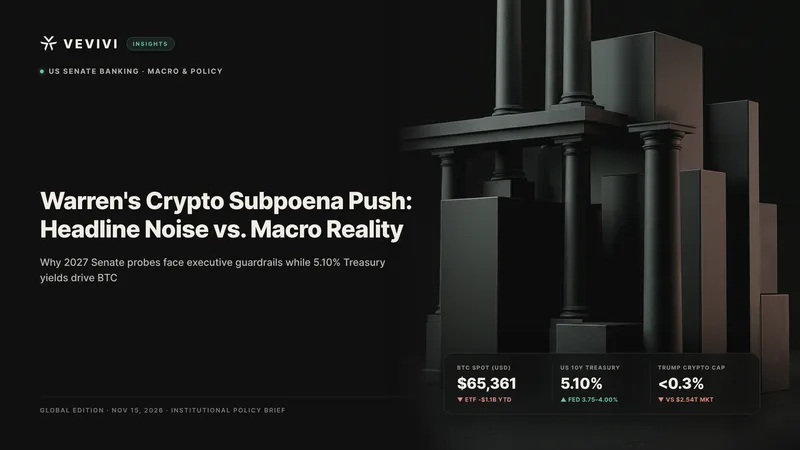
Institutional investors, however, must separate rhetorical intensity on Capitol Hill from the liquidity plumbing that actually prices macro risk. As of November 15, 2026, Bitcoin trades at $65,360.70—down roughly 16.2% from its $78,000 election-week range—while Ethereum stands at $1,827.04. Rather than congressional press releases, the primary catalysts behind this repricing are the Federal Reserve holding its federal funds target range at 3.75%–4.00%, the U.S. 10-Year Treasury yield climbing to 5.10%, and cumulative 2026 net outflows exceeding $1.1 billion across U.S. spot Bitcoin exchange-traded funds (ETFs). Mapping the procedural guardrails around congressional subpoenas against executive-branch regulatory control clarifies why headline turbulence differs fundamentally from systemic market impairment.
The January 2027 Oversight Architecture: Four Congressional Gavels and Subpoena Timelines
Under U.S. congressional rules, the majority party controls every standing committee and subcommittee chair, conferring authority over hearing schedules, witness lists, and oversight agendas. Whereas unified Republican majorities shielded the executive branch over the past two years, four incoming Democratic chairs will establish overlapping investigative tracks beginning January 3, 2027.
Senate Banking and Permanent Subcommittee on Investigations Deadlines
The Senate Banking Committee sits astride digital asset market-structure legislation and prudential banking oversight. On November 9–10, 2026, a senior Warren aide signaled broad scrutiny across private credit, artificial intelligence, crypto ventures tied to the First Family, and prediction markets such as Kalshi and Polymarket. Senators Warren and Jeff Merkley have already opened an early front, setting a November 23, 2026 deadline for the White House to address internal ethics safeguards after a former presidential teleprompter operator paid $173,539 to settle Commodity Futures Trading Commission (CFTC) insider-trading charges over speech-word bets on Kalshi.
Even faster procedural leverage resides in the Senate Permanent Subcommittee on Investigations (PSI), one of the rare Senate panels whose chair holds unilateral subpoena authority without minority consent. Incoming PSI Chair Senator Richard Blumenthal has established an initial November 30, 2026 checkpoint and a hard January 4, 2027 deadline for Binance, Tether, World Liberty Financial (WLFI), and $TRUMP issuer Fight Fight Fight LLC to produce compliance and ownership records voluntarily before compulsory subpoenas are signed.
House Financial Services and Oversight Priorities Across Private Counterparties
In the House of Representatives, presumptive Financial Services Chair Representative Maxine Waters is preparing hearings into the Securities and Exchange Commission (SEC) pausing legacy enforcement actions, alongside stablecoin reserve oversight and bank supervisory independence. Simultaneously, incoming House Oversight and Government Reform Chair Representative Robert Garcia issued a blunt election-night warning telling administration allies to lawyer up, naming presidential business conflicts and corporate governance among his top four subpoena tracks.
A critical legal asymmetry governs how these demands will play out. While the White House can assert executive privilege and litigate congressional separation-of-powers disputes for years, private entities—including offshore issuers, domestic custodians, market makers, and World Liberty Financial counterparties—possess no legal standing to invoke executive privilege on their own. Consequently, private-sector crypto infrastructure firms and banking partners will absorb the earliest wave of document production demands.
Three Core Investigative Targets Behind the Subpoena Push
Democratic oversight plans center on three focal points: sovereign Middle Eastern capital flows into presidential family ventures, federal licensing of a stablecoin trust bank, and retail investor drawdowns in politically branded tokens. None of the three currently involves an adjudicated legal violation, yet public disclosures have sharpened political incentives: President Trump's annual Office of Government Ethics (OGE) filing reported $1.2 billion to $1.4 billion in 2025 crypto-related income, while a Reuters tally estimated $2.3 billion in pre-tax family crypto proceeds between November 2024 and April 2026 against roughly $2.25 billion in cumulative retail buyer losses.
Abu Dhabi Capital Flows Into World Liberty Financial and AI Export Controls
First on the oversight docket is a reported $500 million investment by entities linked to United Arab Emirates National Security Adviser Sheikh Tahnoon bin Zayed Al Nahyan for a 49% stake in World Liberty Financial. Senate Banking Democrats have questioned the sequence between that capital injection and the administration's subsequent decision to lift advanced AI semiconductor export restrictions for Abu Dhabi-based AI group G42, framing the timeline as a potential Foreign Emoluments Clause concern requiring sworn testimony.
Both White House Counsel and World Liberty Financial have flatly rejected any nexus between private token financing and semiconductor export policy. Pressed on the UAE stake during a CBS News 60 Minutes interview aired on November 8, 2026, President Trump stated that he knew nothing about the transaction because his sons manage the business, and countered questions about divesting stablecoin-linked holdings by asking rhetorically how one divests from cash.
OCC Conditional Trust Charter and USD1 Stablecoin Governance
The second flashpoint involves Corporate Decision #1385, issued on August 14, 2026 by the Office of the Comptroller of the Currency (OCC), granting preliminary conditional approval to organize World Liberty Trust Company, National Association. Structured as an uninsured national trust bank that neither takes FDIC-insured deposits nor originates loans, the charter requires fulfilling seven pre-opening conditions—including $20 million in Tier 1 capital, 180 days of liquid operating reserves, and GENIUS Act alignment—before assuming direct issuance and custody of the USD1 stablecoin from BitGo Bank & Trust.
Senator Warren criticized the conditional charter as an unprecedented conflict in which presidentially appointed regulators supervise a first-family financial institution, and sought a Senate floor vote in September 2026 to prohibit presidential bank ownership. Market participants have already priced elevated regulatory friction into the ecosystem: USD1 circulating supply contracted from roughly $3.93 billion in late October to approximately $3.24 billion by mid-November 2026.
Official Memecoin Drawdowns and Divergent Institutional Pricing
The third investigative track targets the Official Trump ($TRUMP) memecoin, which drew ethics scrutiny over promotional White House dinner access for top holders. Following the midterm sweep, $TRUMP sank to an all-time low of $1.12 on November 8, 2026—a drawdown exceeding 98% from its January 2025 inaugural peak. World Liberty's WLFI token similarly hovered near record lows around $0.047, while shares of Trump Media & Technology Group (DJT), which holds 15,649 BTC on its balance sheet, closed at $4.64.
Crucially, spot markets demonstrated sharp asset differentiation immediately after election night: politically branded equities and tokens sold off steeply on November 4 while Bitcoin and Ethereum initially rallied before succumbing to broader bond-yield pressure. Institutional desks are treating presidential conflict probes as idiosyncratic governance risk rather than an existential threat to decentralized layer-1 networks.
Structural Guardrails: Why 2027 Oversight Differs From the 2023 Regulatory Chokepoint
Much of the retail anxiety surrounding an incoming Warren chairmanship stems from memories of the 2021–2024 regulatory cycle. In June 2023, the SEC sued Binance and Coinbase on consecutive days while classifying major layer-1 tokens as unregistered securities, shortly after the March 2023 closures of Silvergate and Signature Bank severed dollar settlement rails. Unredacted correspondence totaling 790 pages—released by the FDIC in February 2025 under Freedom of Information Act litigation—later confirmed that bank supervisors sent formal pause letters to more than two dozen institutions delaying crypto custody and settlement services. Yet the constitutional map for 2027–2029 differs in every operational respect.
Procedural Limits on Subpoenas, Legislation, and Prosecution
Unlike the House Oversight panel or the Senate PSI, standing Senate committees generally require either consultation/agreement with the minority Ranking Member or a formal majority committee vote to enforce contested subpoenas. Because several moderate Senate Democrats previously crossed party lines to support digital asset market-structure bills, sweeping anti-industry fishing expeditions face internal caucus friction. Moreover, a 54-seat Democratic Senate majority remains well below both the 60-vote cloture threshold needed to overcome a Republican filibuster and the 67-vote supermajority required to override a presidential veto.
Legislative history reinforces that constraint. Even under unified Democratic governance earlier in the decade, Senator Warren's standalone Digital Asset Anti-Money Laundering Act never cleared floor passage, nor did oversight letters prevent Fidelity from offering Bitcoin in retirement accounts or halt the January 2024 launch of spot Bitcoin ETFs. Congress also lacks prosecutorial power: criminal referrals go to a Republican-led Department of Justice, and separation-of-powers subpoena battles—as seen in multi-year Supreme Court litigation such as Trump v. Mazars—routinely stretch beyond a presidential term ending in January 2029, leaving independent state attorneys general as the primary non-pardonable legal wildcard.
Executive Agency Alignment and Interim Rulemaking After the CLARITY Act Vote
Most importantly, executive regulatory agencies remain under administration-appointed leadership—including SEC Chair Paul Atkins alongside current CFTC, OCC, and FDIC heads—through January 2029. Although H.R. 3633, the Digital Asset Market Clarity Act, failed a Senate cloture vote 49–50 on September 15, 2026 amid partisan clashes over public-official ethics bans and earlier industry friction over stablecoin yield provisions, federal regulators have pivoted toward administrative rulemaking.
Specifically, the SEC's Proposed Regulation Crypto Assets, unveiled in August 2026, outlines a two-tier capital-raising exemption up to $75 million over 12 months to approximate statutory clarity. While agency safe harbors cannot replicate statutory Chapter 7 bankruptcy priority for customer digital commodities or grant the CFTC plenary spot-exchange licensing authority—and remain vulnerable to judicial review or post-2029 reversal—they preclude a 2023-style coordinated banking blockade over the next two years.
Quantifying Market Exposure: Macro Rates and ETF Flows vs. Political Headlines
Sizing the directly targeted political asset cohort against global on-chain liquidity illustrates why macroeconomic rates, rather than committee gavels, dictate Bitcoin's medium-term trajectory.
Sizing Trump-Linked Digital Assets Against the Global Market
As of mid-November 2026, total global cryptocurrency market capitalization stands near $2.54 trillion, while global stablecoin capitalization totals $284.86 billion per DefiLlama data—anchored by Tether's USDT at $175.25 billion and Circle's USDC at $69.20 billion. By contrast, combining every major Trump-linked balance sheet exposure—USD1 circulating supply (~$3.24 billion), Trump Media's 15,649 BTC (~$1.02 billion), Eric Trump-backed miner American Bitcoin Corp.'s 8,427 BTC (~$551 million), and circulating WLFI and memecoin valuations—yields roughly $5.0 billion to $5.5 billion in aggregate value.
That combined footprint represents less than 0.3% of total digital asset capitalization and roughly 1.1% of global stablecoin supply. Even severe charter delays or valuation compression across politically affiliated ventures lack the balance-sheet scale to trigger systemic deleveraging across core Bitcoin or institutional stablecoin rails.
Real Drivers of Bitcoin Volatility and Conditional 2027 Scenarios
The true headwind pressuring Bitcoin toward $65,361 lies in sovereign fixed-income repricing and institutional ETF flows. Following a 25-basis-point rate hike in September, the Federal Open Market Committee (FOMC) held the federal funds target range steady at 3.75%–4.00% (with the effective rate at 3.88%) on October 28, 2026 amid sticky energy-linked inflation risks. Simultaneously, U.S. Federal Reserve H.15 data shows the nominal 10-Year Treasury yield surging to 5.10% as of November 12, tightening financial conditions and driving U.S. spot Bitcoin ETFs past $1.1 billion in cumulative 2026 net outflows, with BlackRock's IBIT closing at $38.94.
Looking into Q1 2027, institutional positioning centers on three conditional scenarios. In the base case, televised oversight hearings serve primarily to build a 2028 electoral accountability narrative—mirroring SSRS exit poll findings where over half of 2026 voters rated government corruption a crucial issue—while regulatory agencies maintain constructive supervision and Bitcoin tracks Treasury yield stabilization. In a constructive upside case, bipartisan voter ownership—documented by Gallup's September 2026 survey at 11% of U.S. investors, including 12% of Republicans and 9% of Democrats—combined with U.S. Treasury reliance on $284.86 billion in stablecoin T-bill demand, nudges lawmakers toward a revised market-structure compromise incorporating stricter ethics and consumer-protection clauses. Conversely, the primary downside tail risk would materialize if PSI subpoena clashes after January 4 escalate into Department of Justice friction over Tether or Binance settlement plumbing while 10-Year Treasury yields remain pinned above 5.10%, warranting disciplined dry powder management.
Key Investor Questions on Congressional Crypto Oversight
Can Senator Elizabeth Warren unilaterally halt bank crypto custody or revoke spot Bitcoin ETF approvals as Senate Banking Chair?
No. Committee chairs control oversight hearings and investigative inquiries, but rulemaking, licensing, and enforcement rest with executive-branch regulators such as the SEC, CFTC, and OCC, alongside federal courts. Current Trump-appointed agency heads hold office into 2029, and any standalone restrictive legislation would face a 60-vote Senate filibuster hurdle as well as a presidential veto.
Why do Senate Permanent Subcommittee on Investigations deadlines for Tether and Binance matter more for liquidity than memecoin hearings?
Scale and market-plumbing centrality separate the two tracks. Politically branded tokens and affiliated corporate treasuries represent under 0.3% of the $2.54 trillion digital asset market, whereas Tether's $175.25 billion USDT supply accounts for over 61% of global stablecoin liquidity and Binance anchors global derivative and spot order-book depth. Traders should monitor the November 30 checkpoint and January 4 PSI document deadline for any spillover into institutional dollar settlement channels.
Is U.S. digital asset market-structure legislation permanently dead after the September 2026 CLARITY Act vote?
Floor passage is stalled in the near term following the 49–50 cloture defeat on September 15, 2026, but bipartisan structural incentives remain intact. Industry coalitions have pivoted post-election toward Democratic consumer-protection priorities, nearly one in ten Democratic investors holds digital assets, and dollar-backed stablecoins remain major structural buyers of short-duration U.S. Treasury bills. Until a compromise bill emerges, SEC administrative safe harbors will serve as the interim operating framework.
Disclaimer and Risk Warning
This article is provided strictly for informational and educational purposes based on publicly available on-chain metrics and macroeconomic data. Nothing in this publication constitutes financial, investment, legal, or tax advice, nor should it be construed as a solicitation, recommendation, or offer to buy or sell any digital asset or financial instrument. Digital assets are subject to high market risk and extreme price volatility, and you may lose part or all of your invested capital. Historical market cycles and past performance referenced herein do not guarantee future results. You are solely responsible for your own investment decisions and should conduct independent research and consult a qualified financial advisor before making any financial commitments.