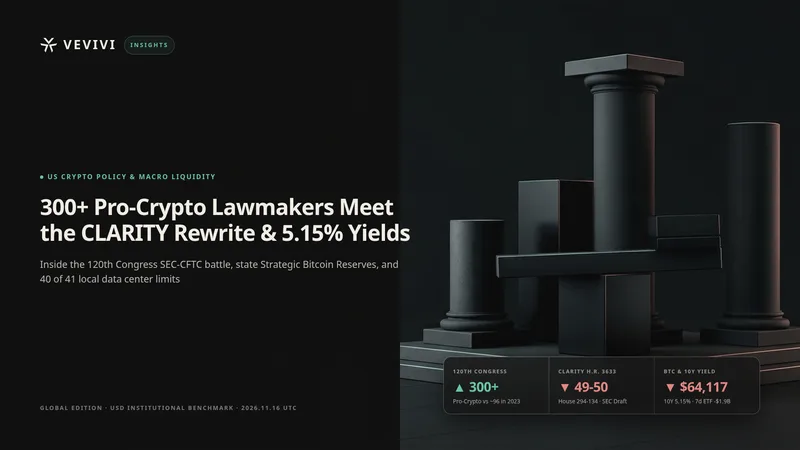
When the 120th United States Congress convenes on January 3, 2027, the digital asset sector will confront a striking paradox: the broadest bipartisan legislative footprint in its history paired with an immediate tug-of-war over regulatory jurisdiction and tight dollar liquidity. Based on public voting records and candidate statements tracked by grassroots advocacy organization Stand With Crypto, the number of pro-crypto federal lawmakers is projected to surpass 300 in the incoming 120th Congress, more than tripling from roughly 96 in 2023 and incorporating over 60 newly elected members. Yet as of November 16, 2026 (UTC), Bitcoin is trading under heavy pressure near $64,117 while Ethereum hovers near $1,796, illustrating the sharp divide between medium-term legislative de-risking and the immediate gravity of a 5.15% U.S. 10-year Treasury yield.
From 96 to Over 300 Pro-Crypto Lawmakers: Structural Bipartisanship in the 120th Congress
The most consequential shift across Washington over the past two legislative cycles is the transition of digital asset policy from a narrow partisan talking point into a constituent-driven issue anchored across both parties. Stand With Crypto race data indicates that 29 of 45 endorsed candidates won their contests, supported by roughly 3 million registered advocates drawn from an estimated 67 million Americans who hold digital assets. Unlike the pre-2024 environment dominated by blanket regulatory hostility, lawmakers across both chambers now face measurable constituent costs if they dismiss retail custody protections, compliant payment rails, or blockchain infrastructure outright.
At the same time, the 2026 cycle exposed the limits of relying solely on concentrated campaign capital without committee-level consensus. Industry political action committees—led by Fairshake alongside affiliated funds—deployed nearly $200 million nationwide, including $56 million to more than $60 million in Ohio's Senate race alone, yet failed to prevent a shift in congressional committee control. By contrast, granular constituent mobilization in razor-thin districts—such as Florida's 9th Congressional District, where roughly 11,000 registered crypto advocates outnumbered an approximate 1,400-vote victory margin, alongside more than 77,000 registered advocates across Ohio—demonstrates why sustained voter engagement provides a more durable legislative floor than ad-hoc campaign spending.
Federal Market Structure Pivot: CLARITY Act Stalemate vs. an SEC-Centered Rewrite
Federal digital asset law enters 2027 split between settled stablecoin legislation and contested spot market structure rules. Payment stablecoins already rest on enacted federal statute under the Guiding and Establishing National Innovation for U.S. Stablecoins Act (GENIUS Act, Pub. L. 119-27), signed into law on July 18, 2025, with federal banking agencies drafting final issuer supervision standards. By contrast, the Digital Asset Market Clarity Act of 2025 (CLARITY Act, H.R. 3633)—which passed the House by a bipartisan 294–134 margin on July 17, 2025 (including 78 Democrats) and cleared the Senate Banking Committee 15–9 on May 14, 2026—fell short on a 49–50 Senate cloture vote on September 15, 2026, leaving the jurisdictional boundary between securities and digital commodities unresolved.
House Financial Services Rewrite and the SEC-CFTC Jurisdictional Boundary
With committee gavels shifting in January 2027, incoming House Financial Services Committee Democratic staff under Rep. Maxine Waters are discussing plans to expand her 2025 Crypto Investor and Consumer Bill of Rights amendment into a comprehensive market structure alternative. Rather than adopting H.R. 3633's core architecture—which assigned primary spot-market oversight of digital commodities to the Commodity Futures Trading Commission (CFTC)—the emerging House framework would expand Securities and Exchange Commission (SEC) jurisdiction over centralized trading venues, tighten retail custody and disclosure mandates, and incorporate federal conflict-of-interest restrictions. While no formal bill text has been released, the fact that incoming committee leaders are drafting market-structure rules immediately rather than pursuing an outright ban confirms that digital asset legislation remains on the active congressional docket.
Senate Banking Oversight vs. Constitutional Veto Guardrails
In the upper chamber, expected Senate Banking Committee leadership under Sen. Elizabeth Warren signaled tough oversight in a November 10, 2026 New York Times interview challenging the sector to demonstrate positive real-world use cases after 18 years. Even so, the arrival of pragmatic pro-crypto Democratic Senators-elect—such as North Carolina's Roy Cooper, who engaged directly with industry roundtables, and Texas's James Talarico, who previously voted in favor of state-level Bitcoin reserve legislation—complicates any attempt to revive a monolithic anti-crypto bloc. Crucially, constitutional math constrains unilateral overreach: passing any new statute requires 60 votes to overcome a Senate filibuster and executive signature from an administration holding veto authority through January 2029, forcing any viable bill toward the bipartisan center.
State-Level Strategic Bitcoin Reserves and the Local AI Data Center Backlash
Because federal market-structure negotiations face prolonged bicameral horse-trading in 2027, policy execution is accelerating at the state and municipal levels. For institutional allocators and digital infrastructure operators alike, state treasury statutes and county-level power zoning ordinances are becoming immediate operational catalysts.
State Treasury Precedents from New Hampshire, Arizona, and Texas to Florida
Three U.S. states established binding legal precedents for state-managed digital asset reserves in 2025. New Hampshire enacted HB 302 on May 6, 2025, becoming the first state to authorize its treasurer to allocate up to 5% of public funds into precious metals and digital assets carrying at least a $500 billion market capitalization—a threshold solely met by Bitcoin. Arizona followed on May 7, 2025 with HB 2749, allowing the state treasurer to retain unclaimed digital assets in native form rather than liquidating them, while Texas enacted SB 21 in June 2025 to establish a standalone, Comptroller-managed Strategic Bitcoin Reserve backed by a $10 million appropriation and an initial $5 million spot ETF execution. In Florida, after earlier reserve bills (SB 550/HB 487 in 2025 and CS/SB 1038/HB 1039 in 2026) stalled in appropriations despite the passage of stablecoin and kiosk laws (HB 175, SB 1568, and HB 505), Governor-elect Byron Donalds—sponsor of federal reserve bill H.R. 2112—has championed a renewed 2027 push for a state Strategic Bitcoin Reserve and tokenized real-world assets, putting Tallahassee's upcoming appropriations calendar in focus.
Local Voter Pushback on Data Centers (40 of 41 Measures) and Bitcoin Mining Differentiation
While state capitals warm to treasury reserves, municipal voters delivered an unmistakable warning on high-density power infrastructure. According to Ballotpedia's verified election tally, local voters across 10 U.S. states favored limiting or blocking data center development in 40 of 41 local ballot measures (97.6%) on November 3, 2026—approving 27 bans, moratoriums, and strict utility thresholds (such as requiring voter approval above 20 megawatts or 500,000 gallons of daily water use) while rejecting 13 pro-development rezoning measures, with Harwood, North Dakota standing as the sole exception. Driven primarily by ratepayer backlash against hyperscale artificial intelligence (AI) buildouts, this zoning wave tests whether Bitcoin mining operators and state chapters can successfully differentiate curtailable, grid-stabilizing mining loads from inflexible 24/7 AI compute clusters.
Macro Rate Reality Check: Why 5.15% Treasury Yields Override Politics in the Short Run
The divergence between a 300-member pro-crypto Congress and Bitcoin's pullback to $64,117 underscores a core institutional rule: legislative headcounts set the long-term regulatory floor, whereas risk-free Treasury yields and ETF flows dictate near-term liquidity. Per U.S. Department of the Treasury par yield curve data, the 10-year Treasury yield closed at 5.15% (with the 2-year at 4.88% and the 30-year at 5.47%) following firmer October inflation prints (+0.4% headline CPI and +0.3% core CPI month-over-month). With the Federal Reserve benchmark rate sitting at 3.75%–4.00% and futures markets pricing an additional tightening move at the December 9, 2026 FOMC meeting, risk-free yields above 5% compress cash-and-carry basis trade spreads and raise the hurdle rate for non-yielding macro assets.
That rate pressure is directly visible in regulated fund flows: U.S. spot Bitcoin ETFs recorded seven consecutive trading sessions of net outflows totaling roughly $1.9 billion between November 5 and November 13, 2026, including $185.5 million in net redemptions on November 13 led by $143.5 million from BlackRock's IBIT, per SoSoValue and Unchained data. Under a constructive medium-term scenario, a 300+ pro-crypto congressional majority prevents punitive statutory rollbacks while state treasury allocations and eventual 10-year yield stabilization revive institutional inflows in 2027. Conversely, under a prolonged tightening scenario, sticky 5%+ long-end yields and partisan deadlock between SEC-focused and CFTC-focused market structure drafts could keep sidelined dry powder locked in short-duration Treasuries well into early 2027.
Key Institutional Q&A
Does a 300+ pro-crypto Congress guarantee fast-track passage of the CLARITY Act in 2027?
No. Exceeding 300 pro-crypto lawmakers creates a durable bipartisan firewall against existential industry bans, but Democratic control of committee gavels shifts the starting draft away from the CFTC-led CLARITY Act (H.R. 3633) toward an SEC-centric investor protection framework. Because neither party commands 60 Senate votes on its own and the White House retains veto power, enacting market-structure legislation will require protracted bipartisan negotiation.
How can U.S. states advance Strategic Bitcoin Reserves while federal market structure stalls?
State Strategic Bitcoin Reserves operate under state public-finance and treasury custody statutes rather than federal altcoin market-structure rules. By imposing a $500 billion minimum market-capitalization threshold—as enacted in New Hampshire (HB 302) and Texas (SB 21)—state treasurers restrict eligibility exclusively to Bitcoin and can execute allocations via regulated U.S. spot ETFs or qualified custodians as soon as state legislatures approve appropriations.
Why is Bitcoin trading near $64,117 despite historic pro-crypto gains in Congress?
Congressional composition is a slow-moving structural catalyst for 2027–2028 institutional compliance, whereas spot prices respond immediately to dollar cost-of-capital shocks. With the U.S. 10-year Treasury yield at 5.15%, markets pricing December Federal Reserve tightening risk, and U.S. spot Bitcoin ETFs shedding roughly $1.9 billion across seven straight sessions, sustained price recovery requires long-end yield stabilization and a reversal in spot ETF net flows.
Disclaimer and Risk Warning
This article is provided strictly for informational and educational purposes based on publicly available on-chain metrics and macroeconomic data. Nothing in this publication constitutes financial, investment, legal, or tax advice, nor should it be construed as a solicitation, recommendation, or offer to buy or sell any digital asset or financial instrument. Digital assets are subject to high market risk and extreme price volatility, and you may lose part or all of your invested capital. Historical market cycles and past performance referenced herein do not guarantee future results. You are solely responsible for your own investment decisions and should conduct independent research and consult a qualified financial advisor before making any financial commitments.