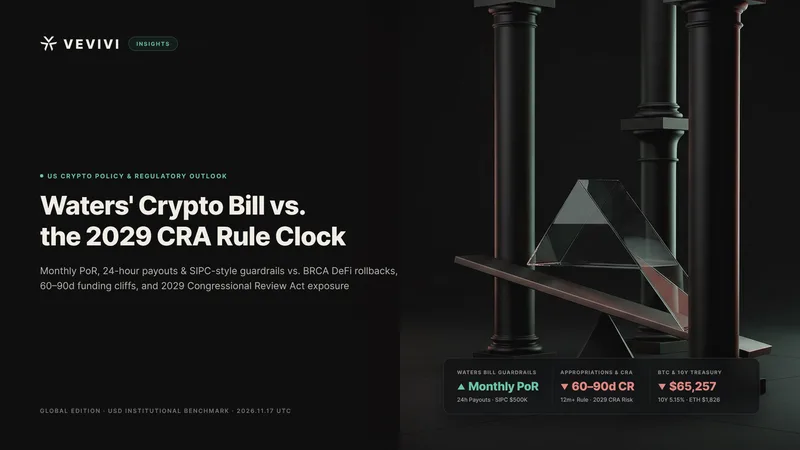
Following the November 3, 2026 U.S. midterm elections that returned both chambers of Congress to Democratic control, Washington's digital asset policy trajectory has shifted beyond headline subpoena threats toward two far more consequential mechanisms: legislative market-structure rewriting and administrative rulemaking clocks. Cross-referencing policy analysis from Paradigm Senior Advisor Justin Slaughter—a former senior advisor at the Securities and Exchange Commission (SEC) and Congressional oversight counsel—against official U.S. House Rules Committee and Government Accountability Office (GAO) records reveals that statutory text and federal appropriations mechanics will dictate institutional risk through 2029.
With Bitcoin trading near $65,257, Ether near $1,826, and the U.S. 10-year Treasury par yield holding at 5.15% according to U.S. Department of the Treasury data, institutional desks are separating partisan noise from structural regulatory catalysts. Moving past already priced-in Senate Banking Committee oversight fears and broad lawmaker headcounts, two concrete policy deltas now stand at the center of U.S. market structure: incoming House Financial Services Committee leadership's expansion of the Crypto Investor and Consumer Bill of Rights, and the administrative timeline threat posed by appropriations riders, 60-to-90-day funding windows, and the Congressional Review Act (CRA) in 2029.
Post-Midterm Congressional Geometry and the End of the CLARITY Act
When the 120th Congress convenes on January 3, 2027, Democrats will hold a 54-to-44 Senate majority and roughly 258 House seats, facing a Republican White House whose executive veto power and regulatory commission chairs remain in place until January 20, 2029.
Filibuster Thresholds and Executive Veto Constraints in Divided Government
Even with bicameral committee gavels, a 54-seat Senate majority falls short of both the 60 votes required to invoke cloture against a legislative filibuster and the two-thirds supermajority (67 Senate votes) required to override a presidential veto. Combined with finite Congressional committee staff bandwidth, expectations of nonstop weekly enforcement-style hearings across every digital asset issuer face clear operational ceilings.
Yet divided government has effectively ended the path for the Republican-led Digital Asset Market Clarity Act of 2025 (CLARITY Act, H.R. 3633). Although H.R. 3633 passed the House on a bipartisan 294-to-134 vote in July 2025, it stalled on a 49-to-50 Senate procedural cloture vote on September 15, 2026, leaving incoming House Democratic leaders with every incentive to draft their own statutory replacement rather than advance H.R. 3633 during the lame-duck session.
Why the Contested 20 Percent of Market Structure Defines On-Chain Viability
Policy discussions on Capitol Hill indicate that Democratic staffers broadly accept roughly 80% of H.R. 3633's foundational disclosures, intermediary registration categories, and custodial recordkeeping standards. The legislative dispute is concentrated in the remaining 20% of the text, yet that contested slice governs the exact provisions most vital to non-custodial software architecture and spot market liquidity.
Rather than relitigating whether blockchain networks should exist, negotiations beginning in early 2027 will center on how House Financial Services Committee staff—who began drafting a replacement framework during summer 2026—draw the boundary between centralized intermediary safeguards and open-source protocol autonomy.
Inside Maxine Waters' Market Structure Rewrite: Guardrails vs. Structural Friction
The House Democratic replacement draft builds directly on Representative Maxine Waters' Crypto Investor and Consumer Bill of Rights, originally filed as Amendment No. 31 to H.R. 3633 and defeated 4-to-8 in House Rules Committee Record Vote No. 151 on July 14, 2025.
Industry-Acceptable Exchange Safeguards: Monthly PoR, 24-Hour Payouts, and SIPC-Style Coverage
Per the official U.S. House Committee on Rules legislative record, Waters' Consumer Bill of Rights framework establishes strict operational mandates for centralized digital asset exchanges and custodians. These include monthly auditor-attested Proof-of-Reserves (Monthly PoR) verifying one-to-one backing of customer liabilities, bankruptcy-remote custody accounts paired with mandatory 24-hour customer withdrawal execution, round-the-clock live customer support, best-execution fiduciary duties, and explicit anti-front-running prohibitions.
The framework also introduces customer asset protection modeled on the Securities Investor Protection Corporation (SIPC). Under the Securities Investor Protection Act of 1970 (15 U.S.C. 78aaa et seq.), SIPC covers up to $500,000 per customer capacity—including a $250,000 limit for cash—when a registered broker-dealer fails, whereas non-security digital assets and payment stablecoins currently carry zero statutory SIPC protection. Because institutional crypto venues already publish cryptographic reserve attestations and segregate client collateral, monthly audited PoR, 24-hour payout rules, and SIPC-style insolvency insurance represent viable compromise ground.
Weakening BRCA Developer Protections and Shifting Spot Oversight Back to the SEC
By contrast, two structural provisions pose acute friction for decentralized protocols and market liquidity. First, the House Democratic draft threatens to roll back protections modeled on the Blockchain Regulatory Certainty Act (BRCA), previously embedded in Sections 309 and 409 of H.R. 3633, which shielded non-custodial software developers, validators, and node operators who never control customer funds from money-transmitter and broker-dealer licensing, while preserving state-level anti-fraud enforcement authority without federal preemption.
Second, the rewrite reverses H.R. 3633's core jurisdictional architecture by shifting primary spot-market and rulemaking authority away from the Commodity Futures Trading Commission (CFTC) and back to the SEC. Paired with public-official conflict-of-interest bans modeled on Amendment No. 30 and commercial banking lobby pressure to revisit stablecoin reward restrictions ahead of the Office of the Comptroller of the Currency (OCC) final rule implementing the GENIUS Act (S. 1582, Public Law 119-27) on January 18, 2027, these provisions form the core legislative fault line.
The Hidden Administrative Clock: Appropriations Riders and 2029 CRA Nullification Risk
The second critical delta lies in administrative law. SEC Chairman Paul S. Atkins and CFTC Chairman Michael S. Selig launched their unified Project Crypto harmonization initiative in late January 2026 and issued the proposed Regulation Crypto Assets rule (Release No. 33-11434, File No. S7-2026-27) on August 18, 2026, pledging to establish bespoke token offering exemptions and tokenized collateral rules under existing statutory authority.
Appropriations Riders and Rolling 60-to-90-Day Continuing Resolutions
Formal notice-and-comment rulemaking under the Administrative Procedure Act (5 U.S.C. 553) typically requires at least 12 months from proposal through economic analysis and final Federal Register publication. As of mid-November 2026, roughly 20 months remain before the 2028 presidential transition cycle narrows regulatory bandwidth.
Although a Democratic Congress cannot remove confirmed SEC or CFTC chairs over policy disagreements, lawmakers control the federal purse through two potent levers. Congress can attach appropriations riders prohibiting agency funds from being expended to finalize specific digital asset rulemakings, or lock federal agencies into rolling short-term continuing resolutions that fund operations in fragmented 60-to-90-day windows amid broader fiscal and foreign-policy standoffs. Repeated funding cliffs and partial shutdown disruptions can severely bottleneck SEC and CFTC staff capacity, pushing rule finalizations into late 2028.
The Congressional Review Act Lookback Window and Sue-and-Settle Exposure in 2029
Any major agency rule delayed into the final months of an administration confronts the Congressional Review Act (5 U.S.C. 801-808). As documented in U.S. GAO report GAO-26-107825, major rules carrying an annual economic impact of $100 million or more require a mandatory 60-day effective-date review window, and rules submitted within the final 60 legislative or session days of Congress fall into the statutory lookback window (5 U.S.C. 801(d)). In 2029, a newly inaugurated administration aligned with a Congressional majority could repeal any late-finalized SEC or CFTC rule by a simple majority vote—permanently barring the agency from issuing a substantially similar rule without an act of Congress.
Institutional precision matters on historical precedent: while Congress passed a bipartisan CRA resolution against SEC custody bulletin SAB 121 (H.J.Res. 109) in May 2024, President Biden vetoed that resolution, and SAB 121 was ultimately rescinded administratively by the SEC via Staff Accounting Bulletin No. 122 on January 23, 2025. Under a unified 2029 government, however, no presidential veto would shield late-stage rules from immediate CRA nullification. Furthermore, third-party litigants can challenge finalized rules in federal court to drag proceedings past January 2029, allowing a successor administration to vacate rules via sue-and-settle consent decrees—underscoring why durable statutory legislation remains superior to agency guidance alone.
Institutional Positioning Amid 5.15 Percent Treasury Yields and Generational Shifts
Live cross-asset pricing confirms that institutional capital is currently anchored more by sovereign rate hurdles than by Congressional rhetoric. With the U.S. 10-year Treasury yield at 5.15% (2-year at 4.88% and 30-year at 5.47%) against a 3.75% to 4.00% Federal Funds target range, BlackRock's iShares Bitcoin Trust ETF (IBIT) closed at $36.79 (-5.55% on 61.16 million shares traded) as Bitcoin consolidated near $65,257. Elevated risk-free dollar yields raise the hurdle rate for institutional basis trades and dry powder deployment across digital asset vehicles.
Over a multi-year horizon, however, demographic turnover inside Congress is steadily eroding dogmatic anti-crypto orthodoxy. Newly elected lawmakers under age 45 increasingly treat blockchain rails, payment stablecoins, and 24/7 perpetual price-discovery venues as neutral financial technology infrastructure rather than a partisan battleground. For regulatory durability before 2029, SEC and CFTC leadership must prioritize finalizing a focused core of capital-formation and custody rules well ahead of the 2028 CRA lookback cutoff, while industry negotiators leverage Waters' acceptable centralized exchange guardrails to defend non-custodial BRCA developer safe harbors.
Frequently Asked Questions
How does Maxine Waters' market structure framework differ from the CLARITY Act?
Whereas H.R. 3633 assigned spot digital commodity oversight primarily to the CFTC and codified BRCA safe harbors for non-custodial DeFi software developers, the expanded Crypto Investor and Consumer Bill of Rights shifts primary spot jurisdiction back to the SEC and narrows DeFi exemptions, while adding centralized exchange mandates including monthly auditor-attested Proof-of-Reserves, 24-hour customer withdrawals, and SIPC-style asset protection.
How can Congress stall SEC and CFTC crypto rules without controlling executive leadership?
Through its constitutional power of the purse, Congress can attach appropriations riders barring funds for specific rulemakings or rely on rolling 60-to-90-day continuing resolutions that disrupt agency staffing. Because Administrative Procedure Act rulemaking typically spans 12 months or longer, delaying final rules into late 2028 exposes them to simple-majority repeal in 2029 under the Congressional Review Act lookback window.
Which policy and macro catalysts should institutional desks monitor from 2027 through 2029?
Key milestones include federal appropriations riders and continuing resolution durations in December 2026, formal bill text from the House Financial Services Committee after the 120th Congress convenes on January 3, 2027, the OCC's final GENIUS Act stablecoin rule taking effect on January 18, 2027, and whether the SEC finalizes Regulation Crypto Assets before spring 2028 to clear the 60-session-day CRA lookback threshold.
Disclaimer and Risk Warning
This article is provided strictly for informational and educational purposes based on publicly available on-chain metrics and macroeconomic data. Nothing in this publication constitutes financial, investment, legal, or tax advice, nor should it be construed as a solicitation, recommendation, or offer to buy or sell any digital asset or financial instrument. Digital assets are subject to high market risk and extreme price volatility, and you may lose part or all of your invested capital. Historical market cycles and past performance referenced herein do not guarantee future results. You are solely responsible for your own investment decisions and should conduct independent research and consult a qualified financial advisor before making any financial commitments.