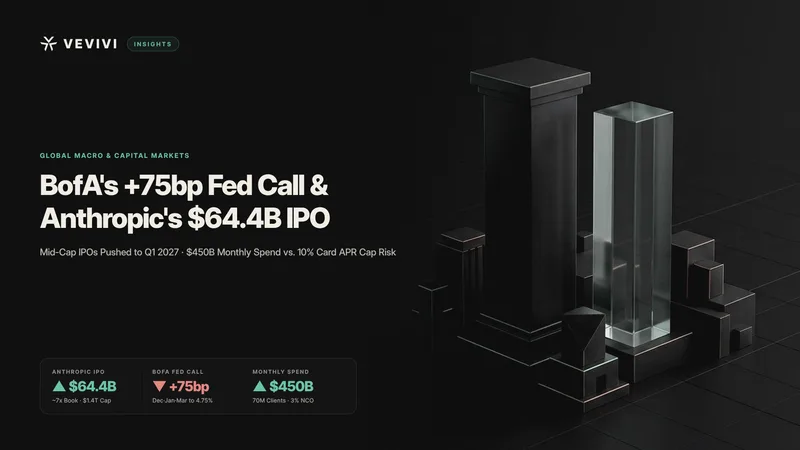
Global capital markets and U.S. commercial credit channels are navigating a rare dual inflection point: renewed Federal Reserve monetary tightening expectations alongside the largest artificial intelligence equity offering in market history. Synthesizing Bank of America Corporation (NYSE: BAC) Chairman and Chief Executive Officer Brian Moynihan's institutional briefing on Bloomberg Television with primary filings from the Federal Reserve, the U.S. Securities and Exchange Commission (SEC), and the Bureau of Labor Statistics (BLS) reveals an economy defined by sharp structural divergence rather than uniform contraction.
With the U.S. 10-year Treasury par yield holding at 5.15%, Anthropic, PBC's up to $64.4 billion Nasdaq initial public offering ($90.4 billion including concurrent private placements) is absorbing institutional liquidity at a scale sufficient to push traditional mid-cap and biotechnology listings into early 2027. Examining the transmission of short-end rate hikes into commercial credit lines, disciplined enterprise AI capital returns, $450 billion in monthly consumer payment flows, and legislative price-control proposals ahead of the 120th Congress provides an objective framework for 2027 positioning.
Three Projected Fed Rate Hikes and the Floating-Rate Squeeze on Mid-Sized Business
Following a 25-basis-point rate increase in September 2026, the Federal Open Market Committee (FOMC) voted 10-to-2 on October 28, 2026 to maintain the federal funds target range at 3.75% to 4.00%, with Governor Lisa D. Cook and Cleveland Fed President Beth M. Hammack dissenting in favor of an immediate 25-basis-point hike. Subsequent BLS data showing October headline Consumer Price Index (CPI) rising 0.4% month-over-month reinforced concerns that disinflation toward the 2% mandate has stalled.
Prime Rate Transmission into Small and Mid-Sized Credit Lines
Bank of America Global Research projects that wringing persistent inflation out of the U.S. economy will require three additional 25-basis-point hikes (+75 basis points cumulative) across the December 8–9, 2026, January 26–27, 2027, and March 2027 FOMC meetings. Executing that trajectory would lift the federal funds target range to 4.50%–4.75% and push the U.S. commercial bank Prime Rate directly from 7.00% to 7.75%.
Unlike large-cap corporations that locked in long-duration fixed-rate bond maturities, small and mid-sized enterprises rely heavily on short-term floating-rate revolving lines of credit to finance payroll, equipment upgrades, and working-capital gaps prior to customer receivables collection. Every 25-basis-point increase reprices those credit lines almost immediately, compelling middle-market operators to calibrate hiring and capital expenditure more conservatively, even as higher yields paid on commercial operating deposits partially cushion net interest outlays.
Fixed-Rate Mortgage Lock-In Versus Retiree Risk-Free Cash Income
Across the household sector, elevated interest rates produce asymmetric wealth and spending effects across age cohorts. Residential housing turnover remains subdued because existing homeowners hold legacy fixed-rate mortgages well below prevailing market rates, limiting sensitivity to incremental short-end hikes. Conversely, U.S. Treasury bills yielding 4.32% at three months and 4.65% at one year—combined with money-market yields of 4.5% to 5.0% and Social Security cost-of-living adjustments (COLA)—have substantially expanded risk-free cash income for retiree households compared with the sub-1% rate regime of the prior decade.
Anthropic's $64.4B Nasdaq Debut and Institutional Liquidity Crowding-Out
While aggregate U.S. equity underwriting volume has expanded over the past year, issuance cadence has turned markedly uneven. According to Amendment No. 2 to Form S-1 filed with the SEC on November 10, 2026, Anthropic, PBC is offering 825 million shares of Class A common stock at $70 to $78 per share, targeting $57.8 billion to $64.4 billion in gross public proceeds ahead of expected pricing on November 18 and Nasdaq Global Select Market trading under ticker ANT on November 19.
Multi-Times Institutional Oversubscription Pushes Mid-Cap Deals into Early 2027
Combined with a $26.0 billion concurrent private placement backed by seven global technology and semiconductor leaders, the transaction represents up to $90.4 billion in total capital formation and implies a valuation of up to $1.4 trillion. Institutional order books compiled during the roadshow reached roughly six to seven times the shares offered, engaging a syndicate of more than 20 investment banks including Bank of America, which has worked on four of the five largest U.S. IPOs on record.
When a single mega-cap listing commands this volume of institutional dry powder, portfolio risk budgets, and buy-side diligence bandwidth, smaller industrial, healthcare, and biotechnology issuers face acute crowding-out. Rather than competing for fragmented investor attention or risking post-debut volatility immediately following a $64.4 billion absorption test, fundamentally sound mid-cap issuers are electing to shift deal launches from fourth-quarter 2026 into first-quarter 2027—indicating pipeline deferral rather than structural cancellation.
Credit Underwriting Discipline and Enterprise AI Return on Investment
Rapid debt and lease expansion across the AI infrastructure buildout has prompted heightened scrutiny of off-balance-sheet commitments, highlighted by Anthropic's S-1 disclosures detailing $161.2 billion in compute lease commitments with Broadcom and up to $120.5 billion with SpaceX AI alongside $33.2 billion in nine-month 2026 revenue. From a commercial bank risk standpoint, Bank of America restricts data-center and GPU-backed project lending strictly to investment-grade credit backstops on fully permitted physical facilities, mirroring the disciplined underwriting that insulated its $1.0 trillion commercial loan book (+8% year-over-year) from post-pandemic commercial real estate write-offs.
Ultimately, long-term viability across the AI capital cycle depends on measurable enterprise productivity outside the model builders themselves. Internally, Bank of America deployed approximately $300 million into AI initiatives in 2026 and is capturing roughly $700 million in annualized operational value—supporting management's decision to raise 2027 net interest income (NII) growth guidance from 5%–7% to 8%+ while achieving its 16% return on tangible common equity (ROTCE) target ahead of schedule.
$450B Monthly Consumer Flows and the Perverse Economics of a 10% APR Cap
Persistent divergence between soft sentiment surveys and hard transaction ledgers—often termed the consumer say-do paradox—continues to anchor U.S. macroeconomic resilience. With the BLS national unemployment rate steady at 4.1% in October 2026 and nonfarm payrolls adding 165,000 jobs, steady paycheck inflows have sustained real household outlays despite localized frustration over shelter, food, and energy costs.
Ledger Evidence Across 70 Million Clients and Wage Convergence
Deposit and card transaction data compiled by the Bank of America Institute across 70 million consumer and small-business clients show aggregate spending running near $450 billion per month, up roughly 4% to 5% year-over-year (with October 2026 household card spending up 5.8% year-over-year, or 4.6% excluding gasoline). Segmenting direct-deposit payroll receipts across low-income (under $75,000), middle-income ($75,000–$150,000), and higher-income (above $150,000) tiers reveals that lower-income after-tax wage growth accelerated to 4.7% year-over-year in October, outpacing middle-income (+3.8%) and higher-income (+3.4%) cohorts.
Households are actively trading down toward value-oriented apparel retailers, discount grocers, and lower-ticket online holiday baskets while maintaining total dollar spending. Credit asset quality remains equally firm: out of roughly $1.1 billion to $1.2 billion in quarterly total net charge-offs at Bank of America, approximately $900 million stems from credit cards, where prime-focused underwriting holds the credit card net charge-off rate in the low-3% range and underpins the bank's record of posting the lowest stressed loss rate among peers in 12 of the past 13 Federal Reserve CCAR stress tests.
Divided Government in the 120th Congress and Credit Rationing Risks Under S. 381
Post-midterm political realignment in Washington—introducing divided government between the White House and a Democratic-led 120th Congress where Senator Elizabeth Warren is positioned to chair the Senate Banking Committee in January 2027—has elevated legislative debate over statutory credit card interest rate caps, notably the 10 Percent Credit Card Interest Rate Cap Act (S. 381 and H.R. 1944).
Empirical bank economics illustrate why statutory price controls risk hurting the exact borrowers lawmakers aim to shield. Whereas Federal Reserve G.19 consumer credit statistics place average commercial bank credit card APRs across all accounts at 20.97% to 21.39%, even Bank of America's super-prime and prime card portfolio generates a gross interest yield of 10% to 11%, leaving a 7% to 8% net yield after ~3% credit losses, with net fee and reward revenue flat over the past five to six years across a competitive landscape of roughly 4,000 U.S. banks. Enforcing a 10% APR ceiling would render near-prime and subprime accounts structurally unprofitable, forcing lenders to revoke credit lines for higher-risk households while slashing interchange-funded consumer rewards programs.
Conditional Market Scenarios and Institutional Signposts for Early 2027
Over the next two quarters, cross-asset pricing across equities, corporate credit, and digital liquidity sensitive to real yields will hinge on where the Federal Reserve establishes its terminal rate and how cleanly public markets digest record AI equity supply. Disciplined capital allocation requires tracking verifiable macro and filing catalysts across both constructive and adverse paths.
Constructive Scenario: Orderly Mega-IPO Digestion and Q1 2027 Issuance Reopening
Under a constructive baseline, Anthropic's $64.4 billion Nasdaq listing achieves stable secondary price discovery after November 19 without draining broader equity risk appetite, while upcoming BLS inflation prints—starting with the November CPI release on December 10, 2026—moderate sufficiently for the FOMC to cap tightening short of a full 75-basis-point sequence. That combination would unlock the backlog of delayed biotech and mid-cap IPOs in first-quarter 2027 and favor large-cap prime banks compounding 8%+ NII growth alongside tangible AI cost efficiencies.
Downside Scenario: Full 75bp Tightening Bite, 5.15%+ Yields, and Credit Contraction
Conversely, if sticky services inflation and 4%+ wage growth compel the FOMC to deliver all three hikes to a 4.50%–4.75% federal funds range while the 10-year Treasury yield remains anchored above 5.15%, financial conditions will tighten sharply. Under that stress regime, a 7.75% Prime Rate would pressure middle-market commercial borrowers, investors would scrutinize multi-hundred-billion-dollar AI compute lease obligations against GAAP cash flows, and heightened legislative friction over consumer credit pricing could accelerate credit-limit reductions across non-prime segments.
Institutional FAQ
Why do three Fed rate hikes hit small and mid-sized businesses faster than U.S. mortgage holders?
Most U.S. homeowners hold long-term fixed-rate mortgages originated at lower historical coupons, insulating their monthly debt service from short-term policy moves. Small and mid-sized enterprises, by contrast, fund inventory, equipment, and payroll working capital through floating-rate bank lines of credit indexed directly to the Prime Rate, meaning a 75-basis-point FOMC tightening cycle raises borrowing costs almost immediately.
Why is Anthropic's $64.4 billion IPO delaying unrelated biotech and mid-cap listings until 2027?
An offering raising up to $64.4 billion publicly ($90.4 billion with concurrent private placements) and drawing six-to-seven-times institutional orders temporarily absorbs buy-side cash allocations, equity syndicate focus, and portfolio risk budgets. Postponing mid-cap and biotech roadshows until early 2027 allows smaller issuers to avoid secondary liquidity congestion and price deals once institutional attention normalizes.
How would a 10% statutory credit card APR cap affect U.S. credit availability?
With average commercial bank credit card rates near 21% per Federal Reserve G.19 data and even prime portfolios requiring ~3% charge-off coverage out of a 10%–11% gross yield, a mandatory 10% APR ceiling eliminates risk-adjusted margin on higher-default cohorts. Rather than extending credit at a guaranteed loss, banks would tighten underwriting cutoffs, curtail credit limits for vulnerable borrowers, and scale back cardholder rewards.
Disclaimer and Risk Warning
This article is provided strictly for informational and educational purposes based on publicly available on-chain metrics and macroeconomic data. Nothing in this publication constitutes financial, investment, legal, or tax advice, nor should it be construed as a solicitation, recommendation, or offer to buy or sell any digital asset or financial instrument. Digital assets are subject to high market risk and extreme price volatility, and you may lose part or all of your invested capital. Historical market cycles and past performance referenced herein do not guarantee future results. You are solely responsible for your own investment decisions and should conduct independent research and consult a qualified financial advisor before making any financial commitments.