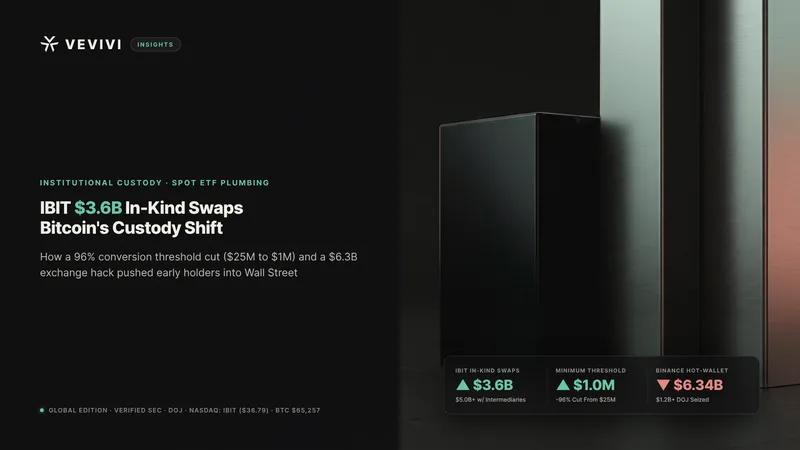
A structural realignment in digital asset custody is accelerating following the U.S. Securities and Exchange Commission (SEC) authorization of in-kind creation and redemption mechanisms and BlackRock's decision to slash conversion thresholds on its iShares Bitcoin Trust (IBIT). Early Bitcoin whales who spent more than a decade defending strict self-custody principles have now converted $3.6 billion of directly held coins into IBIT shares tracked by BlackRock, with cumulative facilitated volume including institutional intermediaries surpassing $5 billion.
As of the November 16, 2026 U.S. market close and global spot settlement window, Bitcoin trades at $65,256.54 while Nasdaq-listed IBIT stands at $36.79 alongside U.S. 10-year Treasury yields hovering between 5.12% and 5.15%. Despite macro rate headwinds and spot price consolidation, high-net-worth Bitcoin holders continue migrating out of private hardware wallets and offshore exchanges into Wall Street private-bank brokerage accounts, driven by tax deferral mechanics, acute cyber and physical security threats, collateralized credit access, and multi-generational estate planning.
Regulatory Clearance and Threshold Compression Unlock Whale Conversions
When U.S. spot Bitcoin exchange-traded funds debuted in January 2024, regulators mandated a strict cash-only creation and redemption model that effectively locked out early low-basis Bitcoin holders. Under that initial regime, migrating native coins into an ETF wrapper required selling spot Bitcoin for U.S. dollars first, crystallizing substantial federal and state capital gains liabilities. That friction disappeared after the SEC voted on July 29, 2025 (Release No. 34-103571) to permit in-kind creations and redemptions for spot crypto exchange-traded products, followed in August 2026 by BlackRock cutting IBIT's in-kind conversion minimum by 96% from $25 million down to $1 million. According to disclosures by Robbie Mitchnick, Head of Digital Assets at BlackRock, in interviews with Barron's and Bloomberg, BlackRock has directly observed $3.6 billion in physical BTC-to-IBIT conversions, while broader swaps routed across partner desks have climbed past $5 billion from roughly $3 billion in October 2025.
Institutional Intermediary Plumbing and Tax-Deferred Wrapper Exchanges
In-kind conversions do not involve individual holders wiring coins directly to an asset manager's retail portal; instead, transactions execute through institutional liquidity intermediaries and Authorized Participants led by Galaxy Digital, Talos, and Virtu Financial, which set operational execution minimums around the $1 million to $2 million band. When a holder delivers appreciated Bitcoin through an intermediary into IBIT's trust custody structure and receives newly minted ETF shares in return, the exchange generally avoids triggering a taxable cash realization event under standard U.S. tax interpretation, preserving unrealized cost basis until the ETF shares themselves are eventually sold. Backed by $67.04 billion in fair-value Bitcoin assets reported in IBIT's Q3 2026 SEC Form 10-Q (and 795,921 BTC worth roughly $60.4 billion in early November), the trust offers deep secondary-market liquidity capable of absorbing multi-hundred-million-dollar whale tranches without order-book slippage.
Separating In-Kind Wrapper Shifts From Net Spot Cash Outflows
Institutional allocators must carefully distinguish in-kind share creations from organic spot demand when interpreting headline ETF flow trackers. Because an in-kind swap simply transfers pre-existing Bitcoin from a private wallet into ETF cold storage in exchange for newly issued shares, it registers positively in fund AUM and share-count statistics without purchasing a single new coin on the open spot market. Meanwhile, cash flows have moved in the opposite direction amid tight monetary conditions: Farside Investors data shows U.S. spot Bitcoin ETFs suffered $1.28 billion in net outflows during the week ended November 6, 2026, with IBIT accounting for $1.21 billion of those redemptions. With the U.S. 10-year Treasury yield pressing near 5.12% to 5.15%, macro-driven cash redemptions are actively offsetting the optical boost of whale in-kind inflows.
Cyber Supply-Chain Breaches and Physical Crime Erode Self-Custody Dogma
Beyond tax efficiency, an acute security reckoning is prompting veteran holders to reconsider sovereign key management. As market strategist Scott Melker observed during a recent Yahoo Finance New York studio segment, digital asset investors are confronting a dual custody crisis spanning both centralized exchanges and personal hardware setups. Even 2010-era Bitcoin adopters once committed to opting out of traditional banking are increasingly delegating custody to regulated securities wrappers.
State-Backed Developer Intrusions and Federal Asset Seizures
The watershed catalyst arrived on October 29, 2026, when North Korea's state-sponsored TraderTraitor cyber group drained $6.34 billion across roughly ten blockchains from Binance hot wallets. Rather than cracking cryptographic private keys, attackers executed a five-month developer supply-chain intrusion—combining a tampered Homebrew package on a DevOps laptop, a malicious fake-interview coding test, and lateral movement through an internal artificial intelligence tool—to command Binance's own signing infrastructure to authorize outbound transfers. Although Binance fully covered affected user balances from corporate reserves and the U.S. Department of Justice announced on November 12, 2026 court authorization to seize more than $1.2 billion out of $2.7 billion frozen alongside an FBI alert on North Korea's $400 million FaceStealer webcam scheme, a comparable breach at a smaller exchange would have caused catastrophic insolvency. Combined with August 2026 scrutiny over a Coldcard hardware wallet firmware flaw, the incident underscored how AI-assisted social engineering and supply-chain exploits can bypass traditional self-custody defenses.
Escalating Offline Extortion and Personal Security Fatigue
Physical violence targeting identifiable crypto holders has compounded digital anxieties. French organized-crime prosecutors documented 77 crypto-linked kidnappings, home invasions, and violent extortion plots in 2026 alone—already exceeding the full-year 2025 tally following high-profile attacks on industry executives—alongside home-invasion conspiracies prosecuted in the United States. BlackRock's Mitchnick noted that physical security and personal peace of mind represent the single primary motivation cited by converting whales. Holding bearer private keys at home turns personal identity leaks into life-threatening coercion risks, whereas brokerage-held IBIT shares sit behind multi-layered institutional settlement delays and reversible compliance controls that neutralize physical ransom incentives.
Wall Street Balance-Sheet Integration and Counterparty Trade-Offs
Once native Bitcoin is wrapped into Nasdaq-listed IBIT shares inside a private bank or prime brokerage account, it transitions from an isolated bearer commodity into productive financial collateral integrated with Wall Street credit and wealth-transfer plumbing.
Brokerage Margin Credit Lines and Seamless Trust Inheritance
Major U.S. banks have rapidly built lending rails around spot ETF shares and custodied digital assets. JPMorgan Chase began accepting IBIT shares as eligible loan collateral in June 2025 before launching institutional U.S. dollar credit lines against custodied crypto via its Kinexys platform in March 2026 with 30% to 50% collateral haircuts, while Morgan Stanley has expanded parallel lending and prime-brokerage integration with Galaxy Digital. Whales can therefore borrow dollar liquidity against their IBIT positions without selling shares or triggering capital gains taxes. Simultaneously, holding Bitcoin exposure inside a private-bank securities account simplifies multi-generational estate planning, replacing fragile multi-signature seed-phrase recovery ceremonies with standard revocable trusts and automated beneficiary transfers.
Custodial Concentration Risks and Conditional Macro Scenarios
Migrating into Wall Street wrappers nevertheless introduces distinct structural trade-offs. Investors surrender permissionless bearer sovereignty in exchange for concentrated third-party custodial exposure at Coinbase Prime's institutional cold-storage affiliate, ongoing 0.25% annual sponsor fees, weekend equity-market trading halts, and sovereign regulatory seizure jurisdiction. Looking ahead, two conditional trajectories will govern market impact: structurally, continued threshold reductions and bank collateral adoption should lock legacy whale supply inside long-term wealth accounts and dampen spot exchange sell pressure; cyclically, if U.S. 10-year Treasury yields remain anchored above 5.10% under hawkish Federal Reserve expectations, institutional cash outflows could keep Bitcoin range-bound near $65,000 despite record in-kind wrapper conversions.
Key Institutional Questions on In-Kind Bitcoin ETF Conversions
Do whale in-kind conversions create immediate upward buying pressure on spot Bitcoin prices?
No, in-kind swaps do not generate immediate open-market spot buying. Because existing Bitcoin is transferred directly from a holder's wallet into the ETF custodian in exchange for newly issued shares, no cash enters spot order books. Over longer horizons, however, absorbing legacy whale coins into pledged private-bank collateral accounts can reduce liquid exchange float during market drawdowns.
Are in-kind Bitcoin-to-ETF share swaps automatically tax-free across every jurisdiction?
Tax deferral is not universally guaranteed across all global jurisdictions. While U.S. tax practitioners generally treat qualifying in-kind ETP contributions of appreciated property as non-realization exchanges rather than cash sales, actual tax treatment depends on investor residency, entity structure, and local statutory rules, requiring independent legal and tax verification.
What new structural risks replace private-key loss when whales migrate into spot ETFs?
Holders trade personal key-management risk for centralized institutional counterparty exposure. Key trade-offs include underlying custodial concentration at Coinbase Prime, reliance on Authorized Participant intermediaries during stress events, inability to rebalance positions outside U.S. equity trading hours, annual management fee drag, and exposure to brokerage-level compliance freezes.
Disclaimer and Risk Warning
This article is provided strictly for informational and educational purposes based on publicly available on-chain metrics and macroeconomic data. Nothing in this publication constitutes financial, investment, legal, or tax advice, nor should it be construed as a solicitation, recommendation, or offer to buy or sell any digital asset or financial instrument. Digital assets are subject to high market risk and extreme price volatility, and you may lose part or all of your invested capital. Historical market cycles and past performance referenced herein do not guarantee future results. You are solely responsible for your own investment decisions and should conduct independent research and consult a qualified financial advisor before making any financial commitments.