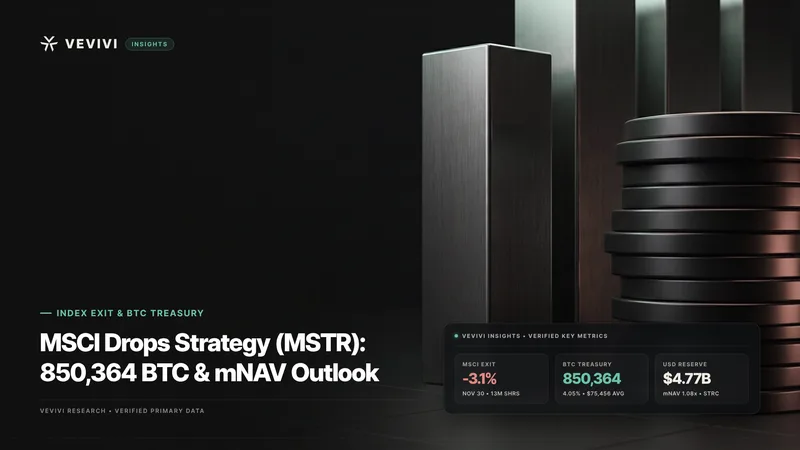
Global index provider MSCI has officially confirmed in its November 2026 Index Review that Strategy Inc. (ticker MSTR), the world's largest publicly traded corporate holder of Bitcoin, will be removed from its flagship global equity benchmarks. Taking effect after the market close on November 30, 2026, the exclusion marks more than a routine index rebalancing: it signals a structural inflection point for the corporate Bitcoin treasury model that long relied on equity valuation premiums to fund relentless balance-sheet accumulation.
First, applying its newly adopted non-operating company methodology, MSCI will delete Strategy from its U.S. and global equity benchmarks after the November 30 close; passive funds tracking these indexes hold roughly 3.1% of basic shares outstanding (about 13 million shares, or roughly $1.57 billion pre-announcement), and the exit imposes zero obligation on Strategy to sell Bitcoin.
Second, per U.S. Securities and Exchange Commission (SEC) Form 8-K filings, Strategy holds 850,364 BTC (4.05% of the 21 million supply cap) acquired at an average purchase price of $75,456, and selectively sold 6,948 BTC during 2026 to restore its STRC preferred stock toward par and build a $4.77 billion USD Reserve that insulates near-term liquidity.
Third, the medium-term trajectory hinges on whether Strategy defends its 1.0x multiple of net asset value (mNAV) and how smoothly institutional Bitcoin demand rotates toward sovereign wealth funds and global banks ahead of convertible bondholder put dates clustering between September 2027 and 2028.
MSCI's Non-Operating Company Rule and the Structural Backdrop Behind Strategy's Exit
According to MSCI's November 2026 Index Review released on November 11, Strategy will exit the MSCI USA Index after the close of trading on November 30, 2026, automatically removing the stock from the broader MSCI World and MSCI ACWI benchmarks as well. While 24 securities are leaving the MSCI USA Index in this review cycle, 23 of them are simply migrating down to the MSCI USA Small Cap Index; Strategy is the sole U.S. company exiting MSCI's equity index universe altogether. Across global markets, six companies failed the new non-operating screen and were marked for deletion: Strategy, Japanese Bitcoin treasury company Metaplanet, Solana treasury company Upexi, U.K. physical uranium holder Yellow Cake, Iceland's Skel, and Agronomics, while 19 additional companies including SharpLink were placed on a watchlist.
The removal concludes a year-long regulatory and methodological tug-of-war. MSCI first proposed on October 10, 2025 to exclude companies whose digital asset holdings accounted for 50% or more of total assets. Following intense market pushback, MSCI paused implementation on January 6, 2026, yet maintained an interim freeze that barred Strategy's index weight from rising regardless of how many new shares the company issued. When MSCI reopened its consultation in August 2026, all explicit references to digital assets had disappeared. Instead, MSCI introduced a balance-sheet and financial-ratio screen targeting companies lacking substantial operating assets that score like investment funds on at least four of five financial metrics across two consecutive annual reporting periods, formally adopting the rule on October 15, 2026.
Although retail commentary occasionally speculated that Morgan Stanley orchestrated the exclusion to sideline a competing financial vehicle, Morgan Stanley fully divested its ownership stake in MSCI back in 2009 and holds no governance tie. The real catalyst stems from institutional asset managers—who account for more than half of MSCI's index segment revenue—raising persistent concerns that balance-sheet accumulation vehicles resemble closed-end funds rather than traditional operating businesses.
Sizing Up Passive Equity Outflows and Retention Across Rival Benchmarks
Mechanical selling pressure from index-tracking funds immediately took center stage following the announcement. Strategy shares slipped roughly 2.5% in after-hours trading on November 11 before falling as much as 7.85% intraday and closing down 6.49% at $114.41 in Nasdaq regular trading on November 12. Based on Strategy's official consultation response, passive funds benchmarked to the affected MSCI indexes hold roughly 13 million MSTR shares, representing 3.1% of basic shares outstanding, or approximately $1.57 billion at the pre-announcement close (roughly $1.49 billion at the November 12 close). Broader modeling by JPMorgan Research estimates that passive and index-linked outflows around the November 30 rebalancing could reach roughly $2.8 billion.
Crucially, this mechanical supply involves MSTR common equity on Nasdaq rather than spot Bitcoin on crypto exchanges. Roughly 13 million shares represents less than a single day's trading volume on November 12 (approximately 19.82 million shares), and index removal neither affects Strategy's Nasdaq listing nor requires a single Bitcoin to be liquidated. Spot Bitcoin moved minimally on the announcement itself, and historical quantitative studies of major equity index deletions show that passive selling clusters tightly into the effective market close before recovering a substantial portion of the price dislocation over the subsequent three weeks.
Near-term contagion risk across other major U.S. benchmarks also appears contained. JPMorgan previously estimated that passive index funds collectively owned between 15% and 18% of Strategy's market capitalization, meaning the vast majority of passive exposure—anchored by the CRSP US Total Market Index tracked by Vanguard, the Nasdaq-100, and FTSE Russell benchmarks—remains intact. Unlike MSCI's balance-sheet asset test, Nasdaq and FTSE Russell classify issuers primarily by legal fund registration and revenue origin. Because accounting standards do not record unrealized Bitcoin appreciation as top-line revenue, Strategy's recognized operating revenue still stems from its enterprise analytics software segment, leaving no immediate rule trigger for cascade deletions. Even so, JPMorgan has cautioned that total passive outflows could reach $8.8 billion if rival index providers eventually adopt MSCI-style balance-sheet screens after extended consultation cycles.
Inside the 6,948 BTC Selective Sales and the STRC-Backed Bitcoin Bank Blueprint
The deeper fundamental question is whether equity valuation pressure could force Strategy into balance-sheet distress and large-scale Bitcoin liquidation. Per SEC Form 8-K disclosures as of November 8, 2026, Strategy holds 850,364 BTC (4.05% of Bitcoin's 21 million maximum supply), acquired at an aggregate cost of $64.16 billion or an average purchase price of $75,456 per coin. Notably, Strategy broke its multi-year pledge of never selling Bitcoin during 2026. When Bitcoin dropped near $59,000 at the end of June 2026, Strategy's mNAV briefly dipped to 0.99x, and its flagship funding instrument—Variable Rate Series A Perpetual Stretch Preferred Stock (STRC, paying a 12.00% annual dividend and designed to trade near $100 par)—suffered a severe blow, plunging to a 52-week low of $71.25. In response, the board adopted its Digital Credit Capital Framework on June 29, 2026.
Under that framework, Strategy executed four disclosed Bitcoin sales totaling 6,948 BTC (generating roughly $431.7 million in gross proceeds) during 2026, earmarking every dollar strictly to service preferred dividends, repurchase discounted STRC shares below par, and fortify cash liquidity. By November 8, 2026, Strategy's dedicated USD Reserve stood at $4.77 billion alongside $146.2 million in separate cash, while STRC closed at $99.96 on November 12—virtually back at its $100 par target. With company-reported mNAV hovering near 1.08x, Strategy faces no acute liquidity crunch. Although none of its Bitcoin is legally pledged as collateral, investors buy Strategy's securities on the implicit backing of its unencumbered Bitcoin reserve, prompting Executive Chairman Michael Saylor to reframe company policy around zero net selling over time.
At the Money20/20 fintech conference in early November 2026, President and CEO Phong Le outlined how this capital stack feeds Strategy's long-term ambition to operate as a global Bitcoin bank. The three-tier architecture pairs Strategy's 850,364 BTC reserve with 12.00% yielding STRC preferred stock, proposing that commercial banks blend STRC with U.S. Treasuries to offer retail depositors digital dollar accounts yielding roughly 7% while retaining a 2% spread. Because Basel III banking rules impose punitive one-for-one capital charges on direct bank Bitcoin holdings, Strategy aims to warehouse Bitcoin volatility on its own balance sheet while supplying regulated institutions with structured preferred securities. Early traction has emerged from a federally chartered U.S. crypto bank and select asset managers, yet clear structural vulnerabilities persist: STRC carries no maturity date, credit agencies such as Moody's treat perpetual preferreds as equity rather than debt, retail accounts hold a major share without deposit insurance, and Bitcoin generates zero native cash yield. Servicing a 12% cash dividend ultimately depends on equity issuance premiums, USD reserves, or selective BTC sales. Whereas Strategy once pulled Bitcoin higher through premium share issuance, the loss of MSCI passive buyers underscores a reversed dynamic: Bitcoin must rally first to re-ignite Strategy's capital markets flywheel.
Macro Headwinds, the 2027–2028 Convertible Put Schedule, and Price-Tier Stress Scenarios
That dependency comes at a challenging juncture, with spot Bitcoin trading under heavy pressure between $70,500 and $71,400 as of November 13, 2026—roughly 44% below its October 6, 2025 all-time high of $126,198. Current prices sit beneath both Strategy's $75,456 average cost basis and JPMorgan's estimated average miner production cost near $85,000. Broader macro and industry catalysts have compounded risk aversion: U.S. spot Bitcoin ETFs recorded more than $1.44 billion in five-day net outflows in early November following the $6.3 billion security breach at Binance, sticky U.S. consumer inflation (September CPI up 3.7% year-over-year) heightened market odds of another Federal Reserve rate hike at the December 8–9 FOMC meeting, and the Democratic sweep of both the Senate and House in the November 2026 U.S. midterm elections effectively sidelined the CLARITY Act following its 49–50 Senate setback in September.
If market weakness persists, Strategy's financial resilience maps onto distinct Bitcoin price thresholds and debt put dates. Annual preferred dividend and debt interest commitments (exceeding $1.76 billion) are covered for more than two years by its $4.77 billion USD Reserve, and even funding those obligations entirely in Bitcoin would equate to roughly 20,000 BTC per year—a volume global spot liquidity could absorb gradually. However, if an additional 5% slide in MSTR shares pushes company mNAV below 1.0x for an extended stretch, accretive common-stock issuance shuts down, effectively turning Strategy from a compounding Bitcoin accumulator into an active fund managing net asset discounts through incremental coin sales.
The decisive calendar test centers on Strategy's convertible senior notes, where binding holder put dates arrive ahead of stated maturities. SEC filings show the first major put window opens on September 15, 2027 ($1.01 billion), followed by clustered put dates in March 2028 ($2.0 billion), June 2028 ($1.5 billion), and September 2028 ($1.4 billion), concentrating roughly $5.9 billion to $6.4 billion in potential cash repayment demands across late 2027 and 2028. A retest of June's $59,000 Bitcoin low would revive selective monetization pressure, while a sustained breakdown below $50,000 heading into the 2027–2028 put window with closed refinancing markets could require liquidating roughly 14% of Strategy's Bitcoin holdings simply to retire principal in cash.
Institutional Handoff to Sovereign Funds and Banks, Plus Key Catalysts Ahead
Conversely, cycle structure and institutional ownership shifts offer substantive support for a medium-term recovery scenario. Unlike prior Bitcoin bear markets that inflicted 70% to 80% peak-to-trough drawdowns, the decline from October 2025's $126,198 peak to June 2026's $59,000 trough stopped near 53%. Historically, Bitcoin's four-year halving rhythm has formed cyclical bottoms roughly a year after an all-time high before building momentum ahead of the next halving—projected for April 2028, right in the middle of Strategy's critical convertible debt window.
Equally telling is the ownership rotation visible in SEC Form 13F institutional filings. While short-term hedge funds unwound spot ETF cash-and-carry basis trade positions between late 2025 and mid-2026, heavyweight institutions with multi-year horizons stepped in. Sovereign wealth vehicles in Abu Dhabi—specifically Mubadala Investment Company and the Abu Dhabi Investment Council via Al Warda Investments—expanded and held combined stakes exceeding $1 billion in BlackRock's iShares Bitcoin Trust (IBIT) throughout the downturn. Meanwhile, Morgan Stanley launched an exchange desk enabling clients to swap spot Bitcoin into ETF shares, Citigroup is rolling out institutional Bitcoin custody in 2026, and global banking regulators are reassessing punitive crypto capital rules. With Citigroup projecting Federal Reserve rate cuts to commence in June 2027 and Wall Street research firm Bernstein forecasting Bitcoin to reach $150,000 by mid-2027, institutional consensus points toward the first half and middle of 2027 as the macro inflection window.
Should macro headwinds ease and Bitcoin rally back toward $130,000 and beyond, Strategy's balance-sheet convexity flips rapidly in its favor. Rising share prices would lift MSTR above conversion thresholds—allowing the vast majority of 2028 convertible notes to convert into equity rather than draining cash—while a restored mNAV premium would expand Bitcoin per share and revive demand for digital credit securities. Although MSCI re-inclusion remains off the table until at least 2028 due to the two-year consecutive reporting screen, investors can gauge near-term resilience through four upcoming checkpoints: FTSE Russell's preliminary index lists, Strategy's weekly Monday Form 8-K disclosures, post-November 30 equity absorption over the ensuing three weeks, and the Federal Reserve's December 8–9 FOMC policy decision.
Q1. Does Strategy's removal from MSCI indexes force the company to sell any of its 850,364 BTC?
A1. No. Exiting MSCI benchmarks is an index constituent adjustment rather than a Nasdaq delisting, imposing zero legal or operational obligation on Strategy to sell Bitcoin. Passive index funds rebalancing around the November 30 market close will sell roughly 13 million shares of MSTR common stock (about 3.1% of basic shares outstanding), while Strategy's $4.77 billion USD Reserve provides more than two years of coverage for preferred dividends and interest obligations.
Q2. Which metrics matter most for evaluating Strategy's financial health and Bitcoin buying capacity going forward?
A2. The two primary barometers are whether Strategy maintains its mNAV multiple above 1.0x and keeps STRC preferred shares anchored near their $100 par value. Sustaining an mNAV above 1.0x alongside a Bitcoin recovery above Strategy's $75,456 average cost basis reopens accretive capital issuance, whereas prolonged sub-1.0x mNAV trading into the September 2027–2028 convertible bond put window would heighten cash reserve drawdowns and selective BTC selling risk.
Disclaimer and Risk Warning
This article is provided strictly for informational and educational purposes based on publicly available on-chain metrics and macroeconomic data. Nothing in this publication constitutes financial, investment, legal, or tax advice, nor should it be construed as a solicitation, recommendation, or offer to buy or sell any digital asset or financial instrument. Digital assets are subject to high market risk and extreme price volatility, and you may lose part or all of your invested capital. Historical market cycles and past performance referenced herein do not guarantee future results. You are solely responsible for your own investment decisions and should conduct independent research and consult a qualified financial advisor before making any financial commitments.