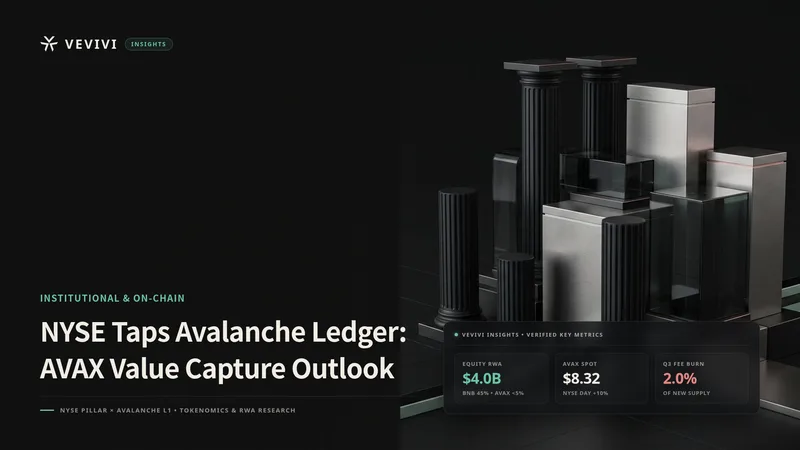
The New York Stock Exchange (NYSE) has officially selected Avalanche (AVAX) as the exclusive post-trade clearing and settlement ledger for its upcoming 24/7 tokenized U.S. equities trading venue. Revealed on November 9, 2026 via The Wall Street Journal and Ava Labs following a year-long confidential evaluation of technical performance and network economics, the milestone coincided on the very same day with retail brokerage giant Charles Schwab launching direct spot trading for AVAX alongside Solana and Chainlink. Yet the market reaction remained notably restrained. After briefly climbing roughly 10% intraday to $8.78 on the announcement, AVAX retraced its gains alongside Bitcoin trading under heavy pressure below $71,000, settling near $8.32 with a market capitalization of approximately $3.71 billion. Understanding why marquee Wall Street adoption did not immediately trigger a sustained token repricing requires comparing this architecture against the Robinhood Chain and Arbitrum (ARB) precedent while auditing Avalanche's underlying tokenomics.
Key Takeaways
First, the NYSE will keep trade execution off-chain on its existing Pillar matching engine while deploying a permissioned Avalanche network exclusively for post-trade atomic settlement, targeting a Q4 2026 launch pending regulatory approval.
Second, Arbitrum's prior 140% rally stemmed not from institutional partnership headlines, but from verified cash flows via a 10% net protocol revenue share from Robinhood Chain fueled by retail memecoin speculation—an activity structurally excluded from the NYSE's permissioned ledger.
Third, because burned transaction fees offset just 2.0% of newly minted AVAX staking rewards in Q3 2026, durable token upside hinges on whether NYSE settlement fees denominate in AVAX and how effectively the Helicon upgrade and native stablecoin yield capture reshape net issuance.
The $4.0 Billion Tokenized Equities Boom and Why Wall Street Is Moving On-Chain
Behind the New York Stock Exchange's push to build blockchain settlement rails lies surging global demand for uninterrupted equity trading across weekends and holidays. While U.S. equities markets currently offer extended-hours sessions until 8:00 PM ET and have pursued 22-hour weekday trading on NYSE Arca, traditional venues remain completely closed over the weekend. Crypto exchanges and on-chain protocols aggressively filled that vacuum with price-tracking equity tokens and high-leverage perpetual derivatives. According to on-chain real-world asset (RWA) market trackers, global tokenized stock supply has roughly doubled over the past four months to reach $4.0 billion.
Market share distribution across networks underscores why legacy exchanges feel urgency. Rather than Ethereum or Solana, Binance-affiliated BNB Chain dominates the sector with more than $1.5 billion in tokenized equities, capturing roughly 45% of total market supply. With over 58% of on-chain equity trading volume occurring outside regular U.S. market hours, crypto exchanges with massive retail user bases successfully funneled idle crypto traders into 24/7 U.S. and Asian tech stock exposure. By contrast, Avalanche's share of tokenized equities slipped from roughly 10% a month earlier to under 5% (approximately $291.8 million), placing its retail distribution footprint on an entirely different scale from exchange-backed chains.
For the NYSE and its parent company, Intercontinental Exchange (ICE), watching offshore crypto venues monetize price discovery generated by NYSE-listed shares posed a clear strategic threat. To recapture round-the-clock order flow, the NYSE designed a dedicated venue combining instant stablecoin funding with atomic on-chain settlement, ultimately selecting Avalanche after a full year of testing. Operating against the backdrop of the U.S. Securities and Exchange Commission's (SEC) five-year Innovation Exemption framework for tokenized securities and a constructive U.S. Commodity Futures Trading Commission (CFTC) posture, the exchange is targeting a Q4 2026 launch subject to final regulatory sign-off, even as Charles Schwab's November 9 addition of AVAX spot trading expanded traditional brokerage access.
Lessons From Robinhood Chain and Arbitrum on When Token Prices Actually Move
For crypto investors, the NYSE announcement immediately invited comparisons to Robinhood's decision to build its Layer-2 network, Robinhood Chain, on the Arbitrum Orbit stack—a catalyst widely associated with sharp rallies in Arbitrum (ARB) and Uniswap (UNI). A granular timeline, however, reveals that markets never rewarded the partnership headline alone. When reports of Robinhood's Arbitrum-based chain first surfaced roughly sixteen months ago, ARB popped 18% before giving back the entire move. Even when Robinhood Chain launched its public mainnet on July 1, 2026, ARB barely budged.
The actual repricing began only when on-chain fee dashboards verified real revenue accrual under the Arbitrum Expansion Program license, which routes 10% of Robinhood Chain's net protocol revenue back to the Arbitrum ecosystem (8% to the Arbitrum DAO treasury and 2% to the developer guild, even though network gas fees are paid in ETH). Once investors could model tangible cash flows hitting the treasury, ARB surged more than 24% within three days and extended its rally by roughly 140% into September 2026.
Yet decomposing where those fees originated exposes a critical caveat. In early September 2026, Robinhood Chain's daily network fees hit an all-time high of $3.75 million, briefly surpassing the combined daily fee generation of Ethereum mainnet and Coinbase's Base network. DefiLlama and on-chain analytics showed, however, that over 80% of trading volume came from memecoin speculation—led by tokens such as Cashcat and launchpad Pons, which minted up to 22,600 new tokens in a single day and generated $5.95 million in single-day app fees—while tokenized stocks accounted for a negligible fraction of chain transactions.
Once memecoin mania cooled, network metrics and token prices contracted in lockstep. Robinhood Chain's average daily transactions dropped 42% from 10.8 million in mid-September to 6.2 million in early October (October 2–8, 2026), while average daily network fees plunged by roughly 98% from peak levels to around $65,000. Tracking that slowdown, ARB fell roughly 32% from its local peak and currently trades near $0.15. Still, the fact that roughly $1.04 billion in DeFi total value locked (TVL) and $1.10 billion in stablecoin supply remained sticky on Robinhood Chain demonstrates a two-layered outcome: speculative memecoin froth evaporated, but core retail brokerage capital stayed on-chain.
Inside NYSE's Permissioned Architecture and ICE's Broader On-Chain Empire
Structurally, the NYSE's tokenized equities venue operates on the exact opposite model from an open retail Layer-2. First, trade execution—matching buy and sell orders—does not happen on-chain; it remains entirely off-chain inside the NYSE's proprietary, ultra-low-latency Pillar matching engine. Avalanche enters strictly post-trade as the clearing and settlement ledger recording ownership transfers and payment finality. Second, the ledger is gated and permissioned rather than open to anonymous deployment.
Dennis Lee, Head of Digital Issuance at the NYSE, and Michael Blaugrund, Vice President of Strategic Initiatives at ICE, emphasized that their selection criteria centered on strict participant access controls, predictable transaction costs, institutional EVM wallet compatibility, and seamless integration with legacy securities rails. Permissionless memecoin launchpads cannot exist inside this environment by design. While that predictability satisfies Wall Street compliance mandates, it completely eliminates the speculative fee spikes that propelled Arbitrum during Robinhood Chain's September boom.
Even so, the institutional ties binding ICE, the NYSE, and Ava Labs run deep. Michael Blaugrund—formerly NYSE Chief Operating Officer, a board member at pioneer digital securities venue tZERO, and CEO of fractional-share infrastructure provider DriveWealth—rejoined ICE roughly fourteen months ago, aligning directly with the start of the NYSE's year-long Avalanche evaluation and building on prior tZERO settlement work on Avalanche. On the protocol side, Ava Labs President and COO Charley Cooper brings direct regulatory and market-structure pedigree from his prior roles as CFTC Chief of Staff, Managing Director at enterprise blockchain consortium R3, and senior leadership at State Street and Deutsche Bank.
Moreover, Avalanche sits within an expansive on-chain market-structure portfolio assembled by ICE. Having founded digital asset platform Bakkt back in 2018, ICE recently committed roughly $2 billion across two tranches to prediction market Polymarket alongside an institutional data distribution pact, and joined BlackRock and Apollo in the $222 million presale for Circle's enterprise blockchain, Arc. For its NYSE tokenized venue, ICE also assembled six transfer-agent and issuance partners—Securitize, tZERO, Broadridge Financial Solutions, Computershare, Equiniti, and Superstate—alongside wallet distribution partner Blockchain. Notably, ICE's separate crypto-exchange joint venture, OKXICE, initially sought to list 63 tokenized U.S. equities under the SEC's Innovation Exemption but has faced formal objections from 67 U.S.-listed corporations—including Microsoft, Alphabet, Nvidia, JPMorgan, and Wells Fargo—underscoring why an issuer-aligned, NYSE-native settlement ledger carries heightened strategic weight.
The Value Accrual Bottleneck: Custom L1 Gas Rules and Q3 On-Chain Realities
Why did AVAX rally 49% over three days in mid-September when testing rumors coincided with a broader crypto bounce and SEC tokenized-equity exemption headlines, yet stall after gaining 10% on official confirmation? Beyond macro headwinds, investors lack a transparent formula translating dedicated enterprise chain volume into direct AVAX token demand.
Under Avalanche's custom Layer-1 (Avalanche L1) architecture, institutional operators launching dedicated chains are not required to use AVAX as their native gas token. Enterprises can denominate transaction fees in USD stablecoins or abstract gas fees entirely to ensure accounting predictability—making stablecoin fee settlement a highly plausible choice for the NYSE ledger. Without AVAX gas denomination or an explicit revenue-sharing bridge akin to Arbitrum's 10% cut, multi-billion-dollar equity settlement volume does not automatically trigger AVAX fee burning.
Currently, the only guaranteed AVAX cash flow from a custom Avalanche L1 to the Primary Network comes from continuous validator fees introduced under ACP-77. Crucially, those fees scale with the number of active validators securing the chain rather than transaction volume. At prevailing network rates, running 10 validators costs roughly $1,500 per year in AVAX, and 100 validators cost roughly $15,000 annually; a tenfold surge in NYSE equity settlement volume does not multiply validator fee burn tenfold. Across Q3 2026, cumulative validator fees paid by all custom Avalanche L1s combined totaled roughly $18,000.
Broader Q3 2026 tokenomics metrics documented by Blockworks and ecosystem researchers highlight this structural disconnect. During the third quarter, transaction fees burned through minting and redemption/burning mechanics offset just 2.0% of newly issued AVAX staking rewards. Over the same period, U.S. spot AVAX ETF net inflows reached roughly $3.6 million—far too modest to absorb ongoing staking issuance—while publicly traded AVAX digital-asset treasury vehicles suffered a severe blow, with Nasdaq-listed Avalanche Treasury Corp. (AVAT) sliding 54% over a 30-day stretch despite reporting mark-to-market accounting gains in Q3. High-profile institutional deployments from JPMorgan Onyx, KKR, BlackRock's BUIDL fund, and Japan's Progmat ($2.8 billion in migrated security tokens) have repeatedly validated Ava Labs' technology without yet resolving AVAX supply-demand dilution.
Beyond Back-End Plumbing: Visa-Style Toll Roads, Helicon, and Key Catalysts Ahead
Dismissing enterprise settlement chains as mere back-end distribution arms for commercial banks and exchanges overlooks one of financial history's most lucrative business models. Visa and Mastercard issue zero credit cards directly; banks handle customer acquisition while the card networks operate the underlying clearing rails and collect a fractional toll on every transaction. Public blockchains compete along three viable long-term archetypes: exchange-affiliated settlement rails, institutional asset vaults, and high-capture toll bridges. Having already secured major institutional asset vaults such as BlackRock's BUIDL and flagship exchange settlement through the NYSE, Avalanche now faces the decisive task of wiring toll collection directly to AVAX.
The Avalanche Foundation has openly acknowledged this priority and initiated supply-and-capture reforms on three fronts. First, the Helicon mainnet upgrade activated on September 22, 2026 introduced auto-renewed staking (ACP-236) and began phasing down the minimum staking reward consumption rate from 10% to 7.5% over 90 days (ACP-285, completing December 21, 2026), projected to trim annual inflation by 0.5 to 1.0 percentage points, alongside validator governance adjustments raising minimum base-fee floors. Second, on November 12, 2026, the Foundation announced six academic research grants modeling how ACP-77 L1 validator fees can transition Avalanche from inflationary staking rewards to sustainable fee-based security. Third, with roughly $998 million in stablecoins circulating on Avalanche generating an estimated $6.5 million in annual U.S. Treasury reserve yield currently retained entirely by external issuers, the Foundation is advancing plans for an ecosystem-aligned stablecoin that routes reserve interest back toward AVAX value accrual.
For investors evaluating AVAX following the NYSE milestone, three verifiable checkpoints will separate narrative hype from fundamental repricing: final SEC and CFTC approval for the NYSE's Q4 2026 launch, disclosure of whether NYSE ledger settlement or validator economics incorporate direct AVAX fee capture or buybacks, and measurable expansion in the quarterly fee-burn-to-issuance ratio well above Q3's 2.0% baseline as Helicon and native stablecoin yield initiatives take effect.
Q1. Why did AVAX give back its initial 10% gain after the NYSE officially selected Avalanche, unlike Arbitrum's 140% rally with Robinhood Chain?
A1. Arbitrum rallied only after on-chain data confirmed a direct 10% net revenue share from Robinhood Chain alongside a massive memecoin fee boom peaking at $3.75 million per day. By contrast, the NYSE venue matches trades off-chain on its Pillar engine and uses a permissioned Avalanche ledger closed to retail memecoin speculation, while the fee token denomination for NYSE post-trade settlement has not yet been disclosed.
Q2. Which concrete metrics should investors track to gauge whether NYSE adoption translates into long-term AVAX token value?
A2. Investors should monitor three primary indicators: regulatory sign-off and fee-currency disclosure for the NYSE's Q4 2026 platform launch, whether Avalanche's fee-burn offset rises meaningfully above its 2.0% Q3 2026 ratio following the Helicon staking overhaul and base-fee increases, and execution on the Foundation's native stablecoin plan to redirect roughly $6.5 million in annual Treasury reserve yield back into the AVAX ecosystem.
Disclaimer and Risk Warning
This article is provided strictly for informational and educational purposes based on publicly available on-chain metrics and macroeconomic data. Nothing in this publication constitutes financial, investment, legal, or tax advice, nor should it be construed as a solicitation, recommendation, or offer to buy or sell any digital asset or financial instrument. Digital assets are subject to high market risk and extreme price volatility, and you may lose part or all of your invested capital. Historical market cycles and past performance referenced herein do not guarantee future results. You are solely responsible for your own investment decisions and should conduct independent research and consult a qualified financial advisor before making any financial commitments.