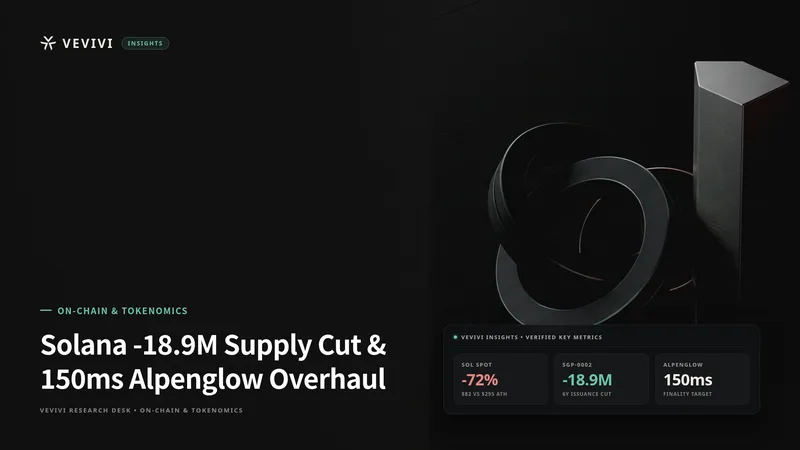
Solana (SOL) remains trading under heavy pressure near $82 as headlines surrounding a Nasdaq-listed treasury firm's full liquidation and spot exchange-traded fund (ETF) redemptions weigh on market sentiment. According to Coinbase and CoinGlass market data, SOL sits roughly 72% below its January 2025 all-time high of $295 after closing 10 consecutive negative monthly candles from October 2025 through July 2026, the longest monthly losing streak in its history. Even against broader crypto drawdowns—with Bitcoin near $69,100 (down about 45% from its October 2025 peak of $126,080) and Ethereum near $1,955 (down 60.5% from its August 2025 high of $4,953)—Solana's steeper correction stands out. Cross-checking SEC filings, governance records, and on-chain metrics clarifies what actually drove the sell-off and why upcoming protocol milestones matter.
First, SkyAI's liquidation of 2.08 million SOL and the record $71.47 million weekly outflow from U.S. spot Solana ETFs reflect corporate share-buyback arbitrage and tactical repositioning rather than an institutional exodus.
Second, roughly 24 million SOL in annual gross issuance, cumulative sales of 5.63 million SOL by memecoin launchpad Pump.fun, and validator data-center concentration amplified downside pressure during the market downturn.
Third, following governance approval of SGP-0002 to cut 6-year issuance by 18.9 million SOL and the October 21 launch of 150-millisecond finality via Alpenglow, concrete activation timelines for supply reduction and fee sharing at Solana Breakpoint in London on November 15–17 represent the critical test for token value capture.
Inside SkyAI's Full Treasury Exit and Spot Solana ETF Outflows
The sharpest blow to near-term sentiment came from Nasdaq-listed SkyAI (ticker SKYA, formerly Sharps Technology). Originally a small medical-device company, the firm raised more than $400 million via a private placement in August 2025 to pivot toward a Solana treasury strategy, accumulating roughly 2.08 million SOL by year-end 2025 at a cost basis of $403.1 million, or approximately $194 per token. According to U.S. Securities and Exchange Commission (SEC) filings, SkyAI liquidated its entire SOL position by October 16, 2026, converting the holdings into approximately $223.8 million in cash at an implied average price near $107.6 per token.
Rather than signaling a collapse in Solana's core technology, the exit stemmed from an equity valuation discount relative to net asset value (NAV). Once SkyAI's market capitalization fell below the market value of its SOL reserves, liquidating tokens to repurchase discounted shares became directly accretive for equity holders; the company deployed the proceeds into a cash tender offer at $3.00 per share or warrant for up to 95% of eligible securities, capped at $201.3 million and extended through November 12, 2026 (Eastern Time). Balance-sheet strain across corporate crypto treasuries has not been unique to Solana: Bitcoin treasury leader Strategy (ticker MSTR) similarly sold Bitcoin in summer 2026 to fund preferred dividends and repurchase its STRC preferred stock before STRC reclaimed its $100 par value on November 4 and Strategy resumed accumulation with a 1,036 BTC ($81.9 million) purchase.
Spot ETF flow figures likewise require fuller context. SoSoValue data shows U.S. spot Solana ETFs logged their first monthly net outflow in October 2026 since launching in October 2025, highlighted by a record single-week redemption of $71.47 million and roughly $170 million in outflows across five weeks. Still, against cumulative historical net inflows of $1.469 billion and total net assets of $1.399 billion at the end of October, those redemptions represent roughly 11% of cumulative inflows, and weekly outflows moderated to $26.25 million in early November—pointing to portfolio de-risking rather than wholesale institutional abandonment.
First Structural Headwind: Heavy Token Issuance and Persistent Sell Pressure
Yet corporate liquidations and ETF flows alone do not explain why Solana underperformed Bitcoin and Ethereum by a wide margin. The deeper driver lies in Solana's supply mechanics. At launch, nearly half of initial token supply was allocated to insiders—including core developers, the foundation, and early venture backers—while less than 2% went to public buyers. With earliest seed rounds priced near $0.04 and subsequent early rounds around $0.20, long-standing venture overhang has persistently weighed on valuation multiples during risk-off phases.
Ongoing inflationary issuance compounded that supply overhang. Solana mints roughly 24 million new SOL annually to compensate validators and staked token holders. Previously, burning 50% of user priority fees partially offset new supply, but implementation of governance proposal SIMD-0096 redirected 100% of priority fees to validators, leaving total token burns near just 1% of gross issuance while roughly 99% enters net circulating supply. Because validators must pay server hosting bills in fiat currency and staking rewards trigger tax liabilities in major jurisdictions, inflationary rewards generate structural, recurring sell pressure.
Meanwhile, Solana's highest-earning application during the memecoin boom—launchpad Pump.fun—collected protocol fees in SOL and systematically converted them into cash, selling a cumulative 5.63 million SOL (approximately $893 million) since early 2024. Combined with scheduled monthly unlocks from the bankrupt FTX estate running through 2028, high network activity paradoxically translated into heavier spot SOL distribution.
Second Structural Transition: Fading Memecoin Dependence and Validator Concentration
Solana's second vulnerability stems from revenue concentration during its post-FTX recovery and heavy hardware demands on validators. During the first half of 2025, roughly 95% of Solana's priority-fee revenue came from traders bidding for faster execution in memecoin speculation. While memecoin trading revived ecosystem liquidity after the FTX collapse, more than 98% of tokens launched on Pump.fun eventually lost active liquidity, causing fee revenue to contract sharply as speculative retail volume cooled.
Validator economics and infrastructure concentration also came under scrutiny during the downturn. Operating a competitive Solana validator requires roughly $70,000 to $100,000 per year in bare-metal hardware and on-chain voting expenses, driving smaller operators out and reducing the active validator count from roughly 2,500 three years ago to 699 in late 2026.
According to an infrastructure post-mortem by InfStones, on August 12, 2026, a BGP routing misconfiguration at bare-metal hosting provider Teraswitch knocked 102 of Solana's 699 validators offline, rendering 28.83% of staked SOL delinquent for roughly 33 minutes. That left a narrow 4.51 percentage-point buffer before reaching the 33.34% threshold that would halt finality—though Solana continued producing blocks uninterrupted, preserving 33 consecutive months (two years and nine months since February 2024) without a network-wide outage.
SGP-0002 Disinflation Acceleration, 150ms Alpenglow Finality, and Institutional Inflows
Crucially, Solana's ecosystem has moved aggressively to address each of these structural weaknesses. On August 28, 2026, stakeholders approved binding governance proposal SGP-0002 (SIMD-0550, Double Disinflation) with 67% participating stake support (176.26 million SOL in favor). Although a separate fee-burn overhaul (SGP-0003) failed to pass, SGP-0002 doubles Solana's annual disinflation rate from 15% to 30%, pulling forward its 1.5% terminal inflation floor from 5.7 years to roughly 2.8 years and eliminating an estimated 18.9 million SOL in projected issuance over the next six years.
Protocol engineers paired supply restraint with a sweeping consensus overhaul. Activated on mainnet on October 21, 2026 (Epoch 1064), the Alpenglow upgrade replaced legacy TowerBFT voting with the Votor consensus protocol, cutting target transaction finality from roughly 12.8 seconds to 150 milliseconds (0.15 seconds) while slashing validator voting costs by roughly half—easing operator margin pressure even as inflationary subsidies decline. Legal overhang also eased on August 31, 2026, when U.S. District Judge Colleen McMahon dismissed all Pump.fun class-action claims against Solana Labs and the Solana Foundation with prejudice.
Beneath the surface, on-chain activity is pivoting decisively from speculative memecoins toward stablecoins and tokenized real-world assets (RWAs). Memecoins fell from 40% of Solana decentralized exchange (DEX) volume in the first half of 2025 to 16% in the first half of 2026, whereas stablecoin trading share more than tripled from 6% to 19%. DefiLlama data places Solana's stablecoin supply near $16.9 billion alongside more than $5 billion in tokenized RWAs; reflecting this transition, Standard Chartered trimmed its 2026 SOL price target to $250 while maintaining a $2,000 target for 2030 anchored on stablecoin micropayments. One day after Alpenglow went live, J.P. Morgan Asset Management expanded its tokenized money market funds onto Solana on October 22, followed on November 4 by $1.1 trillion UK asset manager Schroders launching a tokenized emerging-market bond fund via Centrifuge, and on November 5 by Samsung Wallet enabling Solana-based USDC accounts across 82 million U.S. Galaxy devices. Concurrently, NFT collection DeGods returned to Solana, Magic Eden consolidated operations exclusively onto Solana, and ZetaChain voted to halt its standalone Layer-1 mainnet around December 9, 2026 to migrate 1:1 onto Solana.
Bridging Network Usage and Token Value: Key Catalysts at London Breakpoint
Why has SOL's spot price lagged behind this wave of heavyweight institutional adoption? Traditional financial institutions treat Solana like an ultra-low-cost settlement highway for fund shares and digital dollars; because base transaction fees amount to fractions of a cent, surging institutional transfer volume does not automatically capture value for SOL holders unless protocol economics link network usage to token scarcity or staking yield.
Supply-side positioning already shows resilience despite recent volatility. Roughly 69% of total SOL supply remains locked in staking near historical highs, SkyAI's overhang is fully cleared, and Solana's largest corporate treasury holder—Nasdaq-listed Forward Industries (ticker FWDI)—added 948,601 SOL in its prior quarter and another 226,396 SOL since October 1 to reach 8,727,694 SOL as of November 9, 2026.
Against this backdrop, Solana Breakpoint 2026—taking place November 15–17 at Olympia London with speakers including MoneyGram CEO Anthony Soohoo—stands as a pivotal catalyst. Rather than headline institutional partnerships, market participants should watch for concrete mainnet activation dates on two approved mechanisms: the implementation schedule for SGP-0002's 30% annual disinflation curve, and the rollout timeline for SIMD-0123, which introduces protocol-enforced sharing of priority fees directly with staking delegators. Together, faster issuance compression and native fee distribution would directly connect institutional settlement volume to holder returns—though prolonged macroeconomic tightening or delayed implementation timelines remain downside risks that warrant disciplined verification.
Q1. Could SkyAI's Solana treasury liquidation continue creating additional spot selling pressure in the weeks ahead?
A1. No. According to SkyAI's SEC tender-offer filings, the company completed the sale of its entire ~2.08 million SOL treasury by October 16, 2026, holding approximately $223.8 million in cash with zero remaining SOL on its balance sheet.
Q2. What are the most important announcements to watch at Solana Breakpoint in London on November 15–17, 2026?
A2. Beyond payment and RWA partnership headlines, the primary value-capture catalysts are concrete mainnet activation timelines for SGP-0002—which cuts projected six-year issuance by 18.9 million SOL—and SIMD-0123, which automatically distributes priority-fee revenue to SOL staking delegators at the protocol level.
Disclaimer and Risk Warning
This article is provided strictly for informational and educational purposes based on publicly available on-chain metrics and macroeconomic data. Nothing in this publication constitutes financial, investment, legal, or tax advice, nor should it be construed as a solicitation, recommendation, or offer to buy or sell any digital asset or financial instrument. Digital assets are subject to high market risk and extreme price volatility, and you may lose part or all of your invested capital. Historical market cycles and past performance referenced herein do not guarantee future results. You are solely responsible for your own investment decisions and should conduct independent research and consult a qualified financial advisor before making any financial commitments.