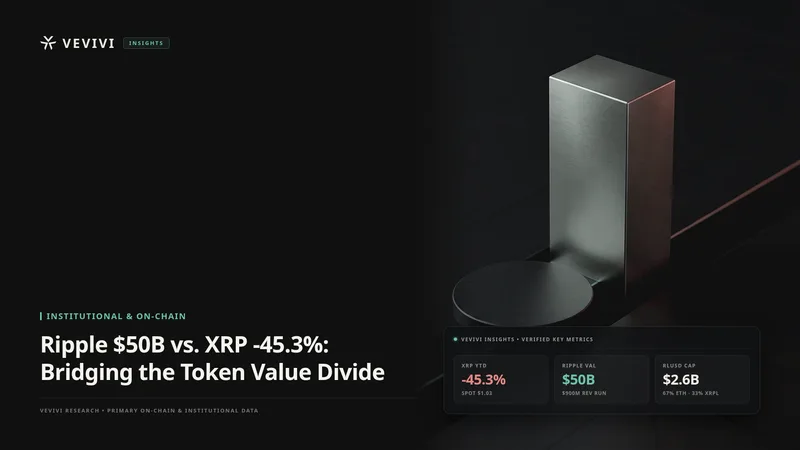
A striking structural divergence has emerged across institutional crypto markets: operating companies are posting record revenue and securing landmark banking charters while their native ecosystem tokens remain mired in multi-year drawdowns. Nowhere is this tension sharper than between Ripple, which has scaled into a regulated institutional financial powerhouse in 2026, and XRP, whose persistent underperformance has sparked open debate between long-term token holders and company leadership.
First, while Ripple achieved a $50 billion valuation and approaches a $900 million annualized product revenue run rate in 2026, spot XRP trades near $1.03 as of November 13, 2026—down 45.3% year-to-date and 71.8% below its July 2025 record high of $3.65, trading under heavy pressure.
Second, Ripple's $2.6 billion RLUSD stablecoin has captured institutional cross-border settlement demand while roughly 67% of its supply circulates on Ethereum rather than the XRP Ledger (XRPL), severing automatic pass-through from corporate partnerships to native token demand.
Third, closing the industry-wide divide between corporate equity and token value will hinge on transparent escrow supply discipline, activation of the XRPL native lending upgrade (XLS-66), and credible token value-accrual mechanisms.
A $50 Billion Corporate Giant vs. a 45.3% Token Drawdown
Throughout 2026, Ripple the corporate entity and XRP the digital asset have moved in opposite directions. According to Ripple's official October 28, 2026 operational disclosure, expansion across payments, custody, prime brokerage, and corporate treasury solutions has put the firm on track to exit 2026 with a $900 million annualized product revenue run rate. Private-market valuation has surged alongside operating scale: per Bloomberg and Fortune reporting, Ripple executed a $750 million share buyback tender offer in March 2026 at a $50 billion valuation, and on October 26, 2026 received final approval from the U.S. Office of the Comptroller of the Currency (OCC) to charter Ripple National Trust Bank.
Token holders face a starkly different reality. Based on Google Finance market data as of November 13, 2026, spot XRP trades around $1.03, reflecting a 45.3% decline from its start-of-year level ($1.88) and a 71.8% drop from its July 2025 peak ($3.65). Despite consistently ranking near the top of global retail spot volume—particularly on major South Korean exchanges—XRP is tracking toward its weakest annual performance since the 2022 bear market even amid a steady stream of enterprise partnership announcements.
That disconnect boiled over in early November 2026 when prominent community members publicly challenged CEO Brad Garlinghouse and CTO Emeritus David Schwartz, arguing that Ripple has prioritized RLUSD and institutional business lines while leaving XRP behind. Responding directly on November 3, Garlinghouse stated that RLUSD does not compete with XRP but rather with rival stablecoins, adding that he wants those settlement use cases running on the XRP Ledger. Although executives reiterated at the late-October Swell 2026 conference in New York that XRP remains Ripple's North Star, investors increasingly demand measurable economic linkage rather than symbolic rhetoric.
RLUSD's Surge to $2.6 Billion and the Limits of On-Chain Fee Capture
At the heart of holder frustration lies a fundamental shift in payment rails: RLUSD, Ripple's dollar-pegged stablecoin, now performs much of the cross-border settlement role originally envisioned for XRP as a volatile bridge currency. Per Ripple's official figures, RLUSD market capitalization reached approximately $2.6 billion by late October 2026, up more than 88% year-to-date. Major enterprise integrations signed in 2026 illustrate this pivot. On March 31, 2026, global B2B payments provider Convera—which processes roughly $190 billion in annual cross-border volume—partnered with Ripple using a fiat-to-stablecoin-to-fiat settlement architecture powered by RLUSD rather than XRP. Similarly, the May 6, 2026 cross-border tokenized U.S. Treasury (OUSG) redemption pilot conducted by Ondo Finance, Kinexys by J.P. Morgan, Mastercard, and Ripple connected the XRP Ledger with commercial bank rails without requiring XRP as an intermediary settlement asset.
Compliance and incident-response mechanics further reinforce institutional preference for issuer-controlled stablecoins. According to blockchain intelligence reports from TRM Labs and Elliptic on the October 29, 2026 Binance hot-wallet security breach—which drained roughly $6.36 billion across ten blockchains—attackers extracted approximately 233.46 million XRP alongside tens of millions in RLUSD. Ripple promptly exercised issuer-level controls to freeze 40.5 million RLUSD remaining in attacker-linked addresses, whereas native XRP carries no protocol-level issuer freeze function and was subsequently split across six external wallets. For regulated financial institutions, instantaneous freeze authority represents a decisive operational advantage.
Moreover, while Garlinghouse noted at Swell 2026 that Ripple's product suite supported over $16 trillion in transaction volume in 2025 and projected that migrating even 1% to 3% onto blockchain rails would transform network activity, current chain distribution tells a sobering story. Early November 2026 on-chain data indicates that roughly 67% of RLUSD supply resides on Ethereum, leaving only about 33% (roughly $900 million to $1 billion) on the XRP Ledger. Even if all RLUSD activity migrated onto XRPL, mechanical XRP lockup would remain modest: following the late-2024 reserve reduction, XRPL requires just a 1 XRP base account reserve, a 0.2 XRP trustline reserve, and negligible per-transaction fee burns, meaning billions of dollars in stablecoin turnover lock or burn only a tiny fraction of circulating XRP supply.
Equity Value Capture and Why Wall Street Bought Shares Instead of Tokens
Where, then, do the cash flows generated by Ripple's institutional expansion accrue? Under the current corporate structure, value flows to Ripple equity shareholders through three primary channels: equity valuation expansion from $11.3 billion in early 2024 to $50 billion in March 2026, multi-billion-dollar share repurchases, and reserve yield income. Under the U.S. GENIUS Act regulatory framework, regulated stablecoin issuers are barred from passing yield directly to stablecoin holders, allowing Ripple to retain the interest income earned on U.S. Treasury reserves backing $2.6 billion of RLUSD. XRP holders, by contrast, possess no dividend rights, fee-sharing claims, or equity ownership, leaving spot price appreciation as their sole return mechanism.
Heavyweight institutions on Wall Street recognized this asymmetry immediately. According to Ripple announcements and reporting by Bloomberg and The Block, when Citadel Securities and Fortress Investment Group led a $500 million strategic equity investment in November 2025 at a $40 billion valuation, participating funds assessed that over 90% of Ripple's net asset value derived from its XRP holdings—yet chose to buy protected corporate equity rather than spot XRP. Those terms included a put option guaranteeing a 10% annualized return if shares are sold back after three to four years, alongside liquidation preferences. The deal underscored David Schwartz's candid observation that a corporation is legally bound to act in the interest of its shareholders rather than sacrificing equity value for token holders.
Crucially, this equity-token disconnect is not unique to Ripple; it has become a structural fault line across institutional crypto companies integrating with Wall Street. Tokenized real-world asset (RWA) leader Ondo Finance saw its total value locked (TVL) surpass $4 billion in October 2026—growing roughly sixfold in two years—yet its governance-only ONDO token remains down more than 80% from its peak while an early-2026 community fee-accrual proposal remains stalled. Canton Network, which processes roughly $359 billion in average daily repo volume via Broadridge's Distributed Ledger Repo platform and went live with DTCC tokenization in October 2026, saw its native token drop roughly 50% from highs even as venture heavyweights led by Andreessen Horowitz (a16z) poured over $300 million into equity of parent developer Digital Asset in mid-2026. Even decentralized lending leader Aave faced governance turmoil in late 2025 when developer Aave Labs routed CoW Swap frontend integration fees to a corporate wallet rather than the DAO treasury.
Ironically, the legal blueprint behind this industry-wide separation stems from the July 2023 U.S. federal court summary judgment in SEC v. Ripple. By ruling that direct institutional XRP sales constituted unregistered securities offerings while blind programmatic exchange trades did not—because secondary buyers could not reasonably expect profits directly from Ripple's managerial efforts—the decision prompted crypto founders across the sector to ring-fence corporate revenue inside equity entities while leaving tokens inside foundations without cash-flow rights, a structural divide highlighted by The Block in March 2026.
Ripple's 36.8 Billion XRP Balance Sheet, IPO Incentives, and XRPL Upgrades
Despite this structural separation, a compelling financial alignment still binds Ripple to XRP's long-term valuation: Ripple remains the single largest holder of XRP on an entirely different scale from typical protocol labs. On-chain escrow and corporate wallet trackers show Ripple controlling roughly 36.8 billion XRP across time-locked escrow contracts (approximately 31.1 billion XRP following the November 1, 2026 relock) and operational wallets. Unlike RWA peers whose equity value rests primarily on recurring fee businesses, Ripple cannot sustain—let alone expand—a $50 billion valuation if the asset representing the vast majority of its balance sheet deteriorates. Furthermore, because investor put options from the late-2025 funding round approach maturity around 2028 to 2029, pursuing a public listing beforehand offers the cleanest exit path, creating a strong balance-sheet incentive to support higher XRP valuation ahead of any potential IPO.
Supply dynamics are also shifting as Ripple diversifies corporate revenue. With product revenue approaching a $900 million annualized pace and institutional equity financing available, Ripple faces far less operational pressure to liquidate treasury XRP than it did years ago. On November 1, 2026, Ripple unlocked its scheduled 1 billion XRP and promptly re-locked 700 million XRP into new escrow contracts maturing in 2029, capping net unlocked supply at 300 million XRP. Still, although U.S. spot XRP ETFs approved in March 2026 have accumulated roughly $1.68 billion in cumulative net inflows, slower autumn inflows highlight that monthly escrow capacity remains large relative to marginal spot demand—meaning formal, rule-based reductions in net escrow releases could materially tighten market float.
Simultaneously, protocol-level upgrades are emerging to create native holding and yield utility on the XRP Ledger. As of early November 2026, the XRPL native Lending Protocol amendment (XLS-66)—which enables single-asset vaults where XRP holders can supply liquidity for institutional credit and earn on-chain yield—has secured 23 of 35 trusted validator votes, approaching the 80% supermajority required over two weeks for mainnet activation. Complementing this technical push are Nasdaq-listed XRP treasury firm Evernorth Holdings (ticker XRPN, holding roughly 473 million XRP), Robinhood's October 27, 2026 partnership for XRPL-based RLUSD settlement at Bitstamp, expanded BNY custody and tokenized trade-finance initiatives, and growing cross-asset bridge demand across tokenized Treasuries, equities, and non-USD stablecoins.
Governance Precedents from Uniswap and Hyperliquid, Plus Balanced Outlook
Market history demonstrates that sustained holder pressure can compel major protocols to redesign token economics. Ripple itself established its original 55 billion XRP escrow lockup in 2017 to address community supply concerns. More recently, decentralized exchange Uniswap resolved years of fee-capture criticism in December 2025 by passing its UNIfication governance proposal with 99.9% approval, activating protocol fee switches and executing an on-chain burn of 100 million UNI. The Ethereum Foundation formalized transparent treasury sale rules with quarterly disclosures, while derivatives platform Hyperliquid routed nearly all protocol revenue into open-market HYPE buybacks and burns—eliminating more than $1.3 billion in supply by August 2026 and proving how decisively market participants reward direct value accrual.
Ultimately, XRP's medium-term trajectory depends on execution rather than partnership headlines. Under a constructive scenario, mainnet activation of XLS-66 unlocks native yield demand for idle XRP, while Ripple codifies stricter escrow release caps or introduces regulatory-compliant token burn and buyback mechanisms—allowing institutional adoption of Ripple Prime, Ripple Treasury, and RLUSD to translate into tighter XRP supply-demand fundamentals. Conversely, key downside risks persist: if commercial bank-issued deposit tokens launching around 2027 and Ethereum-based stablecoins cement dominance over cross-border settlement, and if monthly 300 million XRP net escrow unlocks continue without structural fee capture, the decoupling between Ripple's corporate valuation and XRP's market price could endure. In a maturing regulatory climate where sovereign crypto bans have receded, investors should monitor verifiable supply lockups, validator governance outcomes, and value-accrual reforms above all else.
Q1. Does rising adoption of Ripple's RLUSD stablecoin automatically push XRP's price higher?
A1. Not automatically. Roughly 67% of RLUSD's $2.6 billion supply currently circulates on Ethereum, and even on the XRP Ledger, low reserve thresholds (1 XRP base reserve and 0.2 XRP per trustline) alongside microscopic transaction fee burns absorb very little XRP supply. Meaningful price transmission requires native XRP capital lockups via upgrades like the XLS-66 lending protocol, deeper bridge liquidity across heterogeneous tokenized assets, or explicit escrow supply reductions.
Q2. Why did Wall Street institutions invest in Ripple private shares rather than buying XRP on the open market?
A2. Corporate equity holds legal claims to operating revenue, share buybacks, and U.S. Treasury reserve yield earned on RLUSD collateral, whereas XRP carries no cash-flow or dividend rights. In Ripple's $500 million November 2025 funding round at a $40 billion valuation, institutional investors also negotiated downside protections—including a 10% annualized put option and liquidation preferences—gaining structured exposure to Ripple's XRP-heavy balance sheet without unprotected spot volatility.
Disclaimer and Risk Warning
This article is provided strictly for informational and educational purposes based on publicly available on-chain metrics and macroeconomic data. Nothing in this publication constitutes financial, investment, legal, or tax advice, nor should it be construed as a solicitation, recommendation, or offer to buy or sell any digital asset or financial instrument. Digital assets are subject to high market risk and extreme price volatility, and you may lose part or all of your invested capital. Historical market cycles and past performance referenced herein do not guarantee future results. You are solely responsible for your own investment decisions and should conduct independent research and consult a qualified financial advisor before making any financial commitments.