Every Wednesday from June 12 through December 31, 1968, the New York Stock Exchange (NYSE) took the extraordinary step of shutting its trading floor for the entire day. The closures were triggered not by a lack of buyer demand, but by a physical settlement bottleneck: surging equity volumes overwhelmed manual delivery of paper stock certificates, leaving back offices buried under more than $4 billion in unprocessed trades. According to Securities and Exchange Commission (SEC) historical records, roughly 160 NYSE member brokerage firms failed, merged, or liquidated during that operational crunch, directly catalyzing the 1973 creation of the Depository Trust Company (DTC), the core depository arm of today's DTCC.
Fifty-eight years later, in November 2026, the exchange that once closed midweek to clear paper backlogs is building infrastructure for the exact opposite regime: continuous 24/7/365 trading in tokenized securities. On November 2, 2026, the NYSE expanded its transfer agent collaborator network for its planned tokenized securities venue to six institutions. Notably, three of the four newly added firms are not crypto startups, but legacy Wall Street transfer agents that have maintained official corporate shareholder registries for decades. Just as ledger capacity halted markets in 1968, control over the legally recognized shareholder ledger now defines who can unlock round-the-clock on-chain capital markets.
Why the NYSE Recruited Wall Street’s Registry Giants First
The NYSE’s transfer agent expansion represents a deliberate issuer-onboarding strategy rather than a routine technology vendor partnership. As traditional exchanges extend operating hours and rebuild post-trade rails simultaneously, recent market friction has demonstrated that liquid U.S. equity tokenization cannot scale without issuer participation.
Six Transfer Agent Partners Covering 99% of the S&P 500
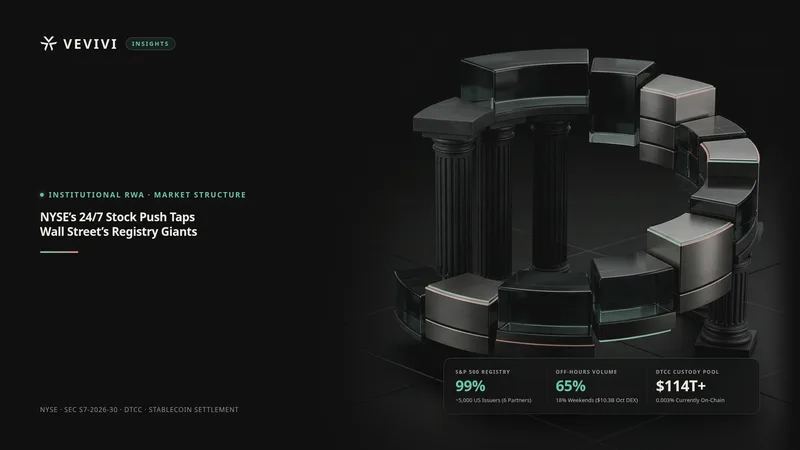
Per the NYSE’s November 2 announcement, Broadridge Financial Solutions, Computershare, Equiniti, and blockchain-native tokenization firm Superstate have joined earlier collaborators Securitize and tZERO to form a six-party transfer agent network supporting the exchange’s planned tokenized venue. Crucially, the three incumbent transfer agents—Broadridge, Computershare, and Equiniti—collectively administer shareholder registries and corporate governance services for nearly 5,000 U.S.-listed public companies, encompassing roughly 99% of S&P 500 constituents.
First outlined in January 2026, the proposed NYSE platform is engineered for 24/7 trading, near-instant settlement, fractional orders sized in U.S. dollar amounts, and stablecoin-based funding, while preserving full fungibility with traditional shares so holders retain identical dividend and proxy voting rights. In parallel, conventional equity venues are extending their schedules: both the Nasdaq Stock Market and NYSE Arca are slated to launch 23-hour, five-day-a-week (23/5) trading sessions beginning December 6, 2026 at 9:00 p.m. ET. Continuous equity market structure is therefore advancing along two parallel tracks—extended hours on legacy matching engines and native on-chain settlement venues.
Corporate Opt-Outs Against Unconsented Tokens and Bullish’s $4.2B Equiniti Deal
Bringing established transfer agents to the forefront directly addresses the corporate backlash that recently stalled third-party, unconsented stock tokenization. Under the five-year conditional Innovation Exemption issued by the SEC on September 17, 2026, Tokenized Securities Venues listing shares tokenized by an unaffiliated third party must give the underlying issuer 30 days’ written notice, during which the company can object and block the listing. When OKXICE—the joint venture between crypto exchange OKX and NYSE parent Intercontinental Exchange (ICE)—proposed listing tokenized U.S. equities under that third-party structure, 43 of the 62 initially noticed companies exercised opt-outs, and preemptive objections pushed total corporate refusals past 50 issuers by early November (reaching 67 U.S. companies, including Nvidia, Microsoft, Apple, JPMorgan Chase, Walmart, and Nike, by mid-November).
Issuer-Sponsored Tokens (ISTs), by contrast, face no opt-out barrier because the public company itself authorizes the tokenized share class. Transfer agents that already run shareholder recordkeeping and proxy voting (such as Broadridge’s ProxyVote infrastructure) serve as the natural institutional bridge to bring blue-chip issuers on-chain. Underscoring the strategic value of registry ownership, NYSE-listed crypto exchange Bullish (NYSE: BLSH) signed a definitive agreement on May 5, 2026, per its SEC Form 6-K filing, to acquire Equiniti—the system of record for nearly 3,000 public issuers—in a $4.2 billion transaction.
SEC Rulemaking Modernization and the 24/7 Stablecoin Settlement Engine
Scaling regulated tokenized equities requires two foundational pillars: legal recognition of distributed ledgers as official shareholder records and programmable cash rails capable of settling trades instantly when commercial bank wires are offline. Both components are converging across U.S. regulatory and market infrastructure channels.
The SEC Transfer Agent Proposal and the Innovation Exemption Debate
On September 1, 2026, the SEC proposed a sweeping modernization of registered transfer agent rules (File No. S7-2026-30, Release No. 34-106246)—the first comprehensive overhaul since those rules were adopted in the late 1970s. The proposal explicitly contemplates distributed ledger technology serving as a security’s official master securityholder file, provided the registered transfer agent maintains operational control and risk-management safeguards. Notably, the NYSE announced its six-partner transfer agent alliance on November 2, exactly one day before the proposal’s November 3, 2026 public comment deadline. Investors should note, however, that November 3 marked the close of the public comment window rather than final rule adoption; formal implementation still requires SEC review of submitted comments and a final Commission vote.
The Commission’s reliance on administrative rulemaking and Section 36 exemptive relief followed the U.S. Senate’s failure to advance the CLARITY Act in mid-September 2026, prompting SEC Chairman Paul Atkins to advance market-structure modernization within the agency’s existing statutory authority. While administrative action accelerates deployment without waiting for congressional legislation, it also carries durability risks if future Commission leadership revisits conditional orders. Market makers and trade groups—including Citadel Securities and the Securities Industry and Financial Markets Association (SIFMA)—have urged the SEC to subject tokenized trading exemptions to formal notice-and-comment safeguards, strict investor-protection standards, and unified market-integrity rules.
Proven Off-Hours Equity Demand, USDC Rails, and the GENIUS Act
In a 24/7 equity market, the true operational bottleneck is not order matching, but round-the-clock cash settlement. Even where domestic instant bank transfers exist, atomic delivery-versus-payment (DvP) against tokenized shares on a blockchain requires on-chain dollar liquidity. According to an October 2026 study by on-chain analytics firm Bitquery covering $10.3 billion in monthly decentralized exchange (DEX) tokenized stock and ETF volume across six issuers, 65% of all trading occurred outside regular U.S. equity market hours, including 18% over weekends between Friday at 8:00 p.m. ET and Sunday at 8:00 p.m. ET—confirming substantial global demand for off-hours U.S. equity execution.
While the NYSE has not yet named an exclusive settlement asset, parent company ICE signed a memorandum of understanding with Circle to explore integrating the USDC stablecoin and Circle’s tokenized money market fund (USYC) across ICE venues and clearinghouses. Moreover, the federal GENIUS Act and final implementing regulations from the Office of the Comptroller of the Currency (OCC) take effect on January 18, 2027, requiring permitted U.S. payment stablecoins to maintain 1:1 reserves in cash and short-term U.S. Treasury bills maturing in 93 days or less—strictly insulating settlement stablecoins from the duration volatility of 10-year and 30-year Treasury bonds. Once integrated into regulated equity settlement, compliant stablecoins transition from crypto-native trading pairs into core capital-market settlement rails.
Blockchain Infrastructure Competition and the Battle Over the Official Ledger
Competition across Wall Street’s tokenization buildout now centers on two intertwined questions: how private clearing ledgers connect to public blockchains, and whether depository wrappers or issuer-native registries become the market standard.
Permissioned Avalanche Clearing and Multi-Chain Partner Rails
Rather than placing core post-trade matching directly onto an unpermissioned network, the NYSE opted for a dual-layer architecture: a private, permissioned ledger controlled by the exchange for core clearing and settlement, paired with external interoperability across institutional wallets, transfer agents, and public chains. Following the initial partner announcement, reports on November 9, 2026 confirmed that the NYSE selected Avalanche technology to power this private, permissioned clearing and settlement ledger, targeting launch pending regulatory approval.
Across the outer issuance and settlement layer, NYSE collaborators already operate live, high-throughput blockchain infrastructure. On November 2, Securitize expanded its 1:1-backed tokenized U.S. equity lineup on Solana to 25 stocks settling in USDC, slated for future compatibility with the NYSE venue. Broadridge’s Distributed Ledger Repo (DLR) platform, running on the institutional Canton Network, processed $7.6 trillion in monthly repo volume—averaging $345 billion per day—in October 2026. Meanwhile, tZERO obtained Commodity Futures Trading Commission (CFTC) derivatives clearing organization registration in October and announced a $350 million business combination agreement with Nasdaq-listed FG Imperii Acquisition Corp. on November 2, 2026 to go public.
DTCC Depository Digital Twins Versus Issuer-Sponsored Equity Tokens
A parallel institutional push from the DTCC and Nasdaq has sparked an architectural contest over what constitutes a true tokenized share. Following a December 2025 SEC staff No-Action Letter, DTC launched its official DTCC Tokenization Service on October 28, 2026 on the Canton Network and a private ledger—with Solana integration slated for the second half of 2027—creating digital twins of eligible securities held inside DTC’s $114 trillion-plus custody pool. However, Computershare argued in a formal July 2026 submission to the SEC that DTC-minted tokens represent tokenized security entitlements (akin to depository receipts) rather than native shares issued directly on the company’s official shareholder register.
That distinction carries direct consequences for investor rights. Many offshore tokenized stock wrappers currently trading on crypto venues lack shareholder voting rights and distribute dividend equivalents indirectly rather than paying native corporate dividends. Once regulated exchanges list fungible tokens carrying full governance and dividend entitlements, liquidity is likely to gravitate toward full-rights instruments. Recognizing that shift, Nasdaq invested $100 million in Kraken parent Payward in September 2026, targeting a second-quarter 2027 launch for issuer-centric Nasdaq Equity Tokens (NETs).
Lessons from Past Failures and Conditions for Public-Chain Value Capture
Institutional adoption of blockchain rails does not automatically translate into immediate token price windfalls for every underlying network. Historical precedents and recent real-world asset (RWA) launches highlight both structural risks and clear conditions for value accrual.
Liquidity Fragmentation Lessons from Switzerland’s SIX Digital Exchange
Regulated licensing alone does not guarantee market liquidity, as illustrated by Switzerland’s SIX Digital Exchange (SDX). Despite becoming one of the world’s first fully licensed distributed-ledger stock exchanges and central securities depositories under Swiss regulator FINMA in September 2021, SDX struggled to attract deep secondary-market liquidity onto an isolated venue. Consequently, SIX Group consolidated digital bond trading back onto the main SIX Swiss Exchange in 2025 and obtained FINMA approval on May 5, 2026 to merge SDX’s digital depository into its traditional central securities depository, SIX SIS AG. Whereas Binance’s short-lived 2021 stock token offering failed within months because it operated outside securities regulation, SDX demonstrated that even fully licensed venues risk stagnation if liquidity is siloed away from primary order books.
Even so, Wall Street’s persistence reflects the sheer scale of the untapped market. According to RedStone and industry RWA tracking, tokenized equities currently total roughly $3.2 billion to $4.0 billion in market value—representing approximately 0.003% of the more than $114 trillion in securities custodied at the DTCC. Tokenized U.S. Treasuries offer a blueprint for institutional scaling: following the March 2024 launch of BlackRock’s BUIDL fund with Securitize, the tokenized Treasury sector expanded from under $1 billion to roughly $15 billion to $16 billion in the second half of 2026.
What Robinhood and Arbitrum Reveal About Equity Versus Token Returns
The 16-month trajectory following Robinhood’s European stock token rollout provides an empirical benchmark for how equity shares and public-chain tokens react to tokenization milestones. When Robinhood unveiled more than 200 U.S. stock and ETF tokens on Arbitrum One on June 30, 2025 alongside plans for a dedicated Arbitrum-based Layer 2, Robinhood (HOOD) shares surged 12.8% on the day (closing at $93.63 from $83.03) and pushed past $100 shortly thereafter, whereas Arbitrum’s ARB token suffered a sharp sell-the-news pullback following its pre-event rally. Sustained fundamental repricing for Arbitrum materialized only after Robinhood Chain went live on public mainnet on July 1, 2026—returning 10% of net protocol revenue to the Arbitrum ecosystem—and monthly tokenized stock volume jumped from $526 million in July to $11.31 billion in September 2026.
Because the NYSE is placing its core clearing and settlement engine on a private, permissioned Avalanche ledger rather than settling primary matches directly on a public Layer 1, native token fee capture may be more indirect at launch than in public-chain-first rollouts. In the near term, publicly traded exchange operators and market-infrastructure providers stand in the most direct path of revenue capture. Over the medium to long term, however, as trillions of dollars in traditional assets validate blockchain settlement across ecosystems such as Ethereum, Solana, Avalanche, and Canton, public networks that begin as external settlement and custody rails gain the institutional credibility needed to evolve into primary capital-market venues in their own right.
Key Questions and Answers
Why did dozens of major U.S. corporations block OKXICE tokenized stocks while the NYSE’s transfer agent model advances?
When an unaffiliated third party tokenizes custodied shares without corporate authorization, issuers face fragmented visibility into beneficial ownership, corporate actions, and proxy voting mechanics. Utilizing the 30-day objection right under the SEC’s September 17, 2026 Innovation Exemption, dozens of blue-chip firms blocked third-party listings. By partnering directly with the six transfer agents that already maintain official shareholder records for 99% of the S&P 500, the NYSE is building a compliant pathway for issuer-authorized tokenization.
Did the November 3, 2026 deadline finalize the SEC’s blockchain shareholder registry rules?
No. November 3, 2026 marked the close of the public comment period for the SEC’s proposed transfer agent modernization rule (File No. S7-2026-30), originally issued on September 1, 2026. The Commission must review public submissions and vote to adopt a final rule before the updated blockchain recordkeeping framework takes permanent legal effect.
Will the NYSE’s 24/7 tokenized platform immediately drive rallies in public blockchain tokens?
Headline partnership announcements frequently trigger short-term sell-the-news volatility, as demonstrated during the June 2025 Robinhood-Arbitrum unveiling. Because the NYSE’s core clearing ledger uses a private, permissioned Avalanche architecture while connecting external chains at the custody and issuance perimeter, durable value accrual for public tokens will depend on measurable on-chain settlement volume and protocol fee-sharing rather than initial press releases.
Disclaimer and Risk Warning
This article is provided strictly for informational and educational purposes based on publicly available on-chain metrics and macroeconomic data. Nothing in this publication constitutes financial, investment, legal, or tax advice, nor should it be construed as a solicitation, recommendation, or offer to buy or sell any digital asset or financial instrument. Digital assets are subject to high market risk and extreme price volatility, and you may lose part or all of your invested capital. Historical market cycles and past performance referenced herein do not guarantee future results. You are solely responsible for your own investment decisions and should conduct independent research and consult a qualified financial advisor before making any financial commitments.