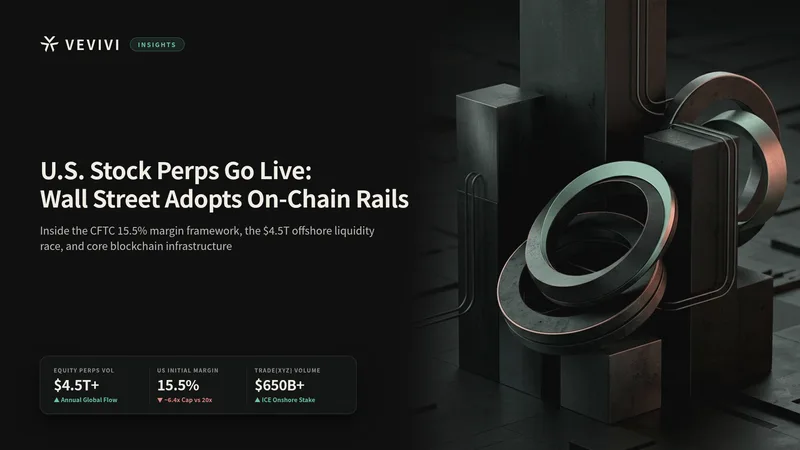
The U.S. Commodity Futures Trading Commission (CFTC) has cleared federally regulated exchanges to list perpetual futures on individual U.S. equities, allowing traders to hold leveraged long or short exposure to flagship New York Stock Exchange (NYSE) and Nasdaq names such as Nvidia, Apple, and Tesla without contract expiration. First pioneered on offshore digital asset venues in May 2016, the perpetual swap has crossed from crypto's regulatory perimeter into the core architecture of U.S. capital markets.
Far more than a routine product listing, the clearance reflects a strategic effort by Washington regulators and institutional operators to reclaim 24-hour equity price discovery from offshore venues. While incumbent exchange groups have split sharply between federal litigation and direct equity stakes in decentralized perpetual protocols, both camps rely increasingly on blockchain-native components—spanning low-latency price oracles, multi-asset clearinghouses, and Layer-2 distribution networks.
From Offshore Crypto Invention to Federally Regulated U.S. Equities
Introduced by BitMEX in May 2016, perpetual futures eliminated fixed expiration dates by using periodic funding-rate payments between longs and shorts—reinforced by institutional cash-and-carry basis trade arbitrage—to tether derivative prices to underlying spot markets. Although U.S. authorities indicted BitMEX's founders in October 2020 over Bank Secrecy Act compliance failures, President Donald Trump's March 2025 pardons of BitMEX's co-founders signaled a broader pivot from offshore exclusion toward onshore regulatory integration.
An Eight-Month SEC and CFTC Harmonization Roadmap Under Regulation 40.3
The November 2026 launch followed a deliberate eight-month interagency sequence. On March 11, 2026, Securities and Exchange Commission (SEC) Chairman Paul S. Atkins and CFTC Chairman Michael S. Selig signed a landmark Memorandum of Understanding acknowledging that fragmented turf wars and duplicative registrations had pushed market innovation offshore. On May 29, 2026, the CFTC approved Kalshi's regulated Bitcoin perpetual contract (BTCPERP) and simultaneously published a policy statement establishing case-by-case review under CFTC Regulation 40.3 for perpetual derivatives referencing non-crypto asset classes.
Acting on that framework, four CFTC-regulated platforms—Kalshi, Coinbase Derivatives, Payward-owned Bitnomial, and Crypto.com's Nadex (operating as OG.com)—filed single-stock perpetual rules on September 18, 2026. Once the 45-day statutory review expired without objection, Chairman Selig confirmed eligibility on November 3, 2026, and Kalshi launched regulated perpetuals on more than 50 major U.S. equities on November 5, generating over $300 million in opening-morning volume.
Wall Street Splits Between Federal Court Challenges and On-Chain Acquisition
Legacy derivatives incumbents reacted in diametrically opposed ways. CME Group ($317.97 close on November 13, ~$113.8 billion market cap) sued the CFTC and Chairman Selig on June 18, 2026, arguing that non-expiring contracts legally constitute swaps rather than futures. On November 3, the Capital Markets Alliance Association—backed by Cboe Global Markets and Citadel Securities—filed suit in the Southern District of New York seeking an emergency halt on single-stock perpetuals as security-based swaps. Although the federal judge denied a temporary restraining order, the court noted substantial statutory questions remain; on November 9, the SEC filed an amicus curiae brief backing CFTC joint security-futures oversight alongside a six-firm industry brief led by Coinbase, Kalshi, and Payward.
By contrast, NYSE parent Intercontinental Exchange (ICE, $178.51 close, ~$99.8 billion market cap) moved to co-opt decentralized perpetual infrastructure directly. Following President Trump's August 19 White House summit remarks highlighting CFTC efforts to bring Hyperliquid onshore legally, ICE announced a definitive agreement and strategic stake on October 29, 2026 alongside billionaire investor Stanley Druckenmiller in Trade[XYZ]—the Hyperliquid-based perpetual deployer—to build a regulated U.S. retail clearing venue (ICE[XYZ]). Whether suing to slow adoption or buying the underlying engine, Wall Street incumbents share the conviction that perpetual market structure is structurally reshaping equity derivatives.
Reclaiming $4.5 Trillion in Offshore Price Discovery Amid Margin Constraints
At the heart of Washington's pivot is a structural vulnerability: when macro or corporate catalysts break overnight or on weekends, offshore perpetual order books reprice U.S. megacap stocks immediately, turning the Monday morning NYSE and Nasdaq opening bell into a lagging indicator of offshore derivative flows.
Offshore Equity Perpetual Dominance Across Binance and Hyperliquid
According to Kalshi market data, global single-stock perpetual futures already exceed $4.5 trillion in annual trading volume across offshore venues. Official Binance disclosures show monthly TradFi perpetual futures volume surged roughly 15-fold from $29.5 billion in January 2026 to $433.4 billion in August 2026, while total centralized crypto exchange stock-perpetual volume hit $665.4 billion that same month. On-chain, Trade[XYZ] surpassed $650 billion in cumulative volume on Hyperliquid—accounting for 55% of Hyperliquid's platform activity in August, with Coin Metrics data confirming AI and semiconductor equities drove more than half of daily turnover.
Crucially, U.S. residents were contractually barred from trading U.S. equities on those offshore venues. When Binance suffered a record hot-wallet security breach on October 29, 2026—with estimated outflows between $2.7 billion and $6.3 billion before over $2.83 billion in stablecoins were frozen and user balances were covered by the exchange—Chairman Selig told CNBC on October 30 that the episode underscored why liquidity belongs inside federally supervised U.S. clearinghouses. Notably, Bitcoin ($64,153 as of November 14 UTC) absorbed the shock without systemic contagion, reflecting market recognition that custody risk is venue-specific rather than a flaw in perpetual settlement mechanics.
The 15.5% Minimum Margin Rule and Lessons From OneChicago
Bringing regulated contracts onshore does not automatically drain offshore dry powder overnight. Kalshi's regulated crypto perpetuals topped $5.5 billion in volume within two weeks of their May 2026 debut, yet global liquidity leadership remained offshore where leverage is higher. U.S. regulators also face the historical cautionary tale of OneChicago, the joint-venture single-stock futures exchange that operated from 2002 until closing in September 2020 largely because a strict 20% initial margin rule (capping leverage at 5x) stifled capital efficiency—a threshold regulators lowered to 15% only after the venue shut down.
Under current U.S. security-futures rules, Kalshi's single-stock perpetuals require a 15.5% minimum initial margin—equating to roughly 6.4x maximum leverage—and pause trading over weekends between Friday afternoon and Sunday evening. Offshore competitors still offer 10x to 20x leverage and uninterrupted 24/7 execution. However, pausing over weekends shields U.S. venues from thin off-hours order-book anomalies that have triggered flash liquidations abroad, creating a regulated middle ground for institutional and compliance-mandated capital.
Four On-Chain Infrastructure Layers Powering Equity Perpetuals
Even when branded and cleared by regulated U.S. exchanges, continuous equity derivatives depend on programmable blockchain rails for sub-second pricing, collateral mobility, and retail wallet distribution. Filtering strictly for infrastructure actively deployed by the U.S. perpetual applicants reveals four foundational pillars.
Institutional Equity Oracles and the 135.5-Hour Off-Market Gap
In leveraged perpetual markets, a single stale or manipulated tick can trigger cascading liquidations across thousands of accounts. Chainlink (LINK, trading near $8.68 on November 14 UTC) serves as the official oracle standard across Coinbase's Base tokenized equities (B20 standard launched August 24, 2026), Robinhood Chain (launched July 1, 2026), Kraken's xStocks tokenized equity suite, and decentralized perpetual venue Lighter—positioning its price feeds to scale regardless of whether onshore or offshore venues capture volume share.
Pyth Network (PYTH) has simultaneously built direct data pipes from Wall Street matching engines onto blockchain rails. After Nasdaq selected Pyth on June 30, 2026 to distribute full TotalView depth-of-book order data on-chain, Pyth secured distribution rights across five NYSE exchanges on November 12, 2026. Complementing both, RedStone focuses specifically on the 135.5 hours each week when traditional U.S. cash equity markets are closed, synthesizing derivative liquidity signals to price off-hours risk accurately.
Licensed Clearing Stacks, Collateral Rails, and Layer-2 Economics
On the licensing front, Kraken parent Payward announced an acquisition of up to $550 million for Bitnomial on April 17, 2026 (completed May 1), securing a full U.S. Designated Contract Market (DCM), Derivatives Clearing Organization (DCO), and Futures Commission Merchant (FCM) stack. Since November 2025, Bitnomial has accepted Ripple USD (RLUSD) and XRP ($0.91 on November 14 UTC) as institutional margin collateral alongside physically delivered XRP futures, and on April 15, 2026 it launched the first U.S.-regulated futures on Injective (INJ)—a Layer-1 network already hosting active on-chain equity perpetual markets. Whether joint SEC–CFTC security-futures margin rules will extend crypto collateral eligibility directly to single-stock perpetual accounts remains unconfirmed and warrants close monitoring.
In retail distribution, Robinhood (HOOD, $77.86 close, ~$70.1 billion market cap) integrated Lighter perpetuals into its wallet ecosystem and launched Robinhood Chain as an Arbitrum Orbit Layer-2 (~$1.09 billion DeFi TVL in early November per DefiLlama). Under the Arbitrum Expansion Program, 10% of net sequencer revenue—8% to the Arbitrum DAO treasury and 2% to the Developer Guild, totaling roughly $4.77 million through November 6—flows to Arbitrum, though ARB (~$0.16) currently lacks direct fee burn or holder distribution and monthly chain gas fees cooled sharply after September's peak. Meanwhile, Robinhood's September 8, 2026 minority equity stakes in Crypto.com and its CFTC-regulated OG.com venue connected retail brokerage order flow to the only U.S. single-stock perpetual applicant backed by an ecosystem token, Cronos (CRO, ~$0.043).
Conditional Market Scenarios and Structural Risks Ahead
The arrival of federally regulated U.S. equity perpetuals marks a milestone in capital-market convergence, yet durable value capture hinges on pending federal court rulings and disciplined tokenomics analysis.
Weighing Institutional Liquidity Expansion Against Legal and Accrual Risks
In a constructive scenario, sustained SEC–CFTC alignment prevails in the Southern District of New York, institutional market makers narrow onshore spreads, and gradual margin and collateral refinements expand total perpetual open interest across both ICE[XYZ] and regulated DCM platforms—directly compounding demand for institutional oracle feeds and cross-margin settlement layers.
Conversely, key downside risks require discipline. Because the federal judge who denied an emergency halt signaled that plaintiffs raised serious statutory questions over security-based swap classification, an adverse merits ruling could force rule rewrites or stricter SEC margin regimes. Investors must also avoid equating exchange equity deals or sequencer activity with automatic token upside where protocol treasuries lack direct buyback, burn, or fee-sharing mechanics.
Key Institutional Questions Answered
The following overview addresses core structural questions surrounding U.S. single-stock perpetual futures and their blockchain infrastructure links.
How Do U.S. Single-Stock Perpetuals Differ From Cash Equities and Standard Futures?
Unlike cash shares or options, single-stock perpetuals require no share borrowing for short positions, carry no option time decay, and eliminate quarterly futures rollover fees through periodic funding payments. On U.S.-regulated venues, leverage is capped near 6.4x via a 15.5% minimum initial margin with central clearinghouse protection and no payment for order flow.
Why Did CME Group Sue Regulators While NYSE Parent ICE Backed Hyperliquid?
CME Group and Cboe derive core franchise margins from incumbent futures and options clearing monopolies that low-cost perpetuals threaten to compress, motivating legal challenges over swap classification. ICE, anchored in cash equities via the NYSE, opted instead to capture global retail perpetual demand onshore by partnering with Trade[XYZ] on Hyperliquid infrastructure.
What Must Investors Verify Before Pricing Infrastructure Token Exposure?
Market participants should verify three distinct factors through primary filings: whether oracle usage translates into recurring protocol fee demand, whether CFTC digital-asset collateral approvals legally extend to joint SEC–CFTC equity futures accounts, and whether Layer-2 revenue-sharing agreements include direct tokenholder distribution rather than passive DAO treasury accumulation.
Disclaimer and Risk Warning
This article is provided strictly for informational and educational purposes based on publicly available on-chain metrics and macroeconomic data. Nothing in this publication constitutes financial, investment, legal, or tax advice, nor should it be construed as a solicitation, recommendation, or offer to buy or sell any digital asset or financial instrument. Digital assets are subject to high market risk and extreme price volatility, and you may lose part or all of your invested capital. Historical market cycles and past performance referenced herein do not guarantee future results. You are solely responsible for your own investment decisions and should conduct independent research and consult a qualified financial advisor before making any financial commitments.