Ethereum's slide below the $2,000 psychological threshold toward $1,909 has placed intense balance-sheet pressure on the publicly traded digital asset treasury firms that fueled last summer's rally. Following Nasdaq-listed blockchain infrastructure company BTCS Inc.'s third-quarter Form 10-Q filing with the U.S. Securities and Exchange Commission (SEC)—disclosing below-cost Ether sales to defend its decentralized finance (DeFi) loan health on Aave—market participants are divided over whether corporate deleveraging marks the start of a broader cascade or the final stage of seller exhaustion.
While surface headlines have sparked fears of institutional abandonment, primary SEC filings, derivatives liquidation logs, and U.S. spot exchange-traded fund (ETF) flow data reveal a more nuanced transition. Late-cycle leveraged entrants and overextended perpetual futures bulls have largely been flushed out, shifting market price discovery squarely onto U.S. spot Ethereum ETFs and flagship corporate holder BitMine Immersion Technologies.
Inside BTCS's DeFi Leverage Defense and Below-Cost Ethereum Sales
Small- and mid-cap public companies that combined at-the-market equity issuance, convertible notes, and on-chain borrowing during the 2025 treasury boom have become the first casualties of tighter collateral math.
How BTCS's $64.1 Million Aave Position Faces a $1,717 Liquidation Threshold
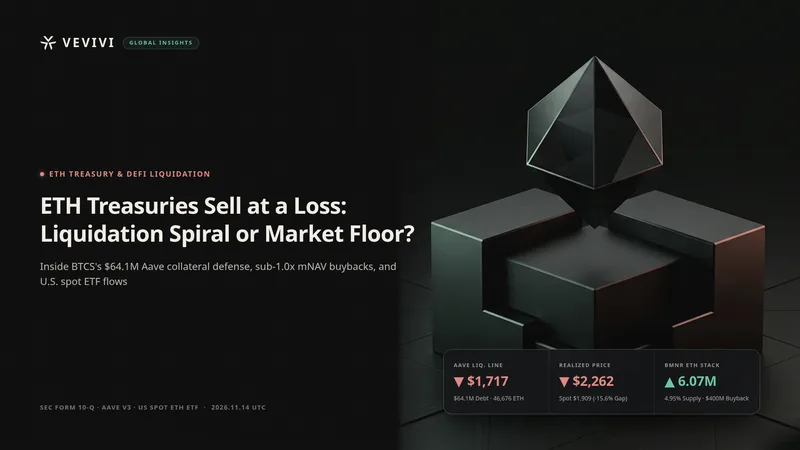
According to BTCS's Q3 2026 Form 10-Q accepted by SEC EDGAR on November 12, 2026, the company recorded $30.61 million in realized losses on digital asset transactions during the first nine months of 2026, contributing to a nine-month net loss of $49.53 million. Contrary to viral market rumors claiming a complete treasury exit, the filing confirms that BTCS did not liquidate its entire position: as of November 9, 2026, the company still pledged 46,676 ETH (valued at $99.3 million at $2,127 per ETH) as collateral backing $64.1 million in Aave protocol loans.
The forced sales stemmed from razor-thin liquidity buffers and tightening collateral ratios. BTCS ended September 30, 2026 with just $463,250 in unrestricted cash against $14.51 million in current convertible notes, while nearly all of its fair-value Ether remained locked inside Aave smart contracts. Because Aave generally applies an 80% liquidation threshold to ETH collateral, holding debt and collateral constant places BTCS's estimated liquidation trigger near $1,717 per ETH. With spot Ether falling toward $1,909, its Aave health factor compressed into the 1.11 to 1.14 zone—leaving roughly a 10% buffer above the 1.0 automatic liquidation floor and compelling management to sell ETH below cost preemptively.
BTCS originally pioneered direct corporate borrowing on Aave to capture a steep financing spread: whereas middle-market public firms face 11% to 14% annual interest rates on traditional commercial credit, DeFi stablecoin borrowing cost roughly 4% annualized. Consequently, BTCS's partial sales represent defensive deleveraging designed to preserve its remaining Ether reserve and validator operations rather than a strategic exit from Ethereum.
Wall Street Margin Cure Windows Versus Unforgiving 24/7 Smart Contracts
On-chain corporate leverage carries structural risks absent from traditional equity markets. Under Federal Reserve Regulation T and FINRA Rule 4210 in U.S. securities markets, leveraged positions operate within defined trading sessions, market-wide circuit breakers, and structured broker margin-call cure periods that typically span multiple business days unless house risk limits intervene. By contrast, Aave smart contracts operate 24 hours a day, 365 days a year without market closes, discretionary grace periods, or regulatory forbearance—auctioning collateral automatically the instant a borrower's health factor breaches 1.0.
When continuous smart-contract liquidations collide with perpetual futures leverage, downside wicks intensify rapidly. On-chain tracking via Lookonchain and Hyperdash shows a prominent Hyperliquid whale saw a remaining 56,667 ETH long fully liquidated across November 8 and 9 for $44.78 million in cumulative account losses, followed on November 12 by the full liquidation of a $493 million combined BTC and ETH whale long position. Historically, while perpetual futures cascades exaggerate downside volatility, they also clear out overleveraged longs and set the stage for sharp short-covering rebounds.
Corporate Treasury Shakeout and the Reversal of the mNAV Flywheel
Evaluating whether corporate selling will persist requires examining how many leveraged treasury entrants still hold disposable inventory.
Why Sub-1.0x mNAV Halts Equity-Funded Accumulation and Spurs Buybacks
The corporate crypto treasury playbook popularized by Michael Saylor's Strategy relies on a market-cap-to-net-asset-value multiple (mNAV) above 1.0x. When shares trade at a premium to underlying coin holdings, issuing new stock to buy crypto increases tokens per diluted share. Once mNAV slips below 1.0x during a downturn, issuing equity dilutes existing shareholders, inverting the flywheel so that deploying dry powder or asset sale proceeds to repurchase discounted shares becomes mathematically accretive.
That inversion now spans the Ethereum treasury sector. BTCS trades near a $47.69 million equity market capitalization, while industry leader BitMine Immersion Technologies carries an $11.01 billion NYSE market cap despite holding roughly 6.07 million ETH—pushing its equity below 1.0x net asset value. Under sub-par mNAV conditions, corporate treasuries cease acting as aggressive marginal buyers and pivot toward balance-sheet defense and share buybacks.
From FG Nexus's Full Exit to AI Data Center Pivots: Evidence of Seller Exhaustion
Crucially, most secondary companies that chased the summer 2025 treasury wave have already capitulated. Nasdaq-listed FG Nexus accumulated a peak of 50,770 ETH between August and September 2025 at an average cost of $3,860, only to liquidate 100% of its digital assets by June 30, 2026 at a $45.2 million net loss—having earned just $144,000 in staking rewards—before pivoting back to real estate as Peter Thiel's Founders Fund exited its entire equity stake.
Similarly, Tokyo-listed Quantum Solutions repeatedly sold ETH tranches to finance artificial intelligence data center infrastructure, mirroring full Bitcoin treasury liquidations by firms such as Bitdeer and Keel Infrastructure. This corporate washout echoes the 2018 post-ICO bear market, when project treasuries—including Filecoin's near-total ETH disposal—dumped Ether down 94% into the $80 range to fund operating expenses right before a cyclical trough formed. Because public executives face fiduciary oversight and career risk, corporate treasuries typically cut losses well ahead of terminal insolvency rather than holding to zero, making headline loss disclosures a lagging indicator of late-stage selling.
BitMine's 5% Supply Ceiling and the Shift to ETF-Driven Price Discovery
With weaker corporate balance sheets largely cleared out, Ethereum's medium-term trajectory depends on who steps in as the marginal institutional buyer.
BitMine's 6.07 Million ETH Reserve, Executive Incentives, and Staking Cap Risk
Corporate Ethereum ownership is now overwhelmingly concentrated in BitMine Immersion Technologies, chaired by Fundstrat co-founder Tom Lee. BitMine holds roughly 6.07 million ETH—approximately 4.95% of Ethereum's 122.2 million circulating supply—with over 5.23 million ETH staked through its Made in America Validator Network (MAVAN). Rather than aggressively expanding spot purchases during recent weakness, BitMine deployed $399.6 million across 2026 to repurchase 22.9 million BMNR shares at an average price of $17.48 to counter its mNAV discount.
Governance incentives keep BitMine aligned with higher ETH prices, as Lee's performance-tied equity awards require a multi-fold recovery in BMNR's share price to vest, echoing Strategy's 2022 conviction hold. However, management has explicitly stated it will cap holdings at 5% of total ETH supply and could sell future staking rewards once that threshold is reached—removing a major structural buyer while reminding investors that Fundstrat's private institutional client notes have at times paired long-term bullishness with tactical dry powder caution.
Spot Ethereum ETF Flow Stabilization Versus the $2,262 Realized Price Barrier
Institutional price discovery has decisively shifted to U.S. spot Ethereum ETFs. Although an Ethereum Foundation-linked wallet sold 5,000 ETH ($9.92 million) via CoW Swap over the past five days—bringing cumulative disposals since October 26 to 7,785 ETH—that volume pales beside ETF redemptions. Per SoSoValue and Glassnode data, U.S. spot Ethereum ETFs endured a record 23-day consecutive outflow streak through late October and shed $1.61 billion in October alone, followed by nearly $696 million in early November outflows, before finally posting a $2.36 million net inflow on November 13 led by Fidelity's FETH ($11.64 million).
On-chain cost-basis metrics confirm current selling reflects capitulation rather than profit-taking. Ethereum's on-chain realized price—the aggregate value of all coins at their last on-chain movement—stands near $2,262 to $2,300. Trading around $1,909 places spot ETH roughly 16% below the average holder's cost basis, a zone historically associated with late-stage washouts, though the $2,260 to $2,300 band will likely act as heavy breakeven resistance once a recovery begins.
Conditional Recovery Catalysts Versus Bitcoin Contagion Risks
Technical analysts pointing to muted capitulation volume remain cautious, pitting structural DeFi collateral demand against macro and Bitcoin-linked balance-sheet risks.
Key Confirmation Signals and Debt Rollover Pressures Across Crypto Treasuries
A constructive bottoming scenario requires three verifiable catalysts: sustained multi-day net inflows into U.S. spot Ethereum ETFs, a commitment from BitMine to retain staking rewards beyond its 5% supply milestone, and durable demand for ETH as pristine on-chain collateral. With mainnet fee burns offsetting less than 5% of new issuance amid roughly 0.88% annualized supply growth, Vitalik Buterin's emphasis on ETH's store-of-value and collateral role—anchoring $139 billion in stablecoins and $44 billion in DeFi total value locked—has become central to its investment thesis.
Conversely, the primary downside risk lies in renewed Bitcoin weakness below $67,200 and debt refinancing stress among leveraged Bitcoin treasuries. On November 11, Nasdaq-listed Bitcoin treasury firm Nakamoto amended its $165 million USDT Kraken credit facility to push $60 million USDT originally maturing December 4, 2026 out to December 4, 2027, underscoring tight liquidity across the sector. Should Bitcoin suffer another leg down and force collateral sales among BTC treasury borrowers, Ethereum could retest BTCS's $1,717 liquidation cluster before a durable floor is secured.
Frequently Asked Questions on Ethereum Treasury Selling
Did Nasdaq-listed BTCS sell all of its Ethereum holdings?
No. BTCS's Q3 2026 Form 10-Q filed with the SEC confirms the company sold a portion of its Ether below cost—booking $30.61 million in nine-month realized losses—to defend its collateral ratios, while still holding 46,676 ETH pledged against $64.1 million in Aave loans as of November 9, 2026.
Why do analysts view corporate treasury loss sales as a potential late-stage bottom signal?
Secondary corporate entrants such as FG Nexus have already exited 100% of their positions, major leveraged perpetual longs have been wiped out, and spot ETH trades roughly 16% below its $2,262 to $2,300 on-chain realized price—indicating that forced and fiduciary sellers have largely exhausted their inventory.
What are the main downside risks that could invalidate an Ethereum recovery?
Continued U.S. spot Ethereum ETF outflows, potential sales of staking rewards once BitMine reaches its 5% supply cap, and broader market contagion if Bitcoin breaks lower amid corporate debt rollovers such as Nakamoto's $165 million USDT Kraken loan facility.
Disclaimer and Risk Warning
This article is provided strictly for informational and educational purposes based on publicly available on-chain metrics and macroeconomic data. Nothing in this publication constitutes financial, investment, legal, or tax advice, nor should it be construed as a solicitation, recommendation, or offer to buy or sell any digital asset or financial instrument. Digital assets are subject to high market risk and extreme price volatility, and you may lose part or all of your invested capital. Historical market cycles and past performance referenced herein do not guarantee future results. You are solely responsible for your own investment decisions and should conduct independent research and consult a qualified financial advisor before making any financial commitments.