Global capital markets in mid-November 2026 are navigating a sharp divergence between restrictive macroeconomic rates and rapid institutionalization across on-chain market plumbing. With the U.S. 10-year Treasury yield holding near 5.15% per Federal Reserve H.15 and St. Louis Fed FRED data and the S&P 500 retreating 1.92% to 7,416.59, Bitcoin (BTC) has consolidated near $64,370 while Ethereum (ETH) trades around $1,820.35, testing digital asset resilience against equity market drawdowns.
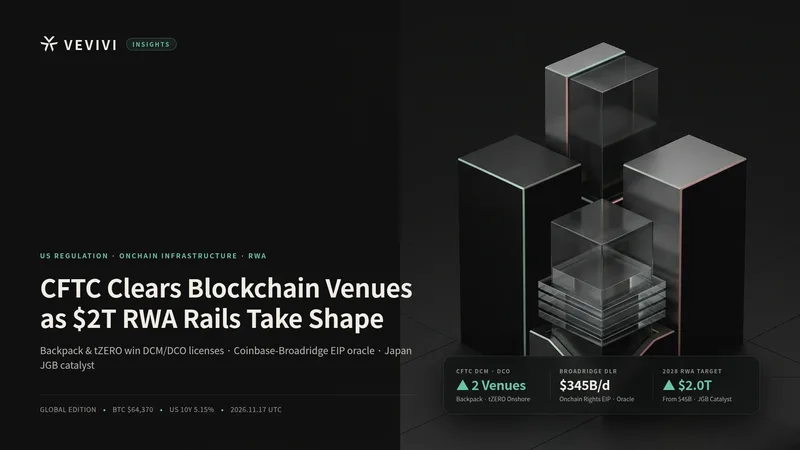
Beneath short-term price consolidation, three foundational regulatory and infrastructure breakthroughs converged on November 16, 2026 across Washington, New York, and Tokyo. Under Chairman Michael S. Selig, the U.S. Commodity Futures Trading Commission (CFTC) cleared the first blockchain-based Designated Contract Market (DCM) and Derivatives Clearing Organization (DCO) frameworks for Backpack and tZERO; Coinbase and Broadridge published an open Ethereum Improvement Proposal (EIP) standard and data oracle for tokenized shareholder governance; and Standard Chartered projected that Japanese Government Bond (JGB) tokenization could help propel the global Real-World Asset (RWA) market to $2 trillion by the end of 2028.
Inside the CFTC Dual Blockchain Exchange and Clearinghouse Approvals
For the first time in U.S. derivatives oversight, federal regulators have authorized venues utilizing blockchain architecture across both trade execution and central clearinghouse settlement. Rather than forcing leveraged price discovery onto offshore venues, the CFTC has established an onshore federal pathway for vertically integrated digital asset derivatives infrastructure.
Backpack Unified Global Order Books and Cross-Margin Architecture
According to official corporate disclosures and CFTC registration records, the agency registered TLD Clearing, Inc., operating as Backpack Clearing, as a Derivatives Clearing Organization on November 13, 2026, before designating TLD Markets, Inc., operating as Backpack Exchange, as a Designated Contract Market on November 16, 2026. Led in the United States by President Mark Wetjen, a former Acting Chairman of the CFTC, alongside board member and former Acting SEC Chairman Michael Piwowar, Backpack now holds both federal licenses governing the complete derivatives trade lifecycle.
This dual license unlocks structural capabilities absent from legacy cash-settled futures exchanges. Drawing on an international footprint spanning over 150 jurisdictions and more than $450 billion in historical trading volume, Backpack plans to offer U.S. participants 24/7 leveraged crypto perpetual futures, combined fiat and crypto collateral posting, cross-margining across positions, and access to a unified global order book. Still, full product activation remains subject to phased implementation, Futures Commission Merchant (FCM) customer fund segregation, collateral haircut schedules, and ongoing compliance with all 23 CFTC Core Principles.
tZERO Institutional Infrastructure Expansion and Statutory Durability Risks
In parallel, a Rule 425 filing submitted to the SEC EDGAR database by FG Imperii Acquisition Corp. (Nasdaq: FGII) on November 16, 2026 confirmed that tZERO Group secured CFTC designation for tZERO DCM, LLC, pairing an onshore derivatives exchange with the October 16, 2026 registration of tZERO DCO, LLC. Satisfying the first earn-out milestone in tZERO's proposed business combination with FGII ($292.29 million market capitalization), the dual approvals extend tZERO's institutional Infrastructure-as-a-Service (IaaS) model alongside its SEC-registered broker-dealer ATS and transfer agent subsidiaries.
Even so, regulatory momentum driven by agency guidance carries statutory durability caveats. Because the broader market-structure bill, the CLARITY Act (H.R. 3633), passed the House 294 to 134 but fell short of Senate cloture at 49 to 50, onshore harmonization currently relies heavily on administrative coordination under Project Crypto between SEC Chairman Paul S. Atkins and CFTC Chairman Michael S. Selig. While deep Wall Street balance-sheet integration makes a wholesale regulatory reversal harder than in prior cycles, the absence of congressional codification leaves administrative rules exposed to appropriations riders or Congressional Review Act (CRA) challenges once the 120th Congress convenes in January 2027.
Coinbase and Broadridge Propose the Onchain Rights Standard and Data Oracle
While CFTC clearing licenses address derivatives market structure, equity tokenization has long struggled with a separate institutional bottleneck: the severance of corporate governance rights from tokenized shares. On November 16, 2026, Coinbase Global (Nasdaq: COIN, $119.84, $31.73 billion market cap) and Broadridge Financial Solutions (NYSE: BR, $195.24, $22.08 billion market cap) unveiled a joint technical framework to bridge issuer disclosures directly into digital wallets.
Closing Issuer Governance Gaps Through Wallet-Native Corporate Action Feeds
Early third-party equity wrappers frequently immobilized underlying shares at custodians without transmitting proxy materials, dividend notices, tender offers, or merger disclosures to end-user wallets. That governance gap prompted pushback from more than 67 public issuers against unconsented token wrappers and led several major multinational corporations to opt out of experimental tokenized trading sandboxes.
Published openly under a CC0 public-domain license at OnchainRights.org and submitted for review as a draft Ethereum Improvement Proposal (EIP), the Onchain Rights Standard allows an issuer or its authorized transfer agent to publish structured corporate action announcements directly on or linked to the token contract itself. Rather than re-keying notices across fragmented chains of depositories, custodians, and data vendors, wallets, brokers, and exchanges across Ethereum and EVM-compatible Layer 2 networks such as Base can read identical, authenticated notices simultaneously.
Leveraging $345 Billion Daily Repo Scale Within Phase-One Boundaries
Alongside the open EIP specification, Broadridge launched a supporting Data Oracle engineered to help participating custodians and wallet providers demonstrate, in aggregate, verifiable distribution of mandatory shareholder communications. The oracle builds directly on Broadridge's institutional scale: its platforms process over 8 billion investor communications annually, underpin more than $18 trillion in average daily securities trading, and settle over $345 billion per day—totaling $7.6 trillion in October 2026—on its Distributed Ledger Repo (DLR) and DLX platforms.
Institutional analysts should note the precise operational boundary between Phase One and Phase Two of the framework. Per technical documentation at OnchainRights.org, the initial release standardizes event announcements and verifiable distribution proof for dividends, stock splits, mergers, rights issues, and annual meetings, whereas actual proxy vote submission and cash dividend disbursement continue routing through regulated broker and custodian rails such as Broadridge ProxyVote. Native on-chain ballot execution and automated corporate action settlement constitute the second development phase, dependent on applicable corporate law and intermediary rules.
Standard Chartered Projects a $2 Trillion RWA Market Led by Sovereign Bonds
Complementing U.S. clearing and governance advances, sovereign debt markets in Asia are beginning to test long-duration on-chain issuance. In a November 16, 2026 research report, Geoffrey Kendrick, Global Head of Digital Assets Research at Standard Chartered, reiterated that the global tokenized Real-World Asset (RWA) market—explicitly excluding stablecoins—is projected to expand from roughly $45 billion today to $2 trillion by the end of 2028.
Moving Beyond $13 Billion in Short-Dated T-Bills Toward Long-Duration Debt
Standard Chartered's $2 trillion end-2028 RWA forecast rests on four institutional pillars: $750 billion in tokenized money-market funds, $750 billion in tokenized listed equities, $250 billion in tokenized investment funds, and $250 billion across private credit, commodities, corporate bonds, and real estate, with Ethereum expected to capture the bulk of settlement volume. Stablecoins are modeled separately to reach $2 trillion by 2030.
To date, sovereign debt on public and permissioned ledgers has consisted almost entirely of short-term U.S. Treasury bills totaling roughly $13 billion, compared with less than $1 billion in non-U.S. government debt and virtually zero long-dated sovereign bonds. Against that backdrop, Japan—the world's third-largest government bond market—convened its first Ministry of Finance (MOF) study group on October 8, 2026 to evaluate three pathways for Japanese Government Bonds (JGBs): wrapping existing JGBs into tokens, issuing native DLT bonds directly on-chain, or deploying a hybrid model.
Unlocking $1.57 Trillion Repo Collateral Mobility Within Institutional DeFi
Private-sector market infrastructure in Tokyo is moving in tandem. In November 2026, Progmat and Digital Asset signed a memorandum of understanding alongside pilots involving Mitsubishi UFJ Financial Group (MUFG) to develop tokenized JGBs (tJGBs) for 24/7 on-chain repurchase agreements—targeting operational friction across Japan's JPY 250 trillion (approximately $1.57 trillion at 159.22 JPY per USD) JGB repo market. Alongside the United Kingdom's Digital Gilt Instrument (DIGIT) pilot slated for early 2027, demonstrable collateral mobility and settlement savings in Tokyo could pressure other G7 treasuries to accelerate sovereign bond tokenization.
Balanced risk assessment nonetheless tempers near-term timeline expectations. Japan's Ministry of Finance has neither selected an underlying blockchain architecture nor fixed an issuance schedule, leaving private initiatives in the pilot and MOU stage. Moreover, persistent smart-contract exploit risks across unvetted retail protocols mean institutional allocators are likely to confine tokenized sovereign bond collateral to permissioned, KYC-gated institutional DeFi venues rather than open liquidity pools during the initial rollout cycle.
Market Structure Convergence and High-Rate Portfolio Implications
Viewed together, the November 16 developments illustrate how institutional digital asset adoption is shifting from passive spot ETF wrappers toward core capital-market infrastructure across clearinghouses, corporate governance, and sovereign collateral.
Connecting Onshore Clearing, Verifiable Governance, and Sovereign Collateral
Three structural frictions previously prevented large asset managers from migrating core workflows on-chain: counterparty exposure on unregulated offshore perpetual venues, legal ambiguity around shareholder communications for tokenized equities, and the scarcity of long-duration sovereign collateral beyond short-term bills. CFTC DCM and DCO licenses for Backpack and tZERO address execution and clearing; the Coinbase-Broadridge EIP and Data Oracle address issuer governance; and sovereign JGB tokenization initiatives expand the addressable collateral base.
Although a 5.15% U.S. 10-year Treasury yield compresses valuation multiples for speculative assets in the near term, elevated risk-free rates simultaneously heighten institutional demand for round-the-clock collateral mobility. Allocators sitting on dry powder increasingly favor infrastructure capable of posting yield-bearing tokenized sovereign debt or regulated digital collateral against cross-margined perpetual futures in capital-efficient cash-and-carry basis trade strategies.
Key Regulatory and Operational Catalysts to Monitor Into Early 2027
Over the coming quarters, institutional conviction will hinge on measurable execution milestones rather than headline announcements. First, market participants will watch how rapidly Backpack US and tZERO DCM onboard Futures Commission Merchants, publish collateral haircut schedules, and list initial contracts under CFTC supervision. Second, adoption of the Onchain Rights EIP across major custodians, wallet providers, and public issuers will test whether governance interoperability convinces hesitant corporations to endorse native equity tokenization.
Third, legislative positioning ahead of the 120th U.S. Congress in January 2027—paired with live settlement metrics from the UK DIGIT pilot and Japan's tJGB repo trials—will determine how quickly administrative breakthroughs harden into permanent market structure. Rather than reacting to spot price volatility as a lagging indicator, tracking regulated clearinghouse open interest and verified RWA settlement volume offers the clearest gauge of institutional traction.
Key Institutional Questions and Answers
How do CFTC DCM and DCO licenses for Backpack and tZERO differ from standard crypto exchange registrations?
Unlike state-level money transmitter licenses or spot brokerage registrations, a Designated Contract Market (DCM) license authorizes a federally supervised derivatives exchange bound by 23 CFTC Core Principles, while a Derivatives Clearing Organization (DCO) registration authorizes a central clearinghouse to collect margin, net exposures, and manage counterparty default risk. Securing both approvals over a blockchain-native execution and settlement stack permits vertically integrated 24/7 derivatives trading and clearing under direct U.S. federal oversight.
Does the Coinbase and Broadridge Onchain Rights Standard immediately execute proxy votes and cash dividends on-chain?
Not in Phase One. According to the technical specification at OnchainRights.org, the initial EIP draft and Broadridge Data Oracle standardize token-linked corporate action notices—covering dividends, splits, mergers, tender offers, and shareholder meetings—and provide aggregate proof of wallet distribution. Actual ballot submission and cash payout settlement continue running through regulated broker and custodian systems such as Broadridge ProxyVote, while native on-chain voting is slated for Phase Two.
Does Standard Chartered's $2 trillion end-2028 RWA forecast include stablecoin market capitalization?
No. Standard Chartered explicitly excludes stablecoins from its $2 trillion end-2028 tokenized RWA target, which comprises $750 billion in money-market funds, $750 billion in listed equities, $250 billion in investment funds, and $250 billion across private credit, commodities, corporate debt, and real estate. Stablecoins are forecast separately to reach $2 trillion by 2030.
Disclaimer and Risk Warning
This article is provided strictly for informational and educational purposes based on publicly available on-chain metrics and macroeconomic data. Nothing in this publication constitutes financial, investment, legal, or tax advice, nor should it be construed as a solicitation, recommendation, or offer to buy or sell any digital asset or financial instrument. Digital assets are subject to high market risk and extreme price volatility, and you may lose part or all of your invested capital. Historical market cycles and past performance referenced herein do not guarantee future results. You are solely responsible for your own investment decisions and should conduct independent research and consult a qualified financial advisor before making any financial commitments.