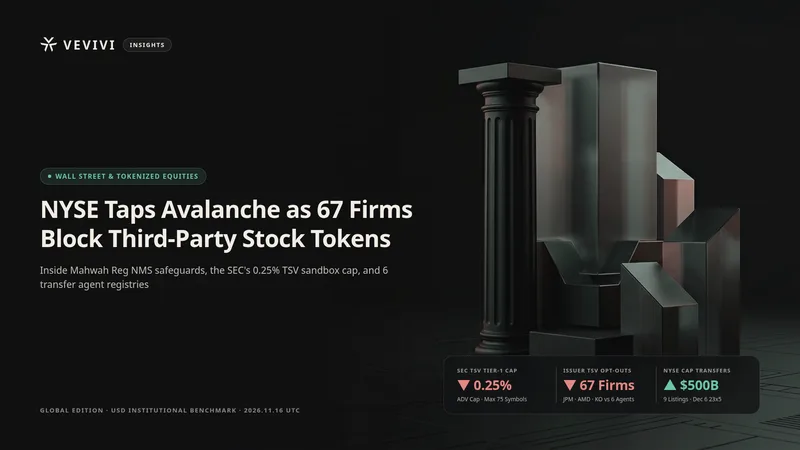
Wall Street's race to put U.S. equities on blockchain rails has crossed from conceptual pilots into a hard architectural divide over regulatory guardrails, order-routing integrity, and post-trade settlement plumbing. Following the November 9, 2026 announcement that the New York Stock Exchange's affiliated upcoming NYSE Digital ATS selected the Avalanche blockchain for institutional clearing and settlement, NYSE President Lynn Martin laid out the sharpest official distinction yet across the three competing models of digital stock trading.
As of November 16, 2026 UTC, active on-chain real-world asset (RWA) assets under management stand at $30.39 billion according to DefiLlama, backed by $284.91 billion in global stablecoin liquidity ($175.32 billion in USDT and $69.32 billion in USDC). With NYSE parent Intercontinental Exchange (ICE) trading at $178.51 ($99.76 billion market capitalization) while advancing parallel digital market structures, institutional allocators must understand why 67 U.S. blue-chip issuers blocked third-party stock tokens even as Wall Street's largest shareholder registry firms wire directly into exchange-grade blockchain rails.
Three Regulatory Tiers Reshaping Tokenized U.S. Equities
Although market commentary frequently groups all blockchain-based stock products under a single banner, U.S. capital market rules split digital equity trading into three fundamentally different legal and operational tiers. Institutional liquidity migration depends on whether a venue preserves consolidated investor protections or operates as a ring-fenced pilot.
NYSE Digital ATS With Reg NMS Safeguards and Avalanche Clearing
First unveiled in January 2026 and updated on November 9, 2026 with the selection of Avalanche as its core settlement ledger, the upcoming NYSE Digital ATS is designed to operate under the highest U.S. securities regulatory standard. Pending final SEC approval, transactions will be matched inside NYSE's Mahwah, New Jersey data center under full Regulation NMS (Reg NMS) price bands, Limit Up-Limit Down (LULD) circuit breakers, enterprise cyber resilience, and broker-dealer AML/KYC rules, while utilizing Avalanche infrastructure to bring post-trade clearing and settlement on-chain.
SEC Innovation Exemption Tokenized Securities Venues (TSVs)
The second tier stems from the SEC's conditional Innovation Exemption issued on September 17, 2026 under Chairman Paul S. Atkins (Press Release 2026-90, Exchange Act Release No. 34-106402), granting five-year temporary relief from exchange and dealer registration through September 17, 2031. Qualifying Tokenized Securities Venues (TSVs), such as the planned OKX-ICE joint venture, execute trades via permissioned automated market maker (AMM) liquidity pools without direct linkage to Reg NMS order routing. To contain spillover risk, SEC rules cap Tier 1 NMS stocks at 75 symbols and 0.25% of prior-month average daily share volume (ADV), and Tier 2 stocks at 250 symbols and 2.5% ADV, enforcing a mandatory three-month trading halt upon repeated volume breaches.
Unapproved Offshore Venues After the $6.3B Exchange Breach
The third tier consists of offshore platforms offering synthetic or wrapped U.S. stock exposure without SEC authorization, Reg NMS price-band controls, or U.S. surveillance standards. Institutional skepticism toward unregulated offshore custody intensified sharply after the October 29, 2026 Binance hot-wallet breach—the largest crypto theft on record at roughly $6.3 billion across ten blockchains via EIP-7702 delegation exploits (with roughly $2.7 billion to $3.0 billion in stablecoins frozen overnight). That episode underscored why U.S. regulators will stress-test AML/KYC, custody resilience, and Reg NMS compliance before permitting offshore models near domestic markets.
Why 67 U.S. Corporations Opted Out of Third-Party TSVs
Under the SEC's September 2026 Innovation Exemption, an unaffiliated third party seeking to tokenize a listed company's shares on a TSV must deliver 30-day advance written notice, giving the corporate issuer a formal right to object. Corporate treasuries moved swiftly: after 33 of the first 63 targeted companies objected in late October, the opt-out roster reached 67 U.S. corporations by mid-November, including JPMorgan Chase, Goldman Sachs, Coca-Cola, AMD, Adobe, Dell Technologies, Nvidia, and Microsoft.
For established S&P 500 and Nasdaq-100 issuers, taking a wait-and-see stance reflects market-microstructure discipline rather than hostility to distributed ledgers. Because TSV liquidity pools sit outside Reg NMS and face a strict 0.25% ADV cap on flagship stocks, thin off-hours order books could generate sharp price dislocations detached from underlying fundamentals without raising capital or improving core liquidity for the issuer.
By contrast, digitally native public companies—including Circle, Strategy (MSTR at $102.22), and Coinbase (COIN at $117.81, $33.80 billion market capitalization)—have chosen to move forward inside the TSV sandbox. This divergence points toward a bifurcated market in which blue-chip multinationals bypass third-party AMM pilots in favor of issuer-consented, Reg NMS-compliant ATS infrastructure.
Six Transfer Agents and the Plumbing Advantage Beyond 23x5 Hours
Expanding trading hours alone no longer requires a blockchain. Beginning Sunday, December 6, 2026, both NYSE Arca and Nasdaq are scheduled to transition traditional equity trading to a 23-hour, five-day-a-week (23x5) schedule—running from 9:00 PM ET Sunday to 8:00 PM ET Friday with a single one-hour daily pause from 8:00 PM to 9:00 PM ET—while preserving standard T+1 settlement on resilient legacy rails.
Where blockchain infrastructure delivers structural value beyond 23x5 hours is in atomic instant settlement (T+0) and beneficial ownership transparency. Under conventional street-name custody chains, public issuers struggle to see real-time retail share ownership, complicating proxy outreach ahead of Annual General Meetings (AGMs). On-chain share registries enable issuers to identify actual beneficial holders directly, streamline proxy voting, and preserve full dividend and governance equivalence.
That registry imperative explains NYSE's November 2, 2026 partnership expansion adding Broadridge Financial Solutions, Computershare, Equiniti, and Superstate alongside Securitize and tZERO. Together, Broadridge, Computershare, and Equiniti administer shareholder records for nearly 5,000 public companies, giving NYSE's digital ecosystem direct registry plumbing across almost the entire U.S. large-cap universe.
$500B Listing Transfers, Tech IPO Rivalry, and Market Scenarios
NYSE's tokenization architecture also reinforces its broader listing battle with Nasdaq. While Nasdaq captured SpaceX's landmark $75.0 billion IPO in June 2026 (priced at $135 per share near a $1.77 trillion to $1.80 trillion valuation) and prepares to host Anthropic's oversubscribed debut (targeting a $1.0 trillion to $1.4 trillion valuation), NYSE has attracted nearly $500 billion in market-capitalization listing transfers across nine major companies in 2026—led by Nasdaq-100 transfers AstraZeneca, Kraft Heinz, and Skydance alongside Fifth Third Bancorp—while processing a record 1.166 trillion system messages on November 5, 2026.
In a constructive institutional scenario, regulatory approval of the NYSE Digital ATS paired with its six-transfer-agent registry network could draw previously hesitant blue-chip issuers onto permissioned on-chain settlement rails without sacrificing Reg NMS price integrity. Conversely, key downside risks remain: if the December 6 launch of 23x5 traditional trading satisfies global overnight demand, migration toward 24/7 on-chain equities could proceed gradually, and network token valuations do not automatically track enterprise partnerships—as illustrated by Avalanche (AVAX) retracing from roughly $8.80 on November 9 to $7.15 on November 16 alongside Bitcoin's consolidation near $64,030 under restrictive U.S. interest rates.
Key Institutional Questions and Answers
How does the NYSE Digital ATS differ legally from an SEC Innovation Exemption TSV?
The NYSE Digital ATS is built as a fully SEC-regulated alternative trading system matched in NYSE's Mahwah data center under Reg NMS price bands and Limit Up-Limit Down protections, using Avalanche strictly for post-trade clearing and settlement. An SEC Innovation Exemption TSV operates under five-year conditional relief through September 2031 using permissioned AMM pools outside Reg NMS, subject to a 0.25% ADV cap (75 symbols max) on Tier 1 stocks and a 30-day issuer opt-out right.
Will the December 6 launch of 23x5 exchange trading make tokenized equities redundant?
Extending NYSE Arca and Nasdaq hours to 23 hours per weekday addresses much of the demand for overnight international execution, leaving open whether issuers truly need Sunday-afternoon trading. However, 23x5 markets retain T+1 settlement and intermediated street-name custody, meaning blockchain rails retain a distinct edge in instantaneous T+0 settlement efficiency and direct retail shareholder visibility for AGM proxy voting.
Why did blue-chip companies block OKX-ICE stock tokens while NYSE signed transfer agents?
Sixty-seven U.S. corporations blocked third-party TSV tokens to avoid fragmented liquidity and off-hours volatility outside Reg NMS protections. By integrating Broadridge, Computershare, Equiniti, Superstate, Securitize, and tZERO—covering nearly 5,000 public issuers—NYSE aligns on-chain shares directly with official corporate registries, ensuring full issuer consent, legal voting rights, and dividend parity.
Disclaimer and Risk Warning
This article is provided strictly for informational and educational purposes based on publicly available on-chain metrics and macroeconomic data. Nothing in this publication constitutes financial, investment, legal, or tax advice, nor should it be construed as a solicitation, recommendation, or offer to buy or sell any digital asset or financial instrument. Digital assets are subject to high market risk and extreme price volatility, and you may lose part or all of your invested capital. Historical market cycles and past performance referenced herein do not guarantee future results. You are solely responsible for your own investment decisions and should conduct independent research and consult a qualified financial advisor before making any financial commitments.