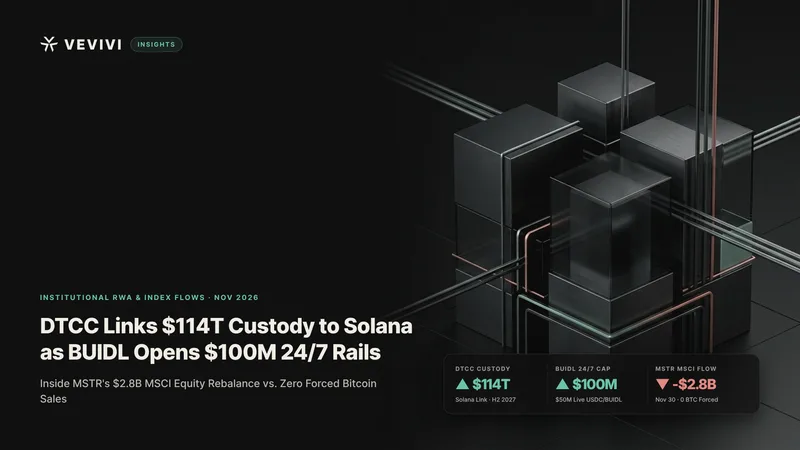
Bitcoin continues to trade under heavy pressure near $63,997 as of November 16, 2026, extending an overnight slide below $67,000 triggered by broad technology-sector deleveraging and executive governance turmoil across flagship artificial intelligence equities. While market commentary quickly blamed MSCI's decision to remove corporate Bitcoin holder Strategy (MSTR) from its global equity benchmarks, primary balance-sheet filings and passive flow mechanics show zero forced liquidation of spot Bitcoin. Beneath the surface volatility, Wall Street's core market plumbing took two decisive steps on-chain: the Depository Trust & Clearing Corporation (DTCC), safeguarding $114 trillion in securities custody, unveiled plans to connect its tokenization platform to Solana, while Securitize and Ethena activated a $100 million 24/7 liquidity facility for BlackRock's tokenized Treasury fund BUIDL.
MSCI Index Removal vs. Bitcoin's Risk-Off Drawdown Mechanics
In its November 2026 Index Review conducted under the non-operating company methodology adopted on October 15, MSCI confirmed that Strategy will exit the MSCI USA, MSCI World, and MSCI ACWI benchmarks after the market close on November 30, 2026. Rather than singling out Bitcoin, the screen simultaneously removed Japan's Metaplanet, micro-cap treasury firm Upexi, UK physical uranium holder Yellow Cake, and Icelandic investment firm Skel Fjarfestingafelag, while placing Ether treasury firm SharpLink on a monitoring watchlist. The rule targets listed vehicles whose valuation derives overwhelmingly from passive asset holdings rather than operating revenue.
Why $2.8 Billion in Passive MSTR Share Outflows Forces Zero Bitcoin Sales
Conflating an equity index deletion with forced cryptocurrency liquidation misreads how passive rebalancing operates. Strategy estimates that funds benchmarked to the affected MSCI indexes hold roughly 13 million MSTR shares, or 3.1% of basic shares outstanding, while JPMorgan projects passive equity outflows near $2.8 billion around the November 30 close. That figure sits well within MSTR's routine single-day trading liquidity on Nasdaq, and passive index trackers sell MSTR common stock—not underlying BTC. According to Strategy's Form 8-K filed with the U.S. Securities and Exchange Commission (SEC) for the period ended November 8, 2026, the company holds 850,364 BTC acquired for $64.16 billion at an average cost basis of $75,456 per coin, alongside a $4.77 billion USD Reserve and $146.2 million in cash dedicated to preferred dividend obligations, leaving no covenant or liquidity trigger that compels spot Bitcoin sales.
Equity Multiple Compression and ATM Capital Formation Friction
Even without forced coin sales, equity index exclusion introduces a tangible second-order headwind for corporate treasury accumulation. With MSTR trading near $102.22 in November 16 pre-market action and spot Bitcoin at $63,997—roughly 15.2% below Strategy's $75,456 average acquisition price—the stock's multiple over net asset value faces compression just as passive index demand steps away. Although Strategy retains $18.34 billion in remaining issuance capacity under its common-stock at-the-market (ATM) program, issuing equity near or below parity dilutes accretive Bitcoin-per-share yield, turning passive index removal into a medium-term throttle on fresh corporate buying rather than a liquidation catalyst.
Wall Street's $114 Trillion Post-Trade Engine Connects to Solana
While short-term traders focused on index rebalancing, global securities settlement infrastructure committed to high-throughput public blockchain rails. On November 12, 2026, DTCC—whose subsidiaries processed $4.7 quadrillion in securities transactions in 2025 and custody $114 trillion in assets across more than 150 countries—announced plans to integrate its DTCC Tokenization Service (DTS) with Solana's Layer-1 network. The move extends DTS less than three weeks after its October 28 launch on the Canton Network and DTCC's private Besu network.
Russell 1000 Equities, ETFs, and U.S. Treasuries Target H2 2027 Integration
Scheduled for the second half of 2027 alongside roadmap integrations for Stellar and Circle's Arc network, the Solana connection will allow eligible assets custodied at The Depository Trust Company (DTC)—spanning Russell 1000 equities, major index ETFs, and U.S. Treasuries—to be minted and managed across their full token lifecycle on-chain. DTCC Clearing & Securities Services President Brian Steele emphasized that DTC-tokenized securities on Solana will preserve the exact investor protections, legal ownership rights, and regulatory safeguards governing traditional book-entry shares, advancing Wall Street's transition from T+1 batch clearing toward atomic settlement and real-time collateral mobility.
Separating Post-Trade Plumbing Upgrades from Native L1 Token Valuation
Institutional adoption of public-chain rails does not automatically translate into immediate spot repricing for underlying network tokens. Solana (SOL) traded between $71.54 and $72.71 on November 16, tracking the broader macro drawdown despite securing a landmark integration with the world's largest central securities depository. Because DTCC's architecture is explicitly market-neutral and multi-chain—routing tokenized representations across Canton, Besu, Solana, Stellar, and Arc—investors must distinguish between long-term post-trade volume migration in late 2027 and near-term fee capture accruing directly to SOL holders.
Always-On Institutional Dollar Liquidity via BlackRock BUIDL and SoFiUSD
Complementing DTCC's multi-year settlement roadmap, immediate round-the-clock dollar liquidity bridges went live for institutional and retail participants alike. On November 12, 2026, NYSE-listed Securitize Corp. (managing roughly $5 billion in tokenized assets) and Ethena Labs launched a $100 million 24/7 liquidity facility for BlackRock's USD Institutional Digital Liquidity Fund (BUIDL, holding approximately $2.8 billion in assets). Historically, even tokenized Treasury funds faced weekend settlement bottlenecks whenever traditional wire rails closed.
How the $100 Million BUIDL-to-USDC Swap Pool Solves Weekend Collateral Gaps
The facility opens with $50 million in funded liquidity—split evenly between $25 million in USDC and $25 million in BUIDL—paired with an automated replenishment mechanism capable of supplying up to an additional $50 million within roughly one hour, establishing a $100 million capacity ceiling. Eligible institutional holders can now convert yield-bearing tokenized Treasuries into dry powder stablecoins during weekend volatility spikes to meet margin calls or deploy capital, and swap stablecoins back into BUIDL without waiting for Monday banking hours, deepening the on-chain dollar loop alongside Ethena's BUIDL-backed USDtb.
OCC-Chartered SoFi Bank Deploys on Polygon Amid SEC-CFTC Alignment
On the regulated banking front, SoFi Bank, N.A.—a U.S. national bank supervised by the Office of the Comptroller of the Currency (OCC), with parent SoFi Technologies (SOFI) valued near $20.01 billion at $15.04 per share—expanded its bank-issued SoFiUSD stablecoin onto Polygon's payment stack alongside Ethereum and Solana. While the integration opens low-cost digital dollar transfers inside the SoFi app across its 17 million-plus member base, product terms restrict direct bank redemption rights for external non-member wallets. Concurrently, U.S. regulatory turf wars eased further as the SEC filed a November 12 brief in the Southern District of New York backing the Commodity Futures Trading Commission (CFTC) joint-oversight framework in litigation over single-stock perpetual futures.
Index Contagion Scenarios and Institutional Security Thresholds
Rapid convergence between traditional market infrastructure and public blockchains carries twin execution risks: potential rule contagion across competing equity benchmarks and escalating state-sponsored cyber threats targeting institutional custody workflows.
Monitoring Competing Benchmark Rules and the DOJ's $1.2 Billion Seizure Mandate
First, market participants are watching whether S&P Dow Jones Indices or FTSE Russell follow MSCI's non-operating company screen; JPMorgan previously modeled a hypothetical $8.8 billion outflow scenario if major benchmark providers acted in unison, though neither firm has announced comparable rule changes. Second, operational security remains paramount after the U.S. Department of Justice (DOJ) announced on November 13, 2026 that coordinated public-private enforcement has frozen more than $2.7 billion tied to North Korean cryptocurrency thefts and secured court authorization to seize or restrain over $1.2 billion of stolen exchange assets, while exposing a $400 million-plus social-engineering campaign using deepfake video-conferencing malware dubbed Face Stealer.
Frequently Asked Questions on RWA Settlement and Index Rebalancing
Does Strategy's removal from MSCI indexes force the company to liquidate Bitcoin?
No. The November 30 index deletion requires MSCI-benchmarked passive funds to sell MSTR equity shares, leaving Strategy's Nasdaq listing intact and imposing zero obligation to sell any of its 850,364 BTC treasury, which is cushioned by a $4.77 billion USD Reserve. The primary impact is potential compression in MSTR's equity issuance premium for future acquisitions.
When will DTCC's Solana tokenization link go live and which assets qualify?
DTCC targets the second half of 2027 to connect its Tokenization Service to Solana, building on its October 28, 2026 launch on Canton and private Besu networks. Eligible DTC-custodied securities—including Russell 1000 stocks, major index ETFs, and U.S. Treasuries—will retain full statutory ownership protections when represented on-chain.
How does the $100 million BlackRock BUIDL facility work outside banking hours?
Operated through Securitize and supported by Ethena Labs, the pool seeds $25 million in USDC and $25 million in BUIDL ($50 million initial liquidity) with up to $50 million in one-hour replenishment capacity, enabling eligible institutions to execute 24/7 bidirectional swaps between tokenized Treasuries and stablecoins over weekends and holidays.
Disclaimer and Risk Warning
This article is provided strictly for informational and educational purposes based on publicly available on-chain metrics and macroeconomic data. Nothing in this publication constitutes financial, investment, legal, or tax advice, nor should it be construed as a solicitation, recommendation, or offer to buy or sell any digital asset or financial instrument. Digital assets are subject to high market risk and extreme price volatility, and you may lose part or all of your invested capital. Historical market cycles and past performance referenced herein do not guarantee future results. You are solely responsible for your own investment decisions and should conduct independent research and consult a qualified financial advisor before making any financial commitments.