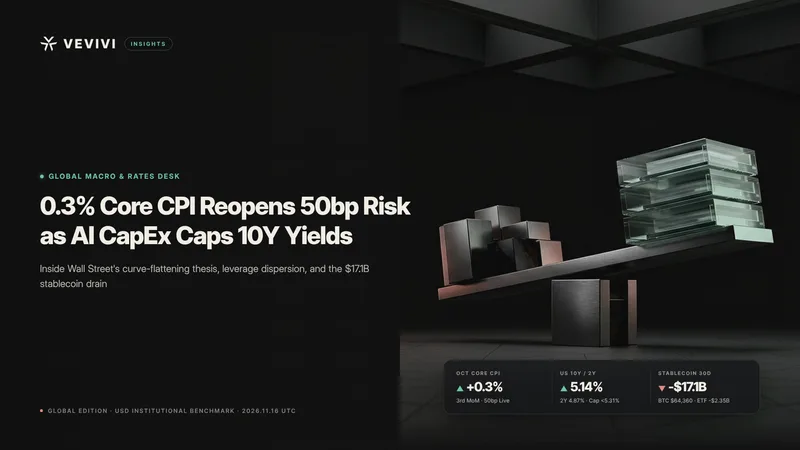
According to the U.S. Bureau of Labor Statistics (BLS), core Consumer Price Index inflation—excluding food and energy—rose 0.3% month-over-month on a seasonally adjusted basis in October 2026, matching the exact 0.3% monthly pace recorded in both September and August. With headline CPI advancing 0.4% on the month, what briefly appeared to be a post-midterm volatility lull across sovereign bonds and global risk assets evaporated within minutes. Rather than acting as a routine lagging indicator, the October inflation report forced institutional desks to reprice the Federal Reserve's near-term reaction function and unwind nearly a month of rate-hike compression.
Insights from Goldman Sachs' North American interest rate trading desk point to three interlocking shocks: persistent inflation breadth across services, the sudden reopening of a 50-basis-point hike tail for the December 8–9 Federal Open Market Committee (FOMC) meeting, and sharp positioning giveback. With the federal funds target range sitting at 3.75%–4.00%, the U.S. 2-year Treasury yield at 4.87%, and the 10-year benchmark holding near 5.14%, higher-for-longer funding costs are sharply separating low-leverage balance sheets from levered borrowers—while draining spot dollar liquidity across global crypto markets.
Three Consecutive 0.3% Core Prints Reset the Fed Reaction Function
Granular BLS tables confirm that October's price pressure was broad-based rather than distorted by a single volatile category. Shelter rose 0.3% over the month—accounting for more than 30% of the headline advance—while food climbed 0.5%, energy gained 0.7%, and sticky service components surged across recreation (+0.8%), transportation services (+0.8%), motor vehicle insurance (+0.7%), and medical care (+0.3%). Aside from a 1.2% pullback in used cars and trucks, domestic demand-driven inflation remained stubbornly incompatible with the central bank's 2% target.
Governor Waller's Credibility Threshold Puts 50 Basis Points Back in Play
Market repricing accelerated because the data directly triggered a policy condition laid out hours earlier by Federal Reserve Governor Christopher Waller in London. Citing 3.4% third-quarter real GDP growth, a stable 4.1% October unemployment rate, and more than 70% of core PCE service components running above 3% year-over-year, Waller explicitly stated that if October core CPI printed around 0.3% or higher, a 50-basis-point hike should be considered in December—warning that a routine 25-basis-point move could put Fed credibility at risk. Having already seen two hawkish dissents at the October 28 FOMC hold, fed funds futures immediately repriced December hike certainty, pushing the implied probability of a 50-basis-point move from zero to an intraday peak of 11% before settling near an 8% tail alongside a 92% probability of 25 basis points.
Why a 15% Oil Pullback Falls Short—Yet 10-Year Yields Face a Structural Ceiling
West Texas Intermediate (WTI) crude futures retreated roughly 13% to 15% from early-month highs to trade near $86.96 per barrel on November 16 amid hopes for Middle East de-escalation following the U.S. midterm elections. Even so, Wall Street rate strategists caution that softer crude prices cannot deliver a full yield refund on their own. War-risk tanker insurance and ship-to-ship transfer expenses through the Strait of Hormuz still embed a $20 to $30 per barrel logistics premium, and October's fixed-income selloff was primarily driven by term-premium repricing, heavy Treasury issuance, and corporate capital expenditure supply rather than energy alone.
Front-End Tightening Anchors the Curve Below October's 5.31% Peak
Despite the hawkish front-end shock, Goldman Sachs' trading desk argues that the U.S. 10-year Treasury yield—currently near 5.14%—is unlikely to eclipse its October 5 FRED closing peak of 5.31% (roughly 5.36% intraday) via convexity selling, the self-reinforcing dynamic in which rising yields force duration holders to shed even more bonds. The first structural brake is active central bank tightening itself: when the Fed hikes aggressively into sticky inflation, rate pressure lands squarely on the 2-year sector (4.87%), anchoring long-run inflation expectations and compressing the 2s10s spread to roughly 27 basis points rather than letting the long end unanchor.
Chair Warsh's AI CapEx Reflexivity Creates a Self-Balancing Brake
The second structural brake stems from Federal Reserve Chair Kevin Warsh's explicit linkage between interest rate levels and external debt financing for the artificial intelligence infrastructure buildout. As hyperscalers and data-center operators tap corporate bond markets to fund multi-year AI capital expenditures alongside sovereign Treasury supply, borrowing costs establish a self-balancing feedback loop. If 10-year yields push too far above 5%, marginal debt-financed AI CapEx slows down automatically, relieving corporate bond supply pressure and capping long-end yields unless an upside corporate earnings surge justifies growth-driven repricing.
Credit Leverage Dispersion and Three Liquidity Warnings in Digital Assets
Across equities, corporate credit, and digital assets, sustained 5% Treasury yields divide market participants along two axes: what is driving yields higher, and how much balance-sheet leverage each borrower carries. For cash-rich mega-cap technology leaders, elevated yields act mainly as a valuation discount-rate adjustment; for highly levered corporations and margin-funded traders, 4.87% two-year yields and 2.90% ten-year real TIPS yields translate into an immediate funding bill problem.
Stablecoin Contraction and ETF Outflows Expose Perpetual Leverage Fragility
That exact funding squeeze is visibly reshaping global digital asset market structure as of November 16, 2026, with Bitcoin trading at $64,360 and Ethereum at $1,801 against a firm U.S. Dollar Index near 103.45. On-chain estimates compiled by Glassnode show global stablecoin supply—the crypto market's primary dry powder—shrinking by roughly $17.1 billion over the past 30 days, the sharpest monthly contraction since June 2022, as 4.23% three-month Treasury bills pull idle dollar liquidity off-chain. Simultaneously, U.S.-listed spot Bitcoin ETFs logged seven consecutive sessions of net outflows totaling $2.35 billion over two weeks, while decentralized exchange spot volume fell 18% over six weeks even as perpetual futures volume climbed 7%—a cold-spot, hot-futures imbalance that triggered over $1 billion in single-day forced long liquidations.
Institutional Portfolio Strategy Ahead of the December FOMC
To navigate a market dominated by mega-cap AI leadership and hawkish rate risk, institutional desks favor owning core secular exposure while strictly sizing down leverage and renting asymmetric downside protection. In traditional markets, combining core equity exposure with out-of-the-money U.S. dollar puts and equity puts allows allocators to construct carry-neutral hedges; in digital assets, the parallel discipline means reigning in leveraged perpetual exposure and cash-and-carry basis trade sizing until spot inflows return.
Over the coming weeks, global macro and crypto desks are tracking four decisive catalysts: the October FOMC minutes on November 18, Middle East crude supply developments, MSCI's November 30 global index rebalancing (carrying an estimated $2.8 billion in passive equity flow impact for Strategy), and the December 8–9 FOMC rate decision followed by November CPI on December 10. Under a constructive scenario where corporate earnings hold firm, the Fed delivers a measured 25-basis-point move toward its terminal rate, and stablecoin issuance turns positive, risk assets can stabilize above key institutional support; conversely, another upside inflation surprise that cements 50-basis-point tightening would keep levered positions vulnerable to further deleveraging.
Key Institutional Questions Answered
Below are concise answers to the three central macro and liquidity questions confronting global multi-asset and digital asset allocators following the October inflation print.
Why did December Fed rate-hike odds climb even after crude oil prices dropped roughly 15% in November?
Monetary policymakers focus primarily on core inflation breadth rather than short-term headline energy swings. Because October core CPI rose 0.3% month-over-month for a third straight month, over 70% of core PCE service components remain above 3% annually, and Strait of Hormuz shipping insurance still adds $20 to $30 per barrel in structural input costs, November's crude pullback could not offset sticky domestic service inflation.
How does AI capital expenditure financing create a ceiling for 10-year U.S. Treasury yields?
As Federal Reserve Chair Kevin Warsh highlighted, the next phase of the AI data-center buildout increasingly relies on external debt issuance rather than internal cash reserves alone. Whenever 10-year Treasury yields push aggressively above 5%, higher corporate borrowing costs naturally slow marginal AI capital expenditure financing, reducing corporate bond supply pressure and preventing a repeat of October's 5.31% convexity selloff.
Which metrics confirm a durable liquidity floor for Bitcoin and digital assets in a 5% yield regime?
Sustainable recoveries require spot capital inflows rather than derivatives-led bounces. Allocators should watch for a reversal in the $17.1 billion 30-day global stablecoin contraction and a return to sustained daily net inflows across U.S. spot Bitcoin ETFs following their $2.35 billion two-week outflow streak.
Disclaimer and Risk Warning
This article is provided strictly for informational and educational purposes based on publicly available on-chain metrics and macroeconomic data. Nothing in this publication constitutes financial, investment, legal, or tax advice, nor should it be construed as a solicitation, recommendation, or offer to buy or sell any digital asset or financial instrument. Digital assets are subject to high market risk and extreme price volatility, and you may lose part or all of your invested capital. Historical market cycles and past performance referenced herein do not guarantee future results. You are solely responsible for your own investment decisions and should conduct independent research and consult a qualified financial advisor before making any financial commitments.