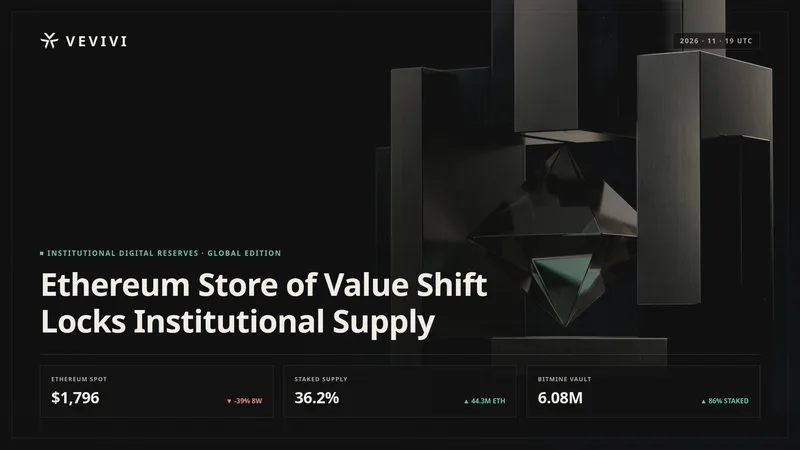
The Ethereum store of value thesis has moved to the center of institutional allocation on November 19, 2026, as Ethereum trades at $1,796 alongside Bitcoin at $63,731, the S&P 500 at 7,324, and the U.S. 10-year Treasury yield at 5.07%. Over the past eight weeks, Ethereum declined 39%, including a 28% slide across the prior two weeks as institutional desks raised cash ahead of major artificial intelligence equity offerings and margin adjustments. Against that backdrop, Ethereum co-founder Vitalik Buterin issued two structural interventions on November 8 and November 18, 2026, formally retiring the expectation that transaction fee burns alone can sustain asset valuation and arguing instead that digital assets must replicate the long-horizon commitment mechanics of residential real estate.
Why the Ethereum Store of Value Pivot Replaces Fee-Burn Economics
For five years following the 2021 EIP-1559 upgrade, market participants valued Ethereum primarily through deflationary fee destruction. Empirical network data in 2026 demonstrates why that single-engine model broke down once execution migrated to Layer 2 rollups and speculative on-chain churn cooled. Whereas Ethereum burned approximately 1.48 million tokens worth $3.6 billion in 2022, cumulative mainnet burns in 2026 fell 98.7% to roughly 19,200 tokens valued near $43 million. On November 8, 2026, Buterin stated explicitly that holders should remain comfortable even if fee destruction stays below 10% of issuance breakeven indefinitely, emphasizing that monetary durability stems from credible neutrality, decentralization, and balance-sheet permanence in an era of artificial intelligence disruption.
Structural Criticism and Ethereum Foundation Treasury Discipline
The transition has not occurred without market friction. Ecosystem critics pointed to recurring treasury liquidations by the Ethereum Foundation as inconsistent with a long-term holding mandate. Primary disclosures show, however, that the Foundation cut its 2026 operating budget by 40%, deployed roughly 70,000 tokens into native staking, and channeled major funding needs through structured over-the-counter placements—including a 10,000-token sale worth $22.9 million at $2,292 per token to Bitmine Immersion Technologies in May 2026, followed by a smaller 2,785-token treasury sale in October 2026.
Housing Affordability, Raleigh Zoning Data, and the Homevoter Paradox
On November 18, 2026, Buterin connected digital asset market structure directly to urban housing economics after economist Peter Tulip highlighted a November 16, 2026 study by The Pew Charitable Trusts on Raleigh, North Carolina. Following municipal land-use and parking reforms enacted in 2021 and 2022, Raleigh expanded annual housing permits by 74% from 3,301 to 5,731 units, adding 16,884 homes—a 7.7% supply expansion between 2021 and 2024. Despite a 6.5% population increase from 2022 to 2025, inflation-adjusted rents in Raleigh fell 15%, lowering the median household income required to afford a typical apartment from 79% to 65% of area median income.
In any ordinary consumer market, a 15% real cost reduction is universally welcomed. Yet because residential property serves simultaneously as shelter and primary household savings—with Federal Reserve May 2026 household survey data showing homeownership at just 24% among U.S. adults aged 18 to 29 compared with 83% among adults aged 60 and older—incumbent owners face what economist William Fischel termed homevoter incentives to block new supply. According to the National Association of Realtors 2026 Profile released on November 5, 2026, the median age of U.S. first-time homebuyers remained stuck at an all-time high of 40, while first-time buyers accounted for only 22% of transactions versus the pre-2008 historical norm of 40%, and 30% of first-time buyers tapped financial assets including equities, retirement plans, or digital assets for down payments.
Financial Nihilism Versus Forced-Savings Market Architecture
Redirecting younger cohorts from property into liquid markets only improves economic welfare if digital platforms foster disciplined compounding rather than zero-sum churn. Working-paper research by University of Chicago and Northwestern University economists Seung Hyeong Lee and Younggeun Yoo examining U.S. households below the $300,000 net-worth threshold found that 4% to 6% of priced-out renters view maximum work effort as unimportant—roughly double the 2% to 3% rate among homeowners—while renters holding between $200,000 and $300,000 exhibit peak crypto participation near 10% alongside elevated credit-card spending.
Empirical Evidence from Dutch Mortgages and Gamified Trading Platforms
Behavioral finance literature confirms that household wealth preservation depends on structural friction rather than willpower. Analyzing the 2013 Netherlands tax reform that required full 30-year principal amortization to qualify for mortgage interest deductions, economists Asaf Bernstein and Peter Koudijs documented in the Quarterly Journal of Economics a near one-for-one increase in household net worth per dollar of mandatory amortization. By contrast, financial economist Terrance Odean and co-authors demonstrated in the Journal of Finance that attention-driven retail herding on zero-commission brokerage apps systematically generates negative subsequent returns, while Dune Analytics data across 4.26 million Solana memecoin launchpad wallets on Pump.fun showed 62.5% suffered net losses and only 0.76% realized gains above $1,000.
Staking Queues, Corporate Vaults, and U.S. Mortgage and Pension Rails
While retail speculation struggles, institutional infrastructure is steadily embedding Ethereum and Bitcoin into illiquid, housing-like balance sheets across three verified channels, even as short-term liquidity remains sensitive to equity rotations. Coinglass and SoSoValue records show U.S. spot Ethereum exchange-traded funds hold $14.44 billion in assets under management after absorbing $184.6 million in three-day net outflows—including $39.83 million on November 18 alongside $306 million in single-day Bitcoin fund redemptions and $1.07 billion in weekly Bitcoin outflows ahead of major artificial intelligence initial public offerings.
Network Staking Lockups and Bitmine Immersion Technologies Filings
Beneath ETF flow volatility, native protocol lockups reached historic scale. Network staking expanded to 44.3 million Ethereum—representing 36.2% of the 122.2 million total supply—offering a 2.63% third-quarter annualized yield, with 1.17 million tokens queued for validator entry on November 1. Although daily validator entry-to-exit ratios fluctuate dynamically rather than holding a static multiple, corporate treasury commitment has intensified: per its November 16, 2026 SEC Form 8-K, Bitmine Immersion Technologies acquired 7,653 tokens over the prior week to reach 6,077,745 Ethereum (6.08 million tokens, or 4.97% of total supply, within $11.8 billion in total holdings) and staked 5,227,037 tokens—86% of its Ethereum reserve, valued at $9.5 billion at $1,823 per token—generating $245 million in annualized staking revenue at a 2.57% yield.
Precise Regulatory Status of U.S. Housing and 401(k) Custody Channels
On the credit and retirement front, precise legal-stage tracking is essential. Under Federal Housing Finance Agency Decision No. 2025-360—an agency directive rather than an enacted federal statute—Fannie Mae and Freddie Mac were instructed to evaluate unliquidated digital asset reserves in mortgage underwriting, prompting top-five U.S. lender Newrez to recognize Bitcoin and Ethereum without forced liquidation starting in early 2026 subject to a 20% valuation buffer. In retirement markets, following Department of Labor Compliance Assistance Release No. 2025-01 and Executive Order 14330, the agency's March 2026 proposed fiduciary safe-harbor rule—which drew over 47,000 public comments—entered final review at the White House Office of Management and Budget in November 2026 for an expected 60 to 90 day clearance window; it remains a proposed rule rather than a promulgated final regulation. Meanwhile, the July 2, 2026 voluntary liquidation of fractional property platform RealT across roughly 700 Detroit homes worth $140 million underscores that locking digital assets inside regulated institutional wrappers is advancing faster than tokenizing fragmented residential deeds.
Institutional Investor Questions on Custody and Allocation Risk
Does the decline in mainnet fee burns weaken long-term monetary scarcity?
Lower fee destruction removes mechanical supply contraction during quiet periods, shifting scarcity reliance toward staking lockups that sequester 36.2% of supply and corporate vaults holding 4.97% of circulating tokens, though net issuance remains modestly positive when Layer 1 base fees stay subdued.
Are U.S. 401(k) retirement plans legally cleared to allocate to digital assets today?
The Department of Labor rescinded its prior cautionary guidance in May 2025, restoring standard ERISA prudence neutrality, but the formal six-factor fiduciary safe-harbor remains a proposed rule undergoing 60 to 90 day White House Office of Management and Budget review rather than an enacted final rule.
What macro risks could challenge institutional store-of-value accumulation?
Sustained U.S. 10-year Treasury yields near 5.07% offer risk-free competition against Ethereum's 2.63% nominal staking yield, while spot ETF wrappers allow rapid cross-asset liquidity withdrawals during equity IPO cycles or leveraged margin calls.
Disclaimer and Risk Warning
This article is provided strictly for informational and educational purposes based on publicly available on-chain metrics and macroeconomic data. Nothing in this publication constitutes financial, investment, legal, or tax advice, nor should it be construed as a solicitation, recommendation, or offer to buy or sell any digital asset or financial instrument. Digital assets are subject to high market risk and extreme price volatility, and you may lose part or all of your invested capital. Historical market cycles and past performance referenced herein do not guarantee future results. You are solely responsible for your own investment decisions and should conduct independent research and consult a qualified financial advisor before making any financial commitments.