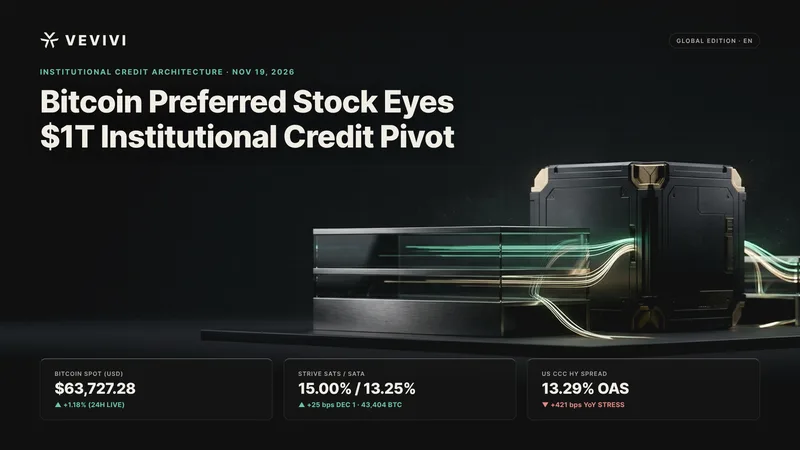
Bitcoin preferred stock has emerged as a structural bridge between digital asset treasuries and traditional fixed-income allocators as Bitcoin trades at $63,727.28 (+1.18% intraday) on November 19, 2026. While the S&P 500 stands at 7,323.63 and the 10-year United States Treasury yield holds near 5.07%, public capital markets are digesting historic artificial intelligence equity issuance alongside severe lower-tier corporate credit dispersion. Against this backdrop, Dallas-based structured finance manager Strive has expanded its debt-free corporate reserve to 43,404 Bitcoin worth $2.77 billion while deploying a two-tier perpetual preferred equity stack yielding between 13.25% and 15.00%. Chief Risk Officer Jeff Walton argues that the next major liquidity catalyst for digital asset balance sheets will not come solely from common equity buyers, but from adapting the rated, finite-duration structured credit playbook that insurance companies and pension funds already use to finance the $1 trillion artificial intelligence data center buildout.
Why the AI Capital Boom and Credit Stress Spotlight Bitcoin Preferred Stock
Capital markets in late 2026 are defined by an extraordinary concentration of artificial intelligence financing paired with widening speculative-grade credit spreads. On November 18, 2026, artificial intelligence developer Anthropic priced its initial public offering at $83.00 per share across 980 million shares, raising $81.3 billion in public proceeds—surpassing SpaceX and its $75.0 billion June 2026 listing—plus $26.0 billion in a concurrent private placement for $107.3 billion in total capital at an approximate $1.5 trillion diluted valuation. According to its registration statement with the Securities and Exchange Commission, Anthropic carries $895.4 billion in multi-year compute commitments and staged 365-day insider lock-ups as shares debut on Nasdaq on November 19, 2026.
One day before that pricing, Nvidia reported third-quarter fiscal 2027 total revenue of $115.8 billion, led by Data Center segment sales of $107.6 billion (up 110% year over year) and fourth-quarter revenue guidance of $130.0 billion. Institutional research from J.P. Morgan Asset Management and Union Bancaire Privée indicates that aggregate hyperscaler artificial intelligence capital expenditure is tracking roughly $820 billion in 2026 and is projected to reach $1.0 trillion to $1.3 trillion annually across 2027 and 2028. Because hyperscaler cash flows alone cannot fund every facility, insurers and pension funds have stepped in as primary lenders through project finance and asset-backed securitization.
Lower-Tier Corporate Spread Widening Versus Unencumbered Reserves
Outside mega-cap compute infrastructure, corporate credit conditions have tightened sharply. Federal Reserve Bank of St. Louis data for the ICE BofA US High Yield CCC or Below Option-Adjusted Spread shows distressed-tier spreads reaching 13.29% in mid-November 2026, widening by 421 basis points year over year from 9.08% and climbing 491 basis points above their January 2026 trough of 8.38%. Elevated risk-free benchmarks near 5.07% on the 10-year Treasury note have pressured leveraged borrowers facing refinancing walls, prompting Strive to maintain $0 in corporate debt and zero pledged collateral across its entire 43,404 Bitcoin reserve.
Inside Strive Two-Tier Perpetual Preferred Equity Mechanics
Securities and Exchange Commission Form 8-K filings dated November 6 and November 16, 2026 detail how Strive engineered two distinct Nasdaq-listed perpetual preferred instruments to segment investor duration and rate preferences while compounding Bitcoin per diluted common share. During the third quarter ended September 30, 2026, Strive recorded $509.0 million in GAAP net income ($494.6 million on a non-GAAP adjusted basis) and achieved a 63.2% year-to-date Bitcoin yield, while its registered investment adviser subsidiary managed over $2.9 billion in client assets. Between November 7 and November 13, 2026, the company acquired an additional 251 Bitcoin for $17.5 million at an average cost of $69,853 per coin.
Variable Senior Dividend Anchoring Versus Fixed Junior Yield
At the senior mezzanine layer sits Strive Variable Rate Series A Perpetual Preferred Stock (14,030,176 shares outstanding, $1.40 billion liquidation preference), which traded at $90.72 on November 19, 2026 against a $100 stated par value. To draw the security back toward par amid broader credit widening, Strive raised its regular annual dividend rate by 25 basis points from 13.00% to 13.25% effective December 1, 2026, paid every business day. Beneath that senior layer sits the 15.00% Series A Perpetual Preferred Stock (7,141,037 shares outstanding following a $609.0 million net initial offering on October 20 and $10.0 million in November at-the-market issuance), which carries no par trading target and locks in a fixed 15.00% annual cash dividend in perpetuity.
This dual architecture directly addresses fixed-income market composition. According to Strive investor disclosures filed with the Securities and Exchange Commission, fixed-rate obligations account for 93% ($39.3 trillion) of the $42.4 trillion United States dollar bond universe, whereas variable-rate instruments represent roughly 4%. Real estate and income-focused allocators frequently hesitate to liquidate long-duration property for variable-rate securities whose coupons could be reduced years later; offering a permanent 15.00% fixed coupon captures that deeper fixed-rate capital pool while adding junior equity cushion beneath the 13.25% senior preferred shares.
Reserve Coverage Ratios and the Rating Agency Tranching Hurdle
Combined annualized dividend obligations across both preferred classes currently equal approximately $293.0 million ($185.9 million on the senior variable shares at 13.25% plus $107.1 million on the junior fixed shares at 15.00%). Against that commitment, Strive holds $465.3 million in cash and cash equivalents, $50.5 million in Strategy preferred equity (505,000 shares), and $2.77 billion in unencumbered spot Bitcoin—a total reserve base of $3.28 billion as of November 19, 2026.
Stress-Testing Dividend Runway Across Drawdown Scenarios
At live Bitcoin prices of $63,727.28, Strive total liquid and digital assets cover 11.2 years (roughly 2,822 business days) of preferred dividends without raising external capital, closely aligning with management operational estimates. Even under a hypothetical 25% spot Bitcoin decline to $47,795, combined cash and digital reserves of approximately $2.59 billion would still cover 8.8 years (over 2,220 business days) of uninterrupted daily distributions.
Despite double-digit yields and multi-year reserve coverage, regulated insurance companies and pension funds remain largely sidelined for two structural reasons: existing digital treasury preferred shares are unrated and perpetual. Statutory capital frameworks penalize instruments that lack both an investment-grade credit rating from a Nationally Recognized Statistical Rating Organization and a legal final maturity date. Walton notes that physical data centers are far less divisible or liquid in a crisis than spot Bitcoin—an institution cannot liquidate 10% of a server hall overnight—yet credit agencies routinely rate data center debt because issuers embed anticipated repayment dates, refinancing step-ups, and senior-subordinate tranching. Carving a finite-duration, rated senior note above perpetual preferred equity represents a conditional structural pathway, though execution depends on rating agency methodology approval, uncorrelated balance-sheet income across reinsurance or structured asset-backed securities, and sustained Bitcoin collateral liquidity.
Key Institutional Questions on Structured Bitcoin Credit
Why do regulated insurers require rated finite-duration tranches over 15.00% perpetual preferred shares?
Insurance general accounts and pension mandates operate under strict risk-based capital charges tied to credit ratings and principal repayment schedules. Perpetual preferred stock has no maturity date for principal return and sits below debt in liquidation priority, triggering equity-like capital charges regardless of whether cash and Bitcoin reserves cover 11.2 years of dividends. Introducing a senior tranche with a defined legal maturity and formal credit rating is required to qualify for investment-grade fixed-income buckets.
Could the $107.3 billion Anthropic capital raise drain institutional liquidity from digital assets?
Mega-cap artificial intelligence offerings absorb substantial near-term risk capital in primary book-building, yet staged lock-up expirations over 365 days also convert years of illiquid venture and employee equity into tradable wealth. Whether post-unlock capital rotates toward Bitcoin-backed fixed income remains a conditional market scenario rather than a certainty, hinging on Federal Reserve rate trajectory, high-yield spread stability near 13.29%, and issuer execution on rated credit structures.
Disclaimer and Risk Warning
This article is provided strictly for informational and educational purposes based on publicly available on-chain metrics and macroeconomic data. Nothing in this publication constitutes financial, investment, legal, or tax advice, nor should it be construed as a solicitation, recommendation, or offer to buy or sell any digital asset or financial instrument. Digital assets are subject to high market risk and extreme price volatility, and you may lose part or all of your invested capital. Historical market cycles and past performance referenced herein do not guarantee future results. You are solely responsible for your own investment decisions and should conduct independent research and consult a qualified financial advisor before making any financial commitments.