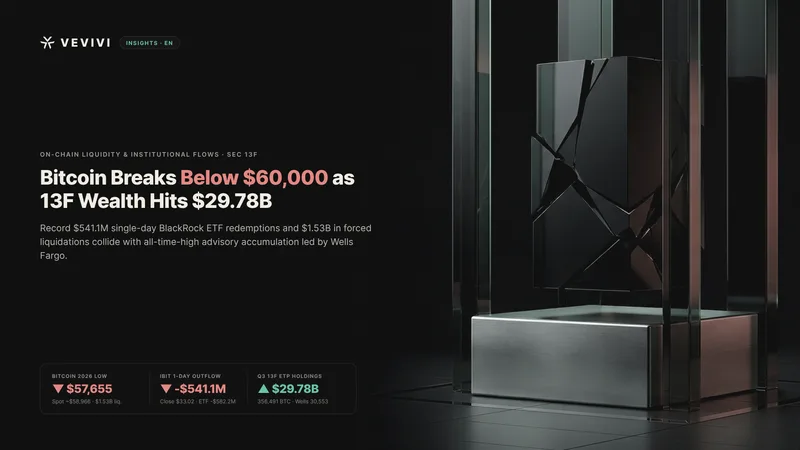
A sharp Bitcoin price crash below $60,000 to a 2026 intraday low of $57,655 on November 20 triggered $1.53 billion in 24-hour derivatives liquidations as the Nasdaq Composite plunged 5.28% to 22,617.73. Spot Bitcoin subsequently stabilized near $58,966 while Ether retreated 7.78% to $1,619, placing Bitcoin roughly 53% below its October 2025 record peak above $126,000 and down 25% month-to-date in its steepest monthly contraction since June 2022. Yet juxtaposing immediate exchange-traded redemptions against mandatory quarterly regulatory disclosures exposes a stark bifurcation between fast-moving tactical liquidity and multi-quarter wealth-management capital.
Bitcoin Price Crash Mechanics and Cross-Asset Drawdown Asymmetry
The Friday breakdown beneath the $60,000 psychological threshold briefly pushed Bitcoin under its July 1 summer trough of $57,717 to its lowest print since 2024. Across global perpetual and futures venues, forced unwinds wiped out $1.53 billion in leveraged positions within 24 hours, with long liquidations accounting for $1.40 billion and Bitcoin contracts absorbing roughly $540 million. Rather than originating from an isolated protocol failure, the cascade tracked an acute Wall Street equity repricing: the S&P 500 fell 3.70% to 6,910.39 to enter technical correction territory, Nvidia slid 14.01% to $125.53, and newly listed artificial intelligence developer Anthropic retreated toward its $83 initial public offering price after closing its $81.3 billion Thursday debut at $97.17.
Tactical Spot ETF Redemptions and Mining Equity Beta
Short-horizon institutional desks and momentum allocators transmitted equity stress directly into regulated spot wrappers. United States spot Bitcoin exchange-traded funds recorded $582.2 million in single-session net outflows, extending cumulative November redemptions to $3.47 billion. BlackRock's iShares Bitcoin Trust absorbed $541.1 million of that daily withdrawal—its largest single-day outflow since launching in January 2024—while its shares closed down 5.87% at $33.02. Listed crypto equities and power-intensive miners pivoting toward artificial intelligence data centers suffered amplified downside beta, with MARA Holdings tumbling 18.57% to $5.085, Strategy declining 9.67% to $77.80, and Coinbase dropping 6.34% to $101.97.
Cross-Asset Drawdowns Across Semiconductors and Precious Metals
Measured from cycle highs, cross-asset performance challenges media narratives that portray digital assets as uniquely impaired. While Bitcoin sits roughly 53% below its all-time high, leveraged cloud and semiconductor equities have endured comparable or deeper peak-to-trough compressions, including CoreWeave at minus 76%, Oracle at minus 68%, Intel at minus 61%, and Robinhood at minus 55%. Even silver experienced a 36% single-session collapse near its cyclical top and remains roughly 65% below its record high, demonstrating that tight dollar liquidity and hawkish rate expectations are repricing duration and leveraged positioning across every high-beta asset class simultaneously.
Record $29.78 Billion Q3 Form 13F Institutional Accumulation
Whereas daily ETF flow tables capture volatile cash-and-carry unwinds and tactical rebalancing, Securities and Exchange Commission Form 13F filings compiled by Galaxy Research on November 19 reveal resilient structural adoption beneath the surface. Across the third quarter ended September 30, 2026, a total of 2,166 institutional investment managers—up by 191 net filers as 358 newcomers entered against 167 exits—added a net 49,229 BTC-equivalent worth $4.11 billion. That buying reversed three consecutive quarters of net institutional reductions totaling 47,054 BTC and lifted aggregate 13F-reported holdings to an all-time high of 356,491 BTC-equivalent, valued at $29.78 billion, or 27.6% of total U.S. spot ETP supply.
Wirehouses and Registered Investment Advisors Overtake Hedge Funds
The composition of institutional ownership has shifted decisively from fast-money arbitrageurs toward fiduciary wealth platforms. Registered investment advisors, wirehouses, and broker-dealer wealth channels expanded their holdings for a ninth consecutive quarter to a record 144,307 BTC-equivalent, capturing 40.5% of all 13F-reported positions and 11.2% of all bitcoin held across U.S. spot funds. Wells Fargo emerged as the single largest 13F holder for the first time at 30,553 BTC-equivalent worth $2.55 billion—rising 91.8% from 15,931 BTC on June 30, with 85.1% housed inside client advisory and brokerage arms—surpassing market maker Jane Street at 23,167 BTC, alongside major additions from Brevan Howard (+8,606 BTC) and Bank of America (+7,201 BTC). Conversely, aggregate hedge fund ownership contracted to 19.0% of 13F holdings from 50.6% in December 2024, while BlackRock's fund still anchored 65.2% (232,453 BTC) of reported institutional positions. Investors must nevertheless recognize reporting lag: between September 30 and November 16, total bitcoin held across all U.S. spot ETPs declined by 38,531 BTC to 1,252,139 BTC during the fourth-quarter selloff.
Short-Term Treasury Cash Plumbing and On-Chain Market Infrastructure
Macroeconomic money-market plumbing added subtle friction to risk liquidity during the same week. On November 19, the U.S. Department of the Treasury auctioned $15 billion in 9-day Cash Management Bills at a 3.910% high rate with a 3.97x bid-to-cover ratio, settling November 24 and maturing December 3, 2026. Although routine as a bridge for month-end operating cash mismatches within Treasury's $628 billion fourth-quarter net marketable borrowing schedule and $850 billion year-end cash target, the sale marked the first 9-day bill issuance since July 21, 2008—a span of 18 years and 4 months—underscoring elevated front-end funding sensitivity as Federal Reserve officials debate December tightening while Treasury Secretary Scott Bessent publicly pushed back against a 50-basis-point hike.
UBS and Chainlink Automate Tokenized Structured Notes on Ethereum
Independent of secondary spot volatility, tier-one banks continue migrating complex post-trade workflows onto public blockchains. In a November 19 production pilot extending UBS Tokenize, UBS partnered with Chainlink using the Chainlink Runtime Environment to automate issuance and lifecycle servicing for tokenized structured notes on Ethereum. Across a global structured-products market exceeding $2 trillion in notional value—where fragmented corporate-action messaging and a 2% settlement-failure rate cost financial firms up to $3 billion annually—smart contracts and verified market-data oracles now track token balances, coupon entitlements, barrier proximity, and product status in real time ahead of planned future settlement integration with bank digital-money instruments.
CFTC Onshore Derivatives Rules and SEC Civil Fraud Enforcement
Federal regulators simultaneously reinforced strict legal boundaries between compliant onshore infrastructure and unregistered or fraudulent operators. Speaking at the Capitol Crypto Forum on November 19, Commodity Futures Trading Commission Chairman Michael Selig affirmed that decentralized perpetual venues such as Hyperliquid receive zero special regulatory exemptions to serve U.S. retail traders: while Hyperliquid Strategies disclosed a pending Futures Commission Merchant brokerage application on November 5, listing derivatives onshore requires either direct Designated Contract Market registration or partnering with an existing licensed exchange. Selig cited Backpack as a compliant blueprint after its affiliates secured federal Derivatives Clearing Organization registration on November 13, Designated Contract Market designation on November 16, and National Futures Association brokerage approval on November 18. On the same day, the SEC announced civil enforcement action 2026-115 in the U.S. District Court for the District of Colorado charging eight entities operating four fake adviser-platform pairs from August 2024 through May 2026 with stealing more than $37 million via social-media chat groups and forged regulatory certificates, removing associated Form D and Forms ADV filings.
Key Structural Questions for Institutional Allocators
Why did spot Bitcoin ETFs see record daily outflows right after record Q3 13F filings?
Form 13F disclosures capture discretionary institutional long holdings as of September 30, reflecting systematic quarterly model-portfolio allocations at wirehouses like Wells Fargo, whereas November's $3.47 billion outflow wave reflects real-time fourth-quarter deleveraging by momentum traders, basis desks, and tax-loss sellers reacting to tech equity drawdowns and hawkish rate pricing.
Does the $15 billion 9-day Treasury Cash Management Bill signal a systemic funding crisis?
No objective evidence points to Treasury insolvency, as the auction drew a robust 3.97x bid-to-cover ratio at 3.910% to bridge a nine-day fiscal receipt gap between November 24 and December 3, though relying on ultra-short tenors unused since July 2008 highlights tight short-term cash management alongside heavy sovereign issuance.
Can U.S. retail traders legally access Hyperliquid perpetual swaps directly today?
No; Hyperliquid remains unavailable to U.S. persons because a pending brokerage application by Hyperliquid Strategies does not authorize contract listing, meaning lawful U.S. retail access requires full exchange and clearinghouse licenses comparable to Backpack's three-part CFTC and NFA stack or an intermediated partnership with a registered venue.
Disclaimer and Risk Warning
This article is provided strictly for informational and educational purposes based on publicly available on-chain metrics and macroeconomic data. Nothing in this publication constitutes financial, investment, legal, or tax advice, nor should it be construed as a solicitation, recommendation, or offer to buy or sell any digital asset or financial instrument. Digital assets are subject to high market risk and extreme price volatility, and you may lose part or all of your invested capital. Historical market cycles and past performance referenced herein do not guarantee future results. You are solely responsible for your own investment decisions and should conduct independent research and consult a qualified financial advisor before making any financial commitments.