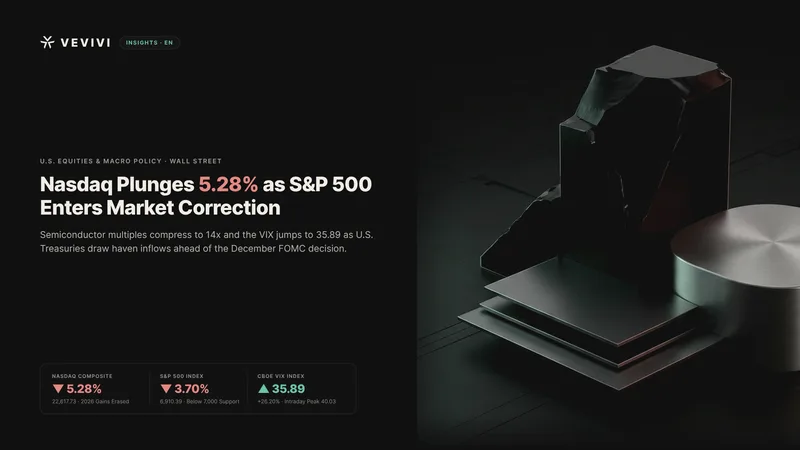
The US stock market selloff accelerated sharply on November 20, 2026, as the Nasdaq Composite plunged 5.28%—losing 1,261.47 points to close at 22,617.73—and erased its entire year-to-date advance. Selling pressure swept across major equity benchmarks simultaneously, pulling the S&P 500 down 3.70% (-265.44 points) to 6,910.39 and dragging the Dow Jones Industrial Average down 1.93% (-949.73 points) to 48,147.33. By slicing decisively through the 7,000 institutional support threshold on its seventh consecutive daily loss, the S&P 500 officially entered technical correction territory more than 10% below its October 6 record peak.
Cross-market volatility gauges confirmed intense institutional demand for downside protection. The CBOE Volatility Index (VIX) surged 26.20% from 28.44 to settle at 35.89 after touching an intraday peak of 40.03, accompanied by spiking equity put-to-call ratios. Within the epicenter of the artificial intelligence hardware complex, the PHLX Semiconductor Index (SOX) tumbled 10.73% to 8,408.59 with all 30 constituent chipmakers finishing in negative territory, raising an urgent allocation question for global desks: whether extreme technical exhaustion marks a durable market floor or merely sets up a short-lived tactical bounce ahead of deeper earnings revisions.
Technical Washout Signals Versus Single-Stock Shock Sensitivity
Short-term market internals display textbook signs of an indiscriminate liquidity flush. Momentum oscillators including relative strength indices and the share of S&P 500 constituents trading above their 20-day and 50-day moving averages have compressed to washed-out levels, while Thursday's session logged the worst advance-decline breadth spread of 2026 before non-technology defensive sectors began stabilizing slightly on Friday. Under normal institutional regimes, a VIX spike to 40.03 intraday (closing at 35.89) alongside elevated hedging activity establishes mechanical conditions for a short-term tradable rebound.
Yet market structure remains acutely vulnerable to single-stock headline shocks across crowded artificial intelligence leaders. Rather than absorbing company-specific news calmly, leveraged and benchmark-sensitive portfolios are treating regulatory inquiries and short-seller allegations as immediate triggers to de-risk entire semiconductor and infrastructure baskets.
Semiconductor Regulatory Scrutiny and Short-Seller Shockwaves
Nvidia shares plunged 14.01% (-$20.45) on November 20 to close at $125.53—testing a 52-week intraday low of $124.50 and compressing its equity valuation to $3.03 trillion—after news surfaced that U.S. Securities and Exchange Commission civil enforcement staff are conducting a preliminary inquiry into potential accounting matters. In strict legal and regulatory terms, this SEC action represents an early-stage civil staff review rather than formal charges or any established finding of wrongdoing, compounding an official state investigative subpoena served on November 19 by California Attorney General Rob Bonta examining whether advanced chips or confidential information reached China and whether investor disclosures complied with California corporate securities law.
Elsewhere in the PHLX Semiconductor Index, Advanced Micro Devices dropped 13.25% to $424.39 on Friday, extending a 7.72% decline to $489.19 on November 19 after short-seller Hunterbrook Capital published a disputed report alleging that Entity-Listed Chinese server manufacturer IEIT Systems continued integrating newer AMD server firmware while highlighting $7.8 billion in fiscal 2025 China and Hong Kong billings plus $4.3 billion billed to Singapore; AMD formally rejected the characterization, and no regulatory finding of an export-control violation has been established. Memory chip leader Micron Technology fell 13.89% to $594.51 as indiscriminate de-grossing hit every hardware supplier in the 30-stock index.
Why the US Stock Market Selloff Compressed Multiples Without Ending Earnings Risk
Institutional strategists at NewEdge Wealth and the Schwab Center for Financial Research emphasize a critical distinction between a tactical oversold bounce and an ultimate cyclical low. Following November's rapid derating, the S&P 500 forward price-to-earnings ratio has compressed to roughly 17x, while semiconductor equities in the PHLX Semiconductor Index have contracted to roughly 14x forward earnings—with the technology sector alone accounting for nearly 80% of the S&P 500's total P/E multiple decline in 2026.
Historically, when broad equity multiples compress to 17x and semiconductor multiples fall to 14x while trailing revenue growth still looks robust, the market is actively front-running downward revisions to consensus 2027 and 2028 earnings estimates. Past institutional drawdown cycles demonstrate two disciplined rules: first, forward valuation multiples exhibit virtually zero statistical correlation with one-year forward S&P 500 returns, making P/E ratios a poor standalone market-timing tool; second, durable cyclical bottoms rarely form while investors are merely anticipating earnings cuts—institutional capital typically steps in aggressively only after the first wave of 2027 and 2028 consensus estimate cuts officially begins.
Primary Equity Supply and High-Yield AI Infrastructure Debt
Capital market absorption is simultaneously being tested by historic primary equity issuance and rising debt-financing costs across frontier artificial intelligence infrastructure. On its second day of Nasdaq trading on November 20, Anthropic fell 8.50% from Thursday's $97.17 close to finish at $88.91 after sliding to an intraday low of $83.05—just $0.05 above its $83.00 initial public offering price—even as lead underwriters exercised their full 147 million-share greenshoe option to lift gross IPO proceeds to $93.5 billion, or $119.5 billion including a concurrent $26.0 billion Class N private placement.
In the credit markets, SpaceX priced $32 billion in off-balance-sheet debt backed by Nvidia Rubin chips through Saturn Funding Trust—part of a broader financing package exceeding $40 billion covering $47.3 billion in GPU hardware—with its $25.2 billion Class A3 tranche yielding 8.259%, more than 230 basis points above the 5.95% U.S. investment-grade corporate bond average. Together, heavy public float expansion and 8.259% structured hardware yields underscore that capital markets are demanding a significantly steeper risk premium to fund artificial intelligence capital expenditures.
Federal Reserve Policy Friction and Cross-Asset Bond Haven Rotation
Macroeconomic policy tension ahead of the December 8–9, 2026 Federal Open Market Committee meeting (with the federal funds target range currently at 3.75% to 4.00%) further complicates equity valuation support. In an official speech in Santiago on November 20, Federal Reserve Governor Lisa Cook stressed that U.S. personal consumption expenditures inflation has remained above the 2% target for 67 consecutive months, estimating October 12-month headline PCE inflation at 3.8% and core PCE at 3.2% alongside third-quarter real GDP growth of 3.4%, annualized real household spending growth of 3.8%, October payroll gains of 165,000 at a 4.1% unemployment rate, and more than $2 trillion in announced U.S. data-center construction projects. Having dissented in October in favor of an immediate 25 basis point hike, Cook warned that policymakers lack the luxury of patience lest inflation expectations become unanchored.
At the same time, overt friction emerged between fiscal officials and FOMC hawks over the pace of tightening. On November 20, U.S. Treasury Secretary Scott Bessent publicly urged the central bank not to pursue an outsized 50 basis point hike in December—pushing back against earlier 50 basis point warnings—leaving interest-rate futures pricing more than 95% odds of a standard 25 basis point increase at the December 8–9 meeting.
Treasury Safe-Haven Bid Versus Digital Asset High-Beta De-Risking
One constructive cross-asset shift emerged inside sovereign fixed income on Friday. After spending much of 2026 moving inversely to traditional portfolio diversification norms, U.S. Treasuries attracted a decisive safe-haven bid at the expense of equities: the U.S. 10-year Treasury yield dropped 11 basis points from 5.04% late Thursday to 4.93%, lifting the iShares 20+ Year Treasury Bond ETF (TLT) by 1.37% to $81.45.
By contrast, liquid digital assets traded strictly in lockstep with high-beta Nasdaq growth risk rather than sovereign duration safety. As leveraged cross-asset books reduced gross exposure during the afternoon equity slide, Bitcoin broke below the $60,000 threshold to trade near $58,967 (-4.76%), confirming that macro liquidity tightening and technology multiple compression continue to govern short-term crypto beta.
Retail AI Positioning Bifurcation and Institutional Triggers for a Durable Floor
Positioning data reveal a stark bifurcation between the broader non-technology market and mega-cap artificial intelligence equities. Following the initial post-election equity pullback earlier in November, retail cohorts did not capitulate; instead, single-stock flow trackers recorded some of the strongest net retail dip-buying on record concentrated indiscriminately in mega-cap artificial intelligence names, leaving crowded positioning unwashed entering Friday's breakdown.
For institutional portfolio managers evaluating capital deployment into year-end and early 2027, distinguishing a fleeting technical bounce from a durable market bottom rests on three measurable checkpoints. First, post-close settlement and flow data must confirm genuine positioning capitulation among crowded single-stock artificial intelligence holders rather than premature retail dip-buying. Second, sell-side consensus for 2027 and 2028 technology and semiconductor earnings must begin formal downward resets so compressed 17x S&P 500 and 14x SOX multiples reflect achievable profit baselines. Third, the December 8–9 FOMC decision must clarify whether a 25 basis point hike stabilizes long-end Treasury yields below 5.00% without triggering credit spread contagion across 8%+ debt-financed infrastructure vehicles.
Key Institutional Questions on Market Structure and Positioning
Does S&P 500 compression to 17x and semiconductor valuation at 14x signal an immediate long-term bottom?
Not automatically. Nearly 80% of the S&P 500's P/E contraction in 2026 has come from technology, and compression to 17x on the S&P 500 and 14x on the PHLX Semiconductor Index historically signals that institutional desks anticipate cuts to 2027 and 2028 earnings estimates. While VIX at 35.89 (40.03 intraday) supports a tactical oversold bounce, historical cycles favor buying the first actual earnings estimate cut rather than relying on forward multiples alone as a timing indicator.
Why did U.S. Treasury yields fall to 4.93% while Bitcoin dropped to $58,967 during the equity rout?
Friday's 5.28% Nasdaq slide to 22,617.73 and 3.70% S&P 500 drop to 6,910.39 restored traditional flight-to-safety demand for sovereign duration, pulling the 10-year Treasury yield down 11 basis points from 5.04% to 4.93% and lifting TLT 1.37% to $81.45 despite 3.8% estimated October PCE inflation and 95%+ odds of a 25 basis point December hike. Conversely, Bitcoin (-4.76% near $58,967) absorbed high-beta liquidity de-risking alongside leveraged semiconductor and artificial intelligence equity positions.
Disclaimer and Risk Warning
This article is provided strictly for informational and educational purposes based on publicly available on-chain metrics and macroeconomic data. Nothing in this publication constitutes financial, investment, legal, or tax advice, nor should it be construed as a solicitation, recommendation, or offer to buy or sell any digital asset or financial instrument. Digital assets are subject to high market risk and extreme price volatility, and you may lose part or all of your invested capital. Historical market cycles and past performance referenced herein do not guarantee future results. You are solely responsible for your own investment decisions and should conduct independent research and consult a qualified financial advisor before making any financial commitments.