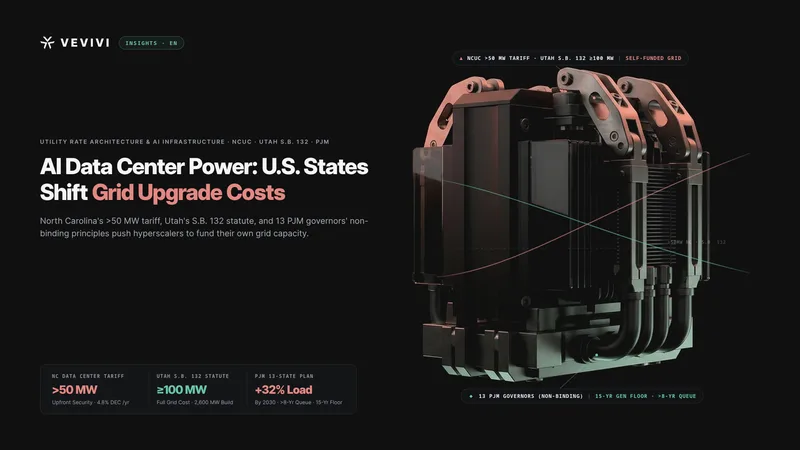
AI data center power is turning into a question of who pays for the grid. In North Carolina, regulators approved new Duke Energy rates on November 16, 2026 together with a separate rate schedule for data centers above 50 MW. Utah's S.B. 132 makes customers of 100 MW or more cover the cost of their own electric service. The 13 governors of the PJM region have agreed that the cost of new emergency capacity should fall on data centers unless they bring their own power or accept curtailment. The National Governors Association announcement of November 22 is a separate matter: its 24 AI principles deal with AI safety, workers, children, privacy and the division between federal and state law, not with electricity.
How North Carolina's Rate Order Puts Data Center Costs on Data Centers
The North Carolina Utilities Commission order announced by Duke Energy sets new rates from January 1, 2027 for Duke Energy Carolinas, with about 2.3 million households and businesses, and Duke Energy Progress, with about 1.6 million customers. Residential rates rise an average of 4.8% a year over two years at Duke Energy Carolinas and 4.7% at Duke Energy Progress. For a typical household using 1,000 kWh a month, that means $6.53 more on January 1, 2027 and $4.66 more on January 1, 2028 at Duke Energy Carolinas, $11.19 a month in total, and $9.62 plus $5.89, or $15.51, at Duke Energy Progress.
The same order creates a new rate schedule for data center customers with loads above 50 MW. It keeps many of Duke Energy's existing data center requirements and adds upfront dedicated-facility payments, financial requirements for transmission upgrades and security requirements against stranded generation investments, with the stated aim of insulating existing customers from the cost and financial risks of new data centers. Duke Energy must refund customers with interest if planned upgrades are not completed on time, and its shareholders add $20 million to help customers in need. Duke Energy's summary of the order does not say how much of the increase comes from data centers; what it changes is who carries the risk of a plant built for a customer that later leaves.
Utah S.B. 132: Contracted Grid Power or Closed Private Generation
A briefing paper from the Utah Legislature's nonpartisan research office describes S.B. 132 of 2025, which sets a separate process for customers with a peak demand of 100 MW or more. They can sign contracts approved by the Public Service Commission with a qualified utility or generation provider, or build a closed private generation system that produces and uses power on site without any connection to the grid. Both paths are meant to make these customers responsible for the cost of their own electric service, including system upgrades and transmission requests. The law covers electric service only; it sets no fuel, environmental or energy-use limits.
The scale explains the urgency. Utah needed an average of about 4 GW to meet statewide electricity demand in 2025, and 100 MW is enough for about 60,900 average Utah homes. Data centers already under construction will need about 2,600 MW of additional power, more than double what data centers use in the state today, and three hyperscale projects account for roughly 2,350 MW of it. Rocky Mountain Power evaluated nearly 3,000 MW of requests from large customers over six months. Nationally, at least 700 hyperscale and colocation data centers are expected to come online within five years, requiring more than 55 GW, and Amazon Web Services, Microsoft and Google held 58% of global hyperscale capacity as of December 2025.
Utah is also narrowing incentives and watching water. Under H.B. 507, from May 6, 2027 local governments may no longer offer sales and use tax increment financing to data centers of 100 MW or more outside regionally significant development zones; earlier agreements continue but cannot be extended. H.B. 76 requires water reporting from data centers that withdraw 75 acre-feet a year or more and began operating on or after July 1, 2026. Closed-loop cooling can cut the water needed for cooling by up to 70% compared with evaporative systems.
PJM Governors' Principles: Backstop Capacity Costs Assigned to Data Centers
The NGA review of regional energy affordability puts the national picture in numbers: electricity demand is forecast to grow 5.7% a year over five years, reaching 32% more by 2030. Data centers used 4.4% of U.S. electricity in 2023, and Lawrence Berkeley National Laboratory expects 6.7% to 12.0% by 2028. In the 13-state PJM region, 40 GW of conventional fossil generation is at risk of retiring by 2030, and projects that came online in 2025 spent more than eight years on average getting connected to the grid.
On January 15, 2026, all 13 PJM governors signed a Statement of Principles with Interior Secretary Doug Burgum and Energy Secretary Chris Wright. It calls for a reliability backstop auction by September 2026 with a 15-year price guarantee for new generators. Its cost goes first to load-serving entities; governors then agreed to have state regulators design large-load rate classes that pass that cost to data centers. Data centers that have procured their own power, or agree to cut their use when demand peaks, are not expected to pay for the backstop. The principles also extend existing price limits over the next two base auctions to freeze prices through 2030, set a 150-day limit for interconnection studies and aim to reform the capacity market in time for the May 2027 auction. They are not binding.
The same review flags a forecasting problem. Grid Strategies found that, nationwide, utilities collectively project 90 GW of new demand by 2030 while other analysts project closer to 65 GW, an overstatement of as much as 40%. The principles ask PJM to count only "real new demand", meaning demand backed by an executed energy service agreement, credit or collateral support, or another material commitment, so that future users are not counted twice.
Fed Policy, Household Debt and Two-Sided Hypotheses
The Federal Reserve is not cutting. In its October 28 statement, the Federal Open Market Committee kept the federal funds rate at 3.75% to 4.00% by a 10 to 2 vote, describing strong economic activity, robust capital investment and elevated inflation. The two dissenters, Lisa D. Cook and Beth M. Hammack, wanted a 0.25 percentage point increase.
The bill increases arrive as household debt keeps growing. The New York Fed's third-quarter household debt report shows total household debt up $334 billion, or 1.8%, to $19.1 trillion, with credit card balances at $1.29 trillion. The share of card balances moving into serious delinquency of 90 days or more was 6.87%, down from 7.05% a year earlier. The Federal Reserve's G.19 consumer credit release puts total consumer credit at $5.22 trillion at the end of September and the commercial bank card rate on accounts charged interest at 22.36%.
Bullish hypothesis: rules that price grid risk up front, such as North Carolina's 50 MW schedule, Utah's two paths and PJM's large-load rate classes, replace open-ended disputes with contracts. Projects that secure their own power, or accept curtailment, stay outside the PJM backstop cost and can keep their schedules.
Bearish hypothesis: prepayments, collateral and transmission financial requirements raise the capital a project needs before it draws any power. With the Fed holding at 3.75% to 4.00% and two members preferring an increase, that capital is not getting cheaper, and grid connections that take more than eight years keep grid-dependent projects waiting.
Watch Points and Frequently Asked Questions
- January 1, 2027: new North Carolina rates take effect, $6.53 a month more at Duke Energy Carolinas and $9.62 at Duke Energy Progress for 1,000 kWh, and the two utilities combine with separate rates. The second step follows on January 1, 2028.
- Whether Duke Energy finishes the planned upgrades on time; if not, customers receive refunds with interest.
- May 6, 2027: the end of new sales and use tax increment financing for Utah data centers of 100 MW or more.
- PJM: whether forecasts move toward the 65 GW estimate once only real new demand counts, whether the 150-day study limit holds, and the May 2027 auction.
- Where data centers land within the 6.7% to 12.0% range for 2028.
The bearish hypothesis weakens if the 150-day study limit takes hold and connection times fall well below eight years. The bullish one weakens if state regulators do not adopt large-load rate classes, because the PJM principles are not binding.
Why are U.S. states making AI data centers pay for their own power?
To keep existing customers from carrying the cost and risk of new large loads. North Carolina's order adds upfront payments and security against stranded generation for data centers above 50 MW, Utah's S.B. 132 makes customers of 100 MW or more responsible for their own service and upgrades, and the PJM governors want backstop capacity costs passed to data centers that do not bring their own power. Households in North Carolina still face $11.19 to $15.51 more a month by 2028 for 1,000 kWh.
Do the NGA AI principles require data centers to supply their own power?
No. The 24 principles published on November 22, five shared priorities, five federal recommendations and 14 state principles, cover AI safety and innovation, oversight of frontier models, national security, a careful approach to federal preemption, consumer harms, children, workers, automated decisions in housing, employment, lending and insurance, cybersecurity and privacy. They do not mention electricity. The power rules come from state regulators, state laws such as Utah's and the PJM principles of January 15, which are not binding.
What does a 100 MW data center mean for Utah's grid?
About as much power as 60,900 average Utah homes, against statewide demand that averaged about 4 GW in 2025. Data centers under construction need about 2,600 MW more, and Rocky Mountain Power evaluated nearly 3,000 MW of requests in six months. Under S.B. 132, a customer of that size either signs a contract approved by the Public Service Commission or generates its own power off the grid.
Sources
- Governors Call for AI Action — National Governors Association, 2026-11-22
- Federal and State Roles in AI Regulation: Statement of Principles — National Governors Association, 2026-11-22
- North Carolina regulators approve more cost-effective path to strengthen reliability and power the state's future — Duke Energy, 2026-11-17
- Data Centers: An Overview of Regulatory Thresholds, Tax Incentives, and Energy Demand — Utah Office of Legislative Research and General Counsel, 2026-08-12
- Governors Collaborate to Ensure Regional Energy Affordability — National Governors Association, 2026-01-21
- Federal Reserve issues FOMC statement — Board of Governors of the Federal Reserve System, 2026-10-28
- Household Debt Increased Moderately; Delinquency Transition Rates Remain Flat — Federal Reserve Bank of New York, 2026-11-10
- Consumer Credit – G.19, September 2026 — Board of Governors of the Federal Reserve System, 2026-11-06
Disclaimer and Risk Warning
This article is provided strictly for informational and educational purposes based on publicly available on-chain metrics and macroeconomic data. Nothing in this publication constitutes financial, investment, legal, or tax advice, nor should it be construed as a solicitation, recommendation, or offer to buy or sell any digital asset or financial instrument. Digital assets are subject to high market risk and extreme price volatility, and you may lose part or all of your invested capital. Historical market cycles and past performance referenced herein do not guarantee future results. You are solely responsible for your own investment decisions and should conduct independent research and consult a qualified financial advisor before making any financial commitments.