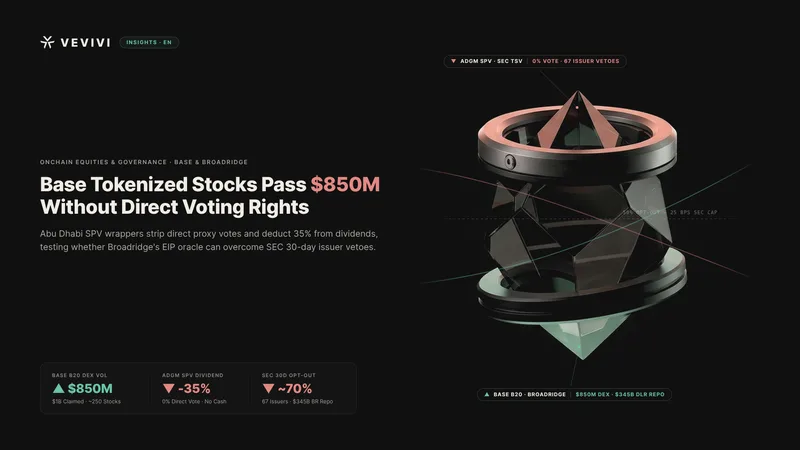
Base tokenized stocks have surged past $850 million in verified weekly decentralized exchange volume according to Token Terminal data through November 13, 2026, while executive disclosures claim total weekly turnover just crossed $1 billion across roughly 250 permissionless B20 equity tokens. Launched offshore on August 24, 2026 atop Base's custom Azul execution stack with 200-millisecond block times, these tokenized shares have also accumulated approximately $30 million in on-chain money-market borrowing, lifting Base ahead of Solana as the second-largest on-chain financing network behind Ethereum.
Yet that rapid offshore liquidity expansion stands in sharp contrast to both equity market pricing and underlying legal documentation. On Friday, November 20, 2026, Coinbase Global, Inc. closed down 6.34% at $101.97 after touching a 52-week intraday low of $101.71, NVIDIA Corp. fell 14.01% to $125.53, Broadridge Financial Solutions, Inc. settled at $181.41, and Ethereum traded near $1,703.36 on November 22. More importantly, a line-by-line reading of the offshore offering prospectus reveals a structural gulf between synthetic DeFi composability and enforceable U.S. National Market System shareholder ownership.
How Base Tokenized Stocks Separate Price Exposure From Direct Shareholder Rights
Public executive commentary has framed Base's equity tokens as one-to-one fully backed instruments carrying voting rights, dividends, and zero debt-wrapper risk. However, the official offering prospectus for the NVIDIA token demonstrates that non-U.S. buyers are not acquiring direct book-entry shares registered at The Depository Trust Company. Instead, the legal issuer is Coinbase Onchain SPV Ltd, a special purpose vehicle incorporated in the Abu Dhabi Global Market, and each token represents a contractual certificate of beneficial interest in underlying shares held in trust at U.S. broker-dealer Alpaca Securities.
That offshore SPV wrapper alters shareholder economics across three concrete dimensions. First, token holders possess 0% direct voting rights; the Abu Dhabi issuer merely states that it may attempt to submit proxy votes on behalf of holders who clear internal eligibility checks, offering no legal guarantee of execution. Second, investors receive 0% cash dividends; gross corporate distributions are reduced by a 5% administrative fee plus a 30% U.S. statutory nonresident withholding tax—a combined 35% haircut—before the net remainder is forcibly reinvested into fractional underlying shares. Third, all roughly 250 B20 tokens were listed offshore on a 100% permissionless basis without prior consent from the underlying public corporations, and remain strictly off-limits to U.S. persons.
For active DeFi traders posting $30 million of tokenized equities as lending collateral, this wrapper introduces asymmetric weekend gap risk. Underlying shares held at Alpaca Securities can only be created, redeemed, or hedged without friction during U.S. cash market hours, whereas Base liquidations execute 24 hours a day at 200-millisecond intervals. When a high-beta benchmark such as NVIDIA drops 14.01% in a single Friday session to $125.53, weekend thin order books can force DeFi money-market liquidators to clear collateral at steep discounts to net asset value before traditional equity market makers reopen on Monday morning.
Weighing the Institutional Bull Case Against the Onshore Regulatory Bottleneck
Evaluating whether Coinbase and Base can convert offshore retail momentum into durable U.S. institutional market share requires testing the bullish infrastructure thesis symmetrically against onshore securities law constraints.
The Institutional Infrastructure Bull Case
Proponents argue that Base is assembling a full-stack settlement rail before competitors lock in liquidity network effects. On November 16, 2026, Coinbase Global and Broadridge Financial Solutions published an open technical standard—submitted as an Ethereum Improvement Proposal alongside the new Broadridge Data Oracle—to deliver corporate-action and proxy notices directly to digital wallets with verifiable proof of aggregate distribution. Broadridge brings entrenched Wall Street plumbing: its Distributed Ledger Repo platform settles over $345 billion in daily tokenized repos ($7.6 trillion in October 2026), and its broader systems process 8 billion annual investor communications underpinning $18 trillion in daily global securities trading.
Alongside governance messaging, institutional payment rails are converging on Base. Citigroup commercial banking accounts now accept USDC stablecoins directly on Base via the Coinbase Developer Platform, while autonomous software agents use the x402 protocol to execute $0.01 to $0.02 micropayments for market data and compute inference. Because Base leadership reiterated on November 21, 2026 that a native network token remains strictly exploratory with no rush to launch, sequencer fees and stablecoin float economics accrue directly to Coinbase Global rather than facing immediate token-unlock dilution.
The Onshore Regulatory and Legal Bear Case
Skeptics counter that a messaging standard cannot cure a legal wrapper deficit. As Broadridge's own disclosures confirm, the proposed EIP framework is strictly a communications protocol: it does not create direct voting or dividend rights unless the underlying share structure legally grants them. To serve U.S. investors, Coinbase cannot simply import its Abu Dhabi SPV tokens; it must comply with U.S. Securities and Exchange Commission Release No. 2026-90, the five-year conditional Innovation Exemption issued on September 17, 2026 under Section 36(a)(1) of the Securities Exchange Act of 1934 for Tokenized Securities Venues.
The SEC order imposes three rigid guardrails that invert Base's permissionless offshore model. First, every tokenized National Market System stock traded on a U.S. venue must confer the exact same legal rights and privileges—including full voting and cash dividend parity—as traditional shares of the equivalent class. Second, onshore venues face strict symbol ceilings, trading volume caps as low as 25 basis points (0.25%) of underlying share volume, and mandatory concurrent trading halts whenever the primary listing exchange pauses trading. Third, any venue listing shares tokenized by an unaffiliated third party must deliver formal written notice to the corporate issuer and honor a 30-day issuer opt-out veto.
Lessons From the 67 Issuer Opt-Outs on OKX-ICE and Weekend Liquidity Risks
Real-world precedent shows that corporate treasurers and general counsels actively exercise that veto. Ahead of the November 23, 2026 launch of the OKX-ICE Tokenized Securities Venue—a regulated joint venture backed by Intercontinental Exchange, parent of the New York Stock Exchange—67 public companies opted out within the 30-day window, blocking roughly 70% of targeted corporate equities including Apple, Tesla, Meta, Broadcom, Verizon, UnitedHealth, CoreWeave, and Cerebras. Consequently, OKX-ICE had to anchor its 70-plus launch roster around 59 Direxion exchange-traded funds and crypto-native companies such as Coinbase, Circle, Robinhood, and Strategy.
Corporate reluctance reflects tangible market-structure hazards rather than mere technological conservatism. International Monetary Fund estimates place global tokenized equities at just $2.3 billion out of $65.1 billion in tokenized real-world assets, leaving fragmented pools vulnerable to off-hours price dislocations—exemplified by an offshore Hims & Hers stock token spiking 4.5 times above its cash equity price to $132 during illiquid trading. Furthermore, second-order nonlinearities cut both ways: while 200-millisecond blocks tighten spreads during calm sessions, per-venue 25-basis-point SEC volume caps prevent onshore automated market makers from absorbing institutional block flows during volatility spikes, fragmenting depth across permissioned soulbound-token pools and offshore permissionless DEXs.
Quantitative Trader Watch-Levels and Thesis Invalidation Thresholds
Rigorous positioning requires separating unverified interview claims—such as the self-reported $1 billion weekly total volume and $30 million loan figure—from independently observable on-chain and regulatory metrics.
Under a bullish expansion scenario, verified Token Terminal weekly DEX volume for Base B20 equities sustains above $1.0 billion for four consecutive weeks, on-chain equity collateralized borrowing scales past $75 million with zero weekend oracle bad debt, and Coinbase Global reclaims $115.00 above its $101.71 52-week low as Broadridge ProxyVote wallet integration persuades at least 50% of approached S&P 500 issuers to waive their 30-day SEC objection. Under the base-case bifurcation scenario, offshore B20 DEX turnover consolidates between $600 million and $900 million per week among non-U.S. retail traders, while U.S. onshore Tokenized Securities Venues remain capped near 25 basis points of NMS turnover and concentrated in ETFs.
Conversely, the onshore growth thesis is formally invalidated if S&P 500 issuer opt-out rates exceed 50% upon Coinbase's formal U.S. TSV filing, if Abu Dhabi Global Market regulators restrict permissionless third-party corporate SPV issuance, or if verified weekly Base B20 DEX volume contracts below $400 million.
Key Investor Questions on Tokenized Equities and Onchain Governance
Do holders of Coinbase's offshore B20 stock tokens receive direct voting rights or cash dividends?
No. Under the Coinbase Onchain SPV Ltd prospectus registered in the Abu Dhabi Global Market, token holders receive beneficial-interest certificates over shares custodied at Alpaca Securities with 0% direct voting rights and 0% cash payouts. Dividends incur a 5% administrative fee plus 30% U.S. withholding tax before automatic fractional reinvestment.
Does the Coinbase and Broadridge EIP standard automatically grant legal shareholder rights?
No. Broadridge Financial Solutions and Coinbase designed the November 16, 2026 Ethereum Improvement Proposal and Broadridge Data Oracle strictly as an interoperable wallet messaging and distribution-proof layer. Enforceable proxy voting and cash dividend parity still depend entirely on the legal custody structure of the underlying security.
How does the SEC 30-day issuer opt-out rule restrict U.S. tokenized stock platforms?
Under SEC Release No. 2026-90 issued on September 17, 2026, U.S. Tokenized Securities Venues operating under the five-year Innovation Exemption must guarantee full NMS shareholder rights, obey volume caps as tight as 25 basis points, and give public companies 30 days to veto third-party listings—a mechanism 67 issuers used against OKX-ICE.
Primary Sources and Official Filings
U.S. Securities and Exchange Commission Release No. 2026-90, Order Granting Temporary Conditional Exemptive Relief Pursuant to Section 36(a)(1) of the Securities Exchange Act of 1934 for Tokenized NMS Stocks (September 17, 2026); Broadridge Financial Solutions, Inc. and Coinbase Global, Inc. Joint Release on Proposed EIP Standard for Onchain Shareholder Communications and Broadridge Data Oracle (November 16, 2026); Coinbase Onchain SPV Ltd (Abu Dhabi Global Market) NVIDIA Token Prospectus and Alpaca Securities Trust Custody Disclosures; Token Terminal Base Decentralized Exchange Weekly Volume Dataset (November 13, 2026); International Monetary Fund Global Tokenized Real-World Asset Estimates; NASDAQ and NYSE Official Closing Market Data (November 20, 2026).
Disclaimer and Risk Warning
This article is provided strictly for informational and educational purposes based on publicly available on-chain metrics and macroeconomic data. Nothing in this publication constitutes financial, investment, legal, or tax advice, nor should it be construed as a solicitation, recommendation, or offer to buy or sell any digital asset or financial instrument. Digital assets are subject to high market risk and extreme price volatility, and you may lose part or all of your invested capital. Historical market cycles and past performance referenced herein do not guarantee future results. You are solely responsible for your own investment decisions and should conduct independent research and consult a qualified financial advisor before making any financial commitments.