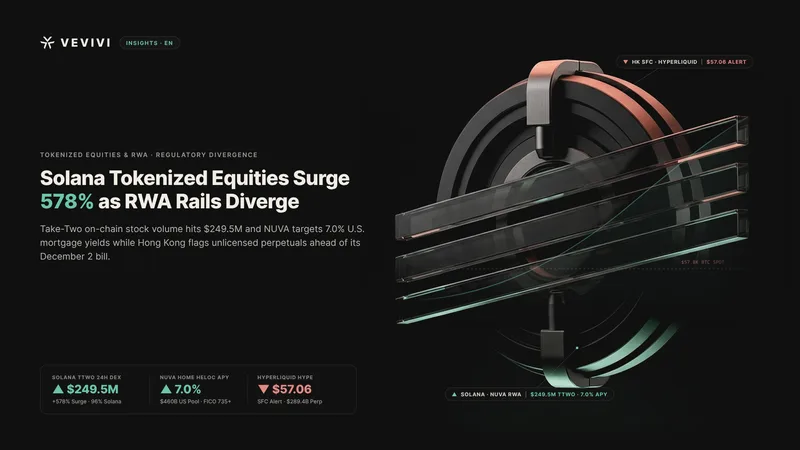
Solana tokenized equities jumped 578% to $249.5 million in single-day decentralized volume even as Bitcoin slid to $57,771. Across digital asset markets as of November 21, 2026, Ethereum traded near $1,638, Solana hovered at $65.76, and Nvidia closed Friday's session down 14.01% at $125.53, exposing a sharp structural split between macro-sensitive spot beta and cash-flow-anchored tokenization rails. Rather than chasing unbacked speculative tokens, institutional and cross-border allocators are concentrating capital into 1:1 custodied public equities, regulated secondary private shares, and overcollateralized real-world credit vaults while global securities regulators tighten the perimeter around unlicensed offshore derivatives.
How Solana Tokenized Equities Outpaced Crypto Spot Markets
Catalyst-driven equity rotation around the November 18, 2026 console release of Grand Theft Auto VI turned Take-Two Interactive into a live stress test for blockchain equity settlement. According to Token Terminal and market data, decentralized exchange volume in tokenized Take-Two shares climbed 578% from $36.8 million to $249.5 million in 24 hours, accounting for 42% of the entire $590.7 million tokenized stock sector on decentralized venues and nearly tripling the $88.1 million recorded by tokenized Nvidia on the same day. Roughly 96% of that turnover—approximately $239 million—executed through a single Solana-based token issued by Backpack Securities and backed 1:1 by underlying shares held in regulated custody, while Take-Two stock on Nasdaq settled at $210.00 on November 20 with a $39.31 billion market capitalization.
Regulated Pre-IPO Secondary Shares Versus Unauthorized Game Tokens
Animoca Brands Co-Founder and Executive Chairman Yat Siu emphasized that major Western entertainment publishers remain unwilling to issue native in-game tokens until comprehensive federal market-structure legislation—specifically the pending CLARITY Act, a House-passed bill awaiting Senate action—establishes statutory certainty in the United States. That legal vacuum explains why rumors of an official Solana currency inside Grand Theft Auto VI remained unfounded while blockchain security firm Blockaid flagged more than 8,800 unauthorized GTA VI tokens on Solana as malicious or spam. By contrast, compliant equity tokenization is scaling rapidly across private and newly public issuers: Republic minted $23.0 million in tokenized Animoca Brands ordinary shares on Solana on May 5, 2026 under OCC-regulated BitGo Bank & Trust custody for secondary trading on the SEC- and FINRA-registered INX Securities alternative trading system alongside $85.8 million in SpaceX-linked preSPCX and $24.7 million in OpenAI-linked preOPAI instruments, while tokenized Anthropic shares went live on Solana across Backpack, Ondo, xStocks, and Securitize during its November 19 Nasdaq debut.
Institutional RWA Credit Vaults Disintermediate Bank Yield Spreads
Beyond continuous weekend and holiday price discovery for equities, blockchain settlement rails are compressing legacy banking intermediation spreads in residential private credit. Co-incubated by Animoca Brands and Nuva Labs—formerly Provenance Blockchain Labs, which anchors an ecosystem exceeding $30 billion in real-world asset total value locked—the NUVA marketplace launched its ERC-20 HOME vault token on Ethereum with a 1 USDC minimum for eligible non-U.S. investors, followed on October 9, 2026 by a strategic institutional distribution alliance with $1.83 trillion asset manager Franklin Templeton.
Underwriting Discipline and Redemption Mechanics in U.S. HELOC Pools
Backed by home equity lines of credit originated through Figure Technology Solutions within a U.S. HELOC asset class that Federal Reserve data places at $460 billion, the NUVA HOME vault targets a variable 7.0% annual yield recalculated monthly, compared with the 3.0% to 4.0% pass-through rates typically retained by commercial bank depositors. While public commentary occasionally compares on-chain credit accrual to instant hourly liquidity, official vault disclosures specify that the 7.0% target is variable and non-guaranteed, safeguarded by a minimum 735 average borrower FICO score, a 69% maximum combined loan-to-value cap, a 40% debt-to-income ceiling, a 5% first-loss equity buffer, a 5% liquid reserve, and an estimated two-U.S.-business-day standard redemption window.
SEC Staff Buyback Guidance Ends the Defensive Memecoin Era
Tokenized equities and real-world credit vaults are simultaneously raising the hurdle rate for native crypto tokens by forcing protocols to compete directly against transparent corporate income statements. Physical-backed collectible rails illustrate how verifiable underlying value anchors liquidity: Solana-based Collector Crypt has vaulted more than 130,000 graded physical trading cards in insured Delaware facilities and crossed $1.6 billion in cumulative volume—capturing 64% of Solana's tokenized card market and $154.3 million in 30-day decentralized volume—because every token maps 1:1 to an externally priced physical asset.
For fungible protocol tokens, regulatory clarity in Washington is replacing the defensive memecoin structure of prior years. On September 28, 2026, the U.S. Securities and Exchange Commission Division of Corporation Finance revised Question 2.5 of its Crypto Asset staff FAQs—subsequently updated on November 2, 2026—clarifying that where a crypto system is functional and has no central party, an issuer's announcement of a non-security token buyback program does not constitute a promise of essential managerial efforts under the Howey test. Investors must nonetheless note the exact legal stage: these FAQs represent non-binding staff guidance rather than a Commission rule, and the broader Regulation Crypto Assets framework issued on August 18, 2026 under Release No. 33-11434 remains a proposed rule awaiting final adoption.
Perpetual Liquidity Moats Meet Hong Kong Licensing Bifurcation
On-chain derivatives illustrate both the power of revenue-backed token economics and the widening regulatory divide across jurisdictions. According to DefiLlama data as of November 21, 2026, decentralized perpetuals incumbent Hyperliquid commands $7.09 billion in total value locked, $289.44 billion in 30-day perpetual volume, $5.86 trillion in cumulative perpetual volume, $5.38 billion in open interest, and $99.13 million in 30-day fees, routing 99% of net perpetual trading fees ($75.45 million in 30-day protocol revenue) to its Assistance Fund for HYPE token buybacks even as HYPE trades at $57.06, down 41.8% from its $97.96 peak. Challenging that liquidity moat, Solana R&D firm Temporal—whose HumidiFi proprietary automated market maker captures up to 60% of Solana spot volume—unveiled Supermassive on November 17, 2026 to unify spot, perpetuals, and options in one net-risk portfolio margin account, though the protocol remains in waitlist stage targeting a 2027 launch.
Asian regulators are drawing an unmistakable boundary between unlicensed leverage venues and bank-grade settlement infrastructure. On November 18, 2026, Hong Kong's Securities and Futures Commission added Hyperliquid to its Suspicious Virtual Asset Trading Platforms Alert List as an unlicensed platform warning—echoing earlier UK Financial Conduct Authority alerts—just two days before the Hong Kong Government gazetted the Virtual Asset Services Legislation (Amendment) Bill 2026 on November 20, 2026. That introduced bill, scheduled for First Reading in the Legislative Council on December 2, 2026, proposes mandatory SFC licensing across virtual asset dealing, advisory, asset management, and custody under Cap. 615, complementing the Hong Kong Monetary Authority's April 10, 2026 decision to grant first-round stablecoin issuer licenses under Cap. 656 to just 2 of 36 applicants—a 5.6% approval rate limited to HSBC and Anchorpoint Financial, the joint venture of Standard Chartered, Animoca Brands, and HKT.
Key Institutional Questions on On-Chain Equities and RWA Regulation
Does the $249.5 million Take-Two tokenized stock surge reflect broad retail adoption or concentrated market-making?
Both forces interacted, so liquidity concentration requires close scrutiny. While Grand Theft Auto VI generated genuine global trading demand that lifted Take-Two's share of decentralized equity volume to 42%, 96% of that turnover flowed through a single Backpack Securities token on Solana supported by dedicated market-making quotes against a relatively compact custodied share float, demonstrating high capital velocity rather than deep multi-issuer dispersion.
Do NUVA HOME vaults and SEC buyback FAQs eliminate credit and regulatory risk for token holders?
No. NUVA's 7.0% annual return on Figure-originated U.S. HELOCs is a monthly reset variable target exposed to borrower prepayments, housing-market stress, two-business-day redemption processing, and strict non-U.S. investor eligibility blocks. Likewise, the SEC Division of Corporation Finance's September 28, 2026 buyback FAQ is non-binding staff guidance limited to functional networks without a central party, whereas buyback promises on non-functional systems can still trigger securities registration liability.
Can Solana's planned Supermassive protocol easily displace Hyperliquid after Hong Kong's SFC alert?
Displacing an entrenched derivatives order book remains an uphill battle. Although Hong Kong's November 18 SFC Alert List entry and pending December 2 licensing bill restrict regulated institutional access to unlicensed perpetual venues, Hyperliquid retains deep order-book stickiness with $289.44 billion in 30-day perpetual volume and $7.09 billion in total value locked, whereas Temporal's Supermassive remains an unlaunched waitlist architecture slated for 2027.
Disclaimer and Risk Warning
This article is provided strictly for informational and educational purposes based on publicly available on-chain metrics and macroeconomic data. Nothing in this publication constitutes financial, investment, legal, or tax advice, nor should it be construed as a solicitation, recommendation, or offer to buy or sell any digital asset or financial instrument. Digital assets are subject to high market risk and extreme price volatility, and you may lose part or all of your invested capital. Historical market cycles and past performance referenced herein do not guarantee future results. You are solely responsible for your own investment decisions and should conduct independent research and consult a qualified financial advisor before making any financial commitments.