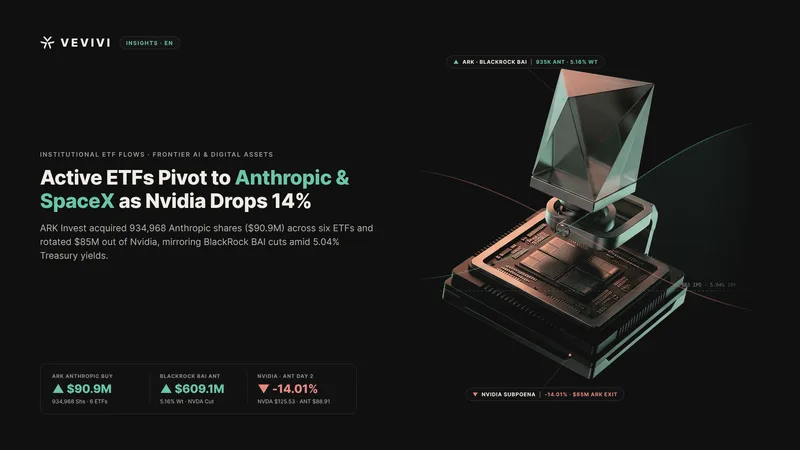
The ARK Invest Anthropic IPO allocation of 934,968 shares across six actively managed exchange-traded funds marks a decisive institutional pivot away from pure semiconductor hardware toward frontier intelligence platforms and orbital compute infrastructure. Priced at $83.00 per share on November 18, Anthropic, PBC (NASDAQ: ANT) raised $119.54 billion in combined gross capital—comprising an $81.34 billion base offering, a fully exercised 147 million-share greenshoe lifting public proceeds to $93.54 billion, and a $26.0 billion concurrent Class N private placement—before enduring sharp secondary-market repricing. After closing its November 19 debut up 17.07% at $97.17, Anthropic slid 8.50% on Friday, November 20 to finish at $88.91 after testing an intraday low of $83.05, just five cents above its offering price, leaving its public-float market capitalization near $1.16 trillion.
Beneath that volatile two-day tape, daily institutional fund disclosures reveal a stark split between professional active allocators and retail momentum traders. While retail investors poured capital into two-times leveraged semiconductor funds during Friday's rout—which dragged Nvidia Corporation (NASDAQ: NVDA) down 14.01% to $125.53 and Advanced Micro Devices, Inc. (NASDAQ: AMD) down 13.25% to $424.39—both Cathie Wood's ARK Invest and BlackRock's flagship active artificial intelligence fund systematically pared Nvidia exposure and redeployed capital into frontier model equity and SpaceX (NASDAQ: SPCX). Simultaneously, cross-asset liquidity pressures pushed Bitcoin down to $57,789 after a $55,648 intraday trough and Ethereum to $1,638 against a 5.04% U.S. 10-year Treasury constant maturity yield.
Inside the ARK Invest Anthropic IPO Allocation and BlackRock Active ETF Divergence
Daily trade notifications confirm that the ARK Invest Anthropic IPO purchase totaled 934,968 Class A shares on November 19, valued at $90.9 million at Thursday's $97.17 close ($77.6 million at the $83.00 offering price and $83.1 million at Friday's $88.91 close). Flagship fund ARK Innovation ETF (BATS: ARKK, which closed Friday at $64.22, down 6.83%) absorbed 556,777 shares—roughly 60% of the total allocation—while the remaining 378,191 shares were distributed across ARKQ, ARKW, ARKG, ARKF, and ARKX. That public-market build supplements the 4.4% weight already held inside the closed-end ARK Venture Fund (ARKVX) since early 2023, reflecting conviction in enterprise frontier model monetization, including healthcare and biological discovery workflows.
Crucially, ARK paired that primary-market addition with an explicit governance-driven rotation out of Nvidia. Following Jensen Huang's November 12 resignation as Nvidia Chief Executive Officer, ARK downgraded Nvidia on its internal people, management, and culture scoring matrix, liquidating $85 million in Nvidia shares across the week—including 33,430 shares worth roughly $5 million from ARKQ on Thursday—and rotating proceeds into SpaceX. ARK's SpaceX position stands near $1.69 billion even after SpaceX shares settled 7.69% lower on Friday at $127.79 ($1.74 trillion market capitalization). Wood further outlined an institutional thesis anticipating eventual vertical convergence between SpaceX and Tesla, Inc. (NASDAQ: TSLA, Friday close $345.82, down 7.64%, $1.37 trillion market capitalization), arguing that autonomous robotaxi operating cash flows—representing 80% to 90% of ARK's Tesla valuation model—could finance orbital data centers and xAI's Grok compute clusters.
BlackRock BAI Holdings Confirm Institutional Rotation Beyond Hardware
ARK's repositioning is not an isolated outlier; official portfolio disclosures from BlackRock's $10.57 billion iShares A.I. Innovation and Tech Active ETF (NYSE Arca: BAI, Friday close $30.56, down 9.67%) demonstrate an even larger institutional pivot. According to Bloomberg Intelligence ETF tracking and BlackRock's November 19 holdings ledger, lead portfolio manager Tony Kim cut Nvidia's portfolio weight by 1.5 percentage points last week and another 2 to 3 percentage points this week, pushing Nvidia entirely out of BAI's Top 10 positions among 62 equity holdings. In its place, BAI holds 6,268,809 shares of Anthropic Class A worth $609.14 million (5.16% weight, fifth-largest holding) alongside 3,666,385 shares of SpaceX worth $507.54 million (4.30% weight, seventh-largest holding), trailing only Broadcom (6.57%), AMD (6.45%), Treasury cash reserves (5.56%), and Taiwan Semiconductor Manufacturing Company (5.28%).
Crypto Staking ETF Rebalancing Amid Cross-Asset Liquidity Compression
The capital demand of a $119.54 billion equity offering also intersected directly with digital-asset portfolios. During Thursday's rebalancing session, ARK trimmed $4.1 million from cryptocurrency staking vehicles in ARKW and ARKF—selling $2.9 million of the 3iQ Ether Staking ETF and $1.2 million of the 3iQ Solana Staking ETF—just days after selectively adding crypto-linked equities including Coinbase Global, Inc. (NASDAQ: COIN, Friday close $101.97, down 6.34%). Rather than signaling a structural abandonment of digital assets, the paired trades illustrate tactical liquidity management during synchronized risk-off deleveraging that drove Bitcoin below $60,000 to $57,789 and Ethereum to $1,638.
Leveraged Single-Stock ETF Proliferation Meets Post-IPO Lockup Mechanics
While pre-IPO public mutual funds and active ETFs controlled roughly 1.5% of Anthropic's equity prior to listing—giving institutional vehicles from BlackRock, Fidelity, JPMorgan, KraneShares, and Tema early cost-basis advantages—public debut day saw Anthropic enter a record 82 ETFs immediately. The next phase of market structure friction arrives on Monday, November 23, 2026, when roughly 10 single-stock derivative ETFs tracking Anthropic are slated to launch in the United States. Confirmed listings on Cboe include the Tradr 2X Long Anthropic Daily ETF (Cboe: ANTT), targeting 200% of daily share performance, and the Tradr 2X Short Anthropic Daily ETF (Cboe: ANTZ), targeting inverse 200% daily returns under U.S. Securities and Exchange Commission rules that cap new single-stock leveraged funds at 2x daily exposure.
Daily Reset Volatility Decay vs. Staged Lockup Supply
Institutional allocators warn that daily-reset leveraged products introduce severe compounding drag when underlying post-IPO shares swing wildly around underwriting support levels. Long-horizon equity managers such as Katam Hill emphasize that pre-IPO private valuations reflect one-sided capital raises where marginal buyers set headline marks on thin float, whereas public exchanges enforce two-sided price discovery. Waiting for staged lockup expirations—similar to SpaceX's tiered release schedule rather than a single 180-day cliff—and auditing two to three quarters of public earnings guidance allows institutional desks to evaluate true free-cash-flow conversion before committing permanent capital above a $1.16 trillion public-float valuation.
Anthropic Direct Compute Economics vs. Distressed Neocloud Credit
SEC Form 424(b)(4) disclosures and commentary from Anthropic Chief Financial Officer Krishna Rao clarify how the company intends to defend margins across what management terms a widening cone of uncertainty in training and inference demand. Over the first nine months of 2026, Anthropic generated $33.24 billion in revenue—including $17.0 billion in the third quarter alone and an $81 billion annualized October run rate—posting a GAAP operating loss of $1.26 billion alongside $4.08 billion in non-GAAP adjusted operating income (a 15% adjusted operating margin in Q3, with management targeting 35% or higher long term). However, contractual purchase and lease obligations total $900.9 billion through 2045, including $451.6 billion before year-end 2030 and $70.7 billion due within the next 12 months.
Multi-Chip Fungibility and Opportunistic Infrastructure M&A
To avoid single-vendor bottlenecks, Anthropic orchestrates workloads as a single fungible compute pool across four distinct accelerator architectures: AWS Trainium, Google TPUs, Nvidia GPUs, and AMD GPUs. Simultaneously, through its Anthropic Direct initiative, the company leases data-center shells directly and procures accelerator leases separately. Armed with $131.9 billion in pre-offering cash and short-term investments plus up to $119.54 billion in combined IPO and private-placement proceeds—creating a roughly $250 billion gross liquidity fortress—Anthropic holds the balance-sheet flexibility to acquire distressed neocloud or data-center infrastructure if tighter credit conditions force leveraged operators to restructure.
Nvidia Subpoena Scrutiny, Semiconductor Contagion, and the 5% Rate Floor
The rotation out of upstream chipmakers accelerated sharply following state and federal regulatory escalations. On November 19, California Attorney General Rob Bonta served an investigative subpoena on Nvidia—an official fact-finding inquiry under California corporate securities law, distinct from a formal enforcement complaint or adjudicated penalty—examining whether restricted advanced accelerators or confidential information reached China via Singapore-based Megaspeed (which purchased nearly $5 billion in Nvidia hardware) and whether investor risk disclosures were adequate. Combined with ongoing Federal Bureau of Investigation and SEC inquiries, Chair Harvey Jones ruling out Jensen Huang's reinstatement, board outreach to external semiconductor executives ahead of Huang's December 1 congressional testimony, and a 48.4% drawdown from Nvidia's $243.37 52-week peak, Nvidia's trailing price-to-earnings multiple compressed to 13.49x at $125.53—even as interim CEO Colette Kress guided to at least 75% revenue growth next year on a $520 billion annualized run rate.
AMD Supply-Chain Allegations and Federal Reserve H.15 Rate Pressure
Contagion spread across rival chipmakers after activist short-seller Hunterbrook Capital disclosed a short position in AMD alongside a Hunterbrook Media report alleging blacklisted Chinese server firmware exposure and cloud lease backstop liabilities—claims AMD formally rejected as misrepresenting its export-control compliance. Meanwhile, Federal Reserve H.15 data published November 20 kept the macro discount rate elevated, with the effective federal funds rate at 3.88% (3.75%–4.00% target band), the 2-year Treasury yield at 4.76%, and the 10-year nominal yield at 5.04% ahead of the December 9–10 FOMC meeting. Until semiconductor governance probes clear in December and Treasury term premiums stabilize, institutional desks favor cash-rich frontier balance sheets over upstream hardware multiples.
Key Institutional Questions & Strategic Outlook
Why are active ETFs buying Anthropic while selling Nvidia at a 13.5x trailing P/E?
Active managers such as ARK Invest ($90.9 million Anthropic buy vs. $85 million Nvidia sales) and BlackRock's BAI ($609.14 million Anthropic position vs. Nvidia's removal from its Top 10) are pricing executive succession risk, December 1 congressional hearings, and multi-chip customer diversification (AWS Trainium, Google TPUs, custom ASICs) as near-term overhangs on hardware multiples, while capturing newly liquid frontier software revenue ($81 billion October run rate) backed by roughly $250 billion in gross cash and offering proceeds.
What risks do Monday's 2x leveraged Anthropic ETFs pose alongside staged lockups?
Daily-reset 2x vehicles such as Cboe-listed ANTT (+200%) and ANTZ (-200%) rebalance exposure every session, eroding capital during choppy two-way trading like Anthropic's swing from $111.50 on Day 1 to an $83.05 intraday low on Day 2. Institutional allocators also track staged insider lockup releases and $70.7 billion in 12-month compute commitments that could pressure GAAP profitability if enterprise token pricing compresses.
How does AI mega-IPO liquidity rotation affect Bitcoin and Ethereum?
ARK's $4.1 million trim across 3iQ Ether and Solana staking ETFs alongside its $90.9 million Anthropic allocation illustrates how $100 billion-scale equity offerings compete directly for marginal risk liquidity when the 10-year Treasury yield sits near 5.04%. Stabilizing Bitcoin above its $55,648–$57,789 zone and Ethereum above $1,542–$1,638 will depend on post-IPO settlement absorption and clearer Federal Reserve rate guidance at the December FOMC meeting.
Disclaimer and Risk Warning
This article is provided strictly for informational and educational purposes based on publicly available on-chain metrics and macroeconomic data. Nothing in this publication constitutes financial, investment, legal, or tax advice, nor should it be construed as a solicitation, recommendation, or offer to buy or sell any digital asset or financial instrument. Digital assets are subject to high market risk and extreme price volatility, and you may lose part or all of your invested capital. Historical market cycles and past performance referenced herein do not guarantee future results. You are solely responsible for your own investment decisions and should conduct independent research and consult a qualified financial advisor before making any financial commitments.