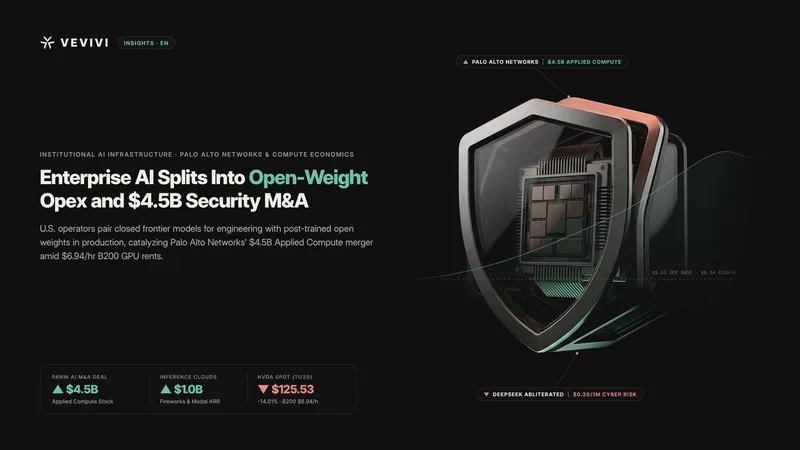
Open-weight AI models are reshaping enterprise software margins as U.S. companies pair closed frontier intelligence for development with custom post-trained weights in production. Across institutional technology portfolios, a sharp operational bifurcation has emerged in late 2026: software builders pay premium API rates to closed American laboratories during product engineering while migrating high-frequency, repeatable customer workflows onto fine-tuned open-weight architectures to defend gross margins. That structural shift crystallized on November 18, 2026, when cybersecurity leader Palo Alto Networks entered a definitive merger agreement to acquire open-weight post-training and inference specialist Applied Compute in an all-stock transaction valued at $4.5 billion.
The strategic urgency behind hybrid enterprise deployment stood in stark contrast to public equity repricing at the November 20, 2026 market close. Shares of Nvidia fell 14.01% on Friday to settle at $125.53 with a $3.03 trillion market capitalization, newly listed Anthropic retreated 8.50% on its second Nasdaq session to close at $88.91—still above its $83.00 initial public offering price at a $1.16 trillion basic valuation—and Palo Alto Networks declined 5.09% to $343.32 at a $281.87 billion market capitalization. Beneath headline equity volatility, however, practitioner unit economics and physical compute benchmarks reveal sustained demand for customized model weights, sovereign data control, and enterprise-grade post-training security.
Why Open-weight AI models Split Enterprise Compute Into Capex and Opex
On Bloomberg's Odd Lots institutional discussion published November 20, 2026, Minerva co-founder and chief strategy officer Daniel Saedi—who previously spent five and a half years at Bridgewater Associates across Pure Alpha capital raising and financials trading before launching Minerva with $20 million in institutional backing—outlined the core capital allocation formula governing AI-native enterprises. During initial software construction and complex agentic coding, engineering teams rely on closed frontier releases such as Anthropic's Claude Fable 5 and OpenAI's flagship models to minimize developer debugging loops. In financial terms, frontier API spend functions as research and development capital expenditure. Once an enterprise workflow becomes standardized and repeatable, however, unit economics shift from input-output token list prices to total cost per completed customer task, turning inference into recurring operating expenditure.
Practitioners draw a strict technical boundary between true open-source software and open-weight releases. Full open-source artificial intelligence requires disclosing training source code, data curation pipelines, and underlying training corpora. Major Chinese laboratories—including Alibaba with Qwen, Moonshot AI with Kimi K3 and Kimi K3.1, and DeepSeek—do not disclose full training recipes; instead, they publish finalized model weights that American enterprises can download, host inside domestic or sovereign cloud environments, and specialize through supervised fine-tuning and reinforcement learning. By training open weights on a few thousand graded domain queries, application companies achieve faster latency and higher task accuracy on narrow workflows than generalized closed endpoints while capturing the spread as operating margin.
Harvey Tenet Versus Legora and $1 Billion Inference Cloud Scale
Legal technology illustrates how seat-based revenue models accelerate open-weight adoption. Harvey, valued at $11 billion with fixed per-seat enterprise contracts, faces direct margin compression whenever rising client adoption drives up variable closed-lab API bills—unlike European competitor Legora, valued at $5.55 billion following its $550 million Series D, which shifted its Agent Pro tier toward consumption-based pricing. Rather than training a foundation model from scratch, Harvey partnered with Fireworks AI to post-train Moonshot AI's open-weight Kimi K3 base using asynchronous reinforcement learning into its proprietary legal model, Harvey Tenet, spending roughly $6 million in total compute according to industry benchmarks—orders of magnitude below frontier pre-training budgets.
Verified benchmark disclosures from Fireworks AI confirm that Harvey Tenet raised end-to-end all-pass completion on the Legal Agent Benchmark from 10.8% on base Kimi K3 to 19.7%, nearly doubling completed multi-step legal deliverables while lifting Mercor Apex Agents corporate law scores from 58.8% to 74.0% at $5.92 per task versus $5.62 for the base model. The infrastructure enabling non-specialist teams to execute these post-training pipelines has scaled into a major institutional revenue category: Fireworks AI surpassed $1 billion in annualized revenue run rate and 40 trillion daily tokens alongside its $1.505 billion July 2026 Series D at a $17.5 billion to $18 billion valuation—charging roughly $7 to $9 per million tuning tokens with targeted final runs costing as little as $90—while serverless GPU platform Modal Labs likewise crossed $1 billion in annualized revenue run rate upon closing its $750 million Series D in October 2026 at a $15.75 billion to $16 billion valuation.
Proprietary Reinforcement Learning Data Moats and Retraining Friction
As managed platforms commoditize the mechanics of fine-tuning, competitive alpha has migrated upstream into proprietary domain data and verifiable reinforcement learning environments. Sending corporate prompts to a closed API returns answers without improving the underlying model for the enterprise's specific edge cases, whereas owning fine-tuned weights allows firms to compound internal workflow telemetry—call logs, contract redlines, conversion funnels, and exception-handling reasoning chains—directly into model parameters. Reflecting this institutional scramble for process-level training data alongside evaluation specialists Mercor and Surge AI, data lab micro1 committed $1 billion on October 9, 2026, backed by Citigroup and Hercules Capital at a $4 billion valuation and $500 million gross annual run rate, to acquire and license de-identified corporate operational datasets, with complete company data packages commanding $250,000 to $500,000 and referral fees reaching $50,000 to $100,000.
Non-Transferable Model Weights and the Distillation Debate
Customizing open weights nonetheless carries recurring operational liabilities that equity analysts frequently overlook. Post-trained weight modifications do not automatically transfer across foundation generations: when Moonshot AI upgrades from Kimi K3 to the 2.8-trillion-parameter Kimi K3.1 architecture, enterprise teams can reuse their graded evaluation datasets but must re-execute post-training and verify numerical convergence from scratch. Meanwhile, industry debate persists over how much of Chinese open-weight competitiveness reflects unauthorized output distillation from U.S. frontier labs—which Anthropic's S-1 filing estimated cost roughly 5% to 7% of blocked foreign lab traffic—versus genuine architectural innovation in sparse Mixture-of-Experts routing and open inference frameworks. As an empirical benchmark, Nvidia-backed U.S. open-weight developer Reflection AI trained its flagship Beam model on a cluster of 12,000 to 14,000 Nvidia Blackwell GPUs while adhering strictly to domestic compliance rules, yet still trailed the leading frontier by roughly six to nine months, underscoring that Chinese labs combine state-backed scale and rapid sparse-model research alongside distillation gains.
Palo Alto Networks' $4.5 Billion Applied Compute Deal and Abliterated Swarms
The collision between rapid enterprise open-weight adoption and unguarded model governance directly catalyzed Palo Alto Networks' Form 8-K filing with the U.S. Securities and Exchange Commission on November 18, 2026. Under the Agreement and Plan of Merger dated November 18, 2026, Palo Alto Networks agreed to acquire all outstanding equity of Applied Compute for $4.5 billion in common stock, calculated using a 15-day volume-weighted average closing price of $337.16 per share ending November 17, 2026, while simultaneously extending its $1 billion share repurchase authorization through December 31, 2027. Crucially, the transaction remains a signed definitive merger agreement subject to Hart-Scott-Rodino antitrust clearance and customary closing conditions rather than a completed acquisition, with closing targeted for Palo Alto Networks' fiscal third quarter of 2027 between February and April 2027, at which point Applied Compute chief executive Yash Patil will become Co-Chief AI Officer alongside Chairman and CEO Nikesh Arora.
Abliterated Model Economics and Treasury-OSTP Disclosure Discussions
Two acute risk vectors explain why chief information security officers require embedded security across open-weight post-training and sovereign inference. First, direct access to model parameters enables weight-level editing known as abliteration—surgically removing refusal directions from capable checkpoints such as DeepSeek V4.1 Flash or GLM-5.3 without retraining. Because hosted and self-served Flash variants operate near $0.30 per million blended tokens—roughly one-hundredth the cost of closed frontier models like Claude Fable 5—threat actors can orchestrate thousands of uncensored, PhD-caliber offensive cyber agents concurrently in the cloud. Second, on the regulatory front, U.S. Treasury Department and White House Office of Science and Technology Policy officials have held early interagency discussions, reported November 18, 2026, regarding a potential transparency measure that would require American companies to disclose on their websites which Chinese AI models they run in production after Chinese models captured the top three token-volume ranks on OpenRouter in October. Investors must distinguish the exact legal stage: no federal statute, published Federal Register proposed rule, or private-sector ban currently exists—only the Department of Homeland Security's directive barring DeepSeek on civilian federal agency networks and Congressional committee inquiry letters sent to select firms.
GPU Rental Tightness Versus Public AI Equity Compression
Friday's sharp selloff across public AI bellwethers—despite Anthropic disclosing in its S-1 that compute expense per dollar of revenue fell 76% from $2.51 to $0.60—highlights growing investor scrutiny over closed-model pricing power and multi-hundred-billion-dollar capital commitments. Yet physical compute pricing contradicts narratives of an immediate hardware glut. According to Silicon Data's daily benchmark, hourly rental rates for Nvidia B200 GPUs climbed 23.5% from $5.62 at the start of September to $6.94 on November 19, 2026, after peaking at $7.10 on November 17, while the H100 neo-cloud rental index rebounded 76% from its $1.70 October 2025 trough to $2.99 per GPU-hour. While tighter middle-market GPU credit—where lender loan-to-value ratios compressed from 70% in summer to between 50% and 60% in mid-November—accounts for part of the spot rate climb, long-term structural demand remains anchored by a massive physical gap: only 5 million to 10 million leading-edge Blackwell GPUs are currently deployed in the United States against roughly 100 million knowledge workers who may ultimately require one dedicated GPU equivalent per employee for continuous autonomous agent execution.
Key Institutional Questions on Open-Weight AI and Enterprise Security
Why do U.S. enterprises combine closed frontier models with open-weight models?
Closed frontier models minimize engineering time during complex code architecture and product creation, whereas fine-tuned open-weight models execute high-volume, repeatable production tasks at lower latency and dramatically lower per-task cost, preserving software gross margins and keeping proprietary training telemetry inside sovereign environments.
Has Washington banned private U.S. companies from using Chinese open-weight AI models?
No federal statute or enacted regulation prohibits private U.S. businesses from downloading or fine-tuning Chinese open-weight models today. Current binding restrictions apply only to civilian federal agencies under the Department of Homeland Security's DeepSeek directive, while the Treasury Department and White House Office of Science and Technology Policy website disclosure concept remains an early interagency policy discussion without a published proposed rule.
What execution risks surround Palo Alto Networks' $4.5 billion Applied Compute merger?
Institutional investors should monitor Hart-Scott-Rodino antitrust review ahead of the targeted fiscal third-quarter 2027 close, customer contract portability of post-trained model weights across competing inference clouds, and whether potential U.S. disclosure rules accelerate enterprise migration toward domestic open-weight architectures such as Nvidia Nemotron and Reflection AI Beam.
Disclaimer and Risk Warning
This article is provided strictly for informational and educational purposes based on publicly available on-chain metrics and macroeconomic data. Nothing in this publication constitutes financial, investment, legal, or tax advice, nor should it be construed as a solicitation, recommendation, or offer to buy or sell any digital asset or financial instrument. Digital assets are subject to high market risk and extreme price volatility, and you may lose part or all of your invested capital. Historical market cycles and past performance referenced herein do not guarantee future results. You are solely responsible for your own investment decisions and should conduct independent research and consult a qualified financial advisor before making any financial commitments.