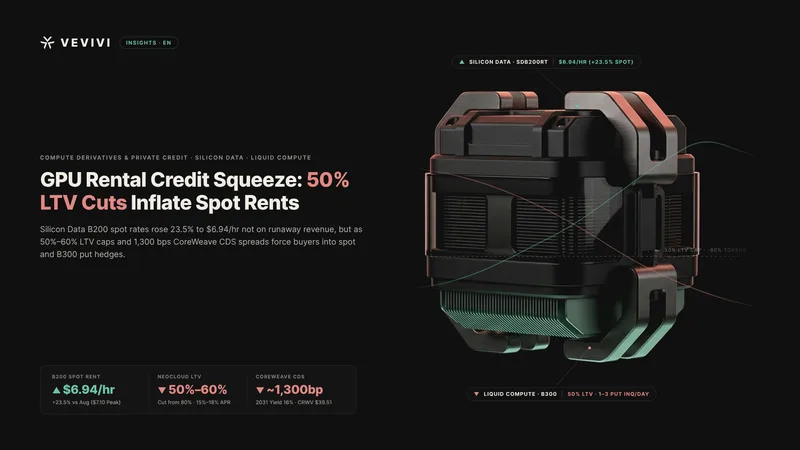
The GPU rental credit squeeze has driven daily spot rates on the Silicon Data B200 Rental Price Index, published under ticker SDB200RT, up 23.5% from $5.62 per GPU-hour entering September 2026 to $6.94 on November 19, after touching an intraday benchmark peak of $7.10 on November 17 (+13.0% over seven days). Equity bulls routinely cite this upward-sloping curve, alongside related Silicon Data readings of $3.11 per hour on H100 ticker SDH100RT and $7.47 per hour on Blackwell B300 instances, as clean proof that enterprise artificial intelligence demand remains immune to capital-market tightening.
Cross-examining underlying private credit term sheets and syndicated loan pricing reveals a sharply different transmission mechanism. Rather than reflecting self-funding enterprise cash flows, spot compute inflation is increasingly an artifact of collateral rationing: lenders are restricting multi-year financing for mid-market neocloud operators, shutting leveraged buyers out of long-term forward leases and crowding marginal demand into a thin on-demand spot market.
How the GPU Rental Credit Squeeze Distorts Spot Benchmarks Through 50% LTV Caps
Over the past 12 to 18 months, the standard debt instrument funding mid-market neocloud operators—ranging from converted cryptocurrency miners to specialized GPU cloud startups—was a three-year, fully amortizing hardware-backed loan underwritten primarily as an offtaker credit wrapper. According to institutional lending desk disclosures detailed by Liquid Compute Chief Product Officer Stanley Lee and Wall Street Journal credit reporting, lenders priced these facilities at an 80% loan-to-value ratio during summer 2026, tightened terms to 70% LTV immediately after Labor Day, and compressed structures to 50%–60% LTV by mid-November with interest coupons quoted in the upper mid-teens at 15% to 18%.
On a $100 million GPU cluster deployment, cutting maximum leverage from 70% LTV to 50% LTV forces an operator to post $50 million in upfront equity or customer prepayments instead of $30 million, a 67% surge in pre-deployment capital requirements. Historically, undercapitalized operators bridged that equity tranche using customer prepayments collected from venture-backed inference startups. As credit committees now audit operator execution, uptime service-level agreements, and experienced deployment track records alongside tenant credit, first- and second-time neocloud borrowers can no longer close term debt, throttling fresh contracted supply.
Public credit markets confirm the exact same repricing at the top of the capital stack. CoreWeave closed Friday, November 20, 2026 at $39.51 on the NASDAQ, down 12.02% on the session and 71.4% below its $138.25 52-week high, while its five-year credit default swap spread widened to approximately 1,300 basis points and yields on its 2031 senior notes climbed to 16%. To preserve debt market access, CoreWeave shifted its latest Delayed Draw Term Loan marketing back up-market to investment-grade offtakers after its prior facility relied on BB-rated counterparties such as Anthropic, Hudson River Trading, and Jane Street.
Startup B300 Lease Math, Non-Assignable Contracts, and Extraterritorial KYC Covenants
Tightening lender underwriting collides directly with a venture capital slowdown in which third-quarter 2026 startup deployment fell roughly 25% below first-quarter levels, while Ramp corporate card telemetry indicates venture-backed firms still account for roughly 80% of top per-employee AI model spend. When Liquid Compute presented AI startups with two three-year NVIDIA B300 lease structures running 24 hours per day, Option A priced at $4.40 per GPU-hour with a 30% upfront prepayment ($34,700 down and $115,600 in total per-GPU outlay), whereas Option B priced at $5.65 per GPU-hour with 0% upfront prepayment ($148,500 total outlay).
Cash-constrained startups consistently select the zero-prepayment contract despite paying an extra $33,000 per GPU, locking in an implied annualized financing cost of 30% to 55%. Preserving balance-sheet cash extends startup runway while signing larger zero-down take-or-pay Total Contract Value commitments allows founders to report rapid top-line compute expansion to venture capital limited partners. Buyers shut out of even zero-down term leases spill directly into short-term spot pools, pushing SDB200RT to $6.94 per hour strictly because their cost of capital prevents forward procurement.
Beneath the pricing surface, legal recovery covenants remain dangerously fragmented. While physical GPU repossession is unnecessary because operators can remarket capacity within minutes by rotating SSH keys, lenders only capture full relighting recovery if loan agreements include enforceable hardware liens, assignable customer contracts, and tri-party data center non-disturbance agreements. If an operator defaults on a legacy $3.80 per hour contract when prevailing rates sit near $4.30, unstandardized covenants trigger contested tenant evictions. Simultaneously, lenders originating data center loans in Southeast Asia have begun inserting extraterritorial United States export-control Know-Your-Customer covenants following Washington's remote-access chip scrutiny, creating immediate loan acceleration triggers if end-user identity audits fail.
Bull Scarcity Thesis Versus Bear Margin Scissors and Historical Credit Analogs
Evaluating compute pricing without confirmation bias requires testing the bullish physical-scarcity thesis symmetrically against the bearish credit-driven margin-scissors thesis. Constructive infrastructure analysts emphasize that Blackwell rollout bottlenecks remain genuine, hyperscalers continue funding multi-billion-dollar clusters off investment-grade balance sheets, and Dell Technologies noted H100 hourly rental quotes rising 67% from $1.96 in July 2025 to $3.10 in November 2026. Under this view, tighter private credit simply weeds out undercapitalized Bitcoin-miner conversions and consolidates market share among Tier-1 operators.
Yet output pricing data exposes a severe margin vise across inference customers. NVIDIA confirmed on its mid-November earnings call that blended LLM token prices have fallen nearly 60% since May 2026, matching Ornn index declines from above $1.20 per million tokens to $0.31 for OpenAI workloads and from roughly $2.00 to $0.77 for Anthropic workloads. Silicon Data's November 12, 2026 Crunch Spread report shows that between May 31 and October 22, B300 rents jumped 51.9% ($4.84 to $7.35) while proprietary token indices fell 36.3%, lifting break-even GPU throughput requirements by 75%. Meanwhile, Bernstein documented a 25% same-day dispersion in H100 quotes ($2.80, $3.01, $3.30, and $3.50 versus CoreWeave's $3.81 sublease assumption), and Ornn's H100 index retreated from $3.50 in early November to $2.92.
Three historical market cycles frame this divergence. Like the 2015 United States shale high-yield freeze, capital-intensive operators look solvent only while high-yield debt rolls smoothly; like post-2008 commercial aircraft finance, collateral only becomes durably bankable after standardized remarketing appraisals and derivative floors replace manufacturer guarantees; and like Sun Microsystems during the 2000 telecom buildout, vendor hardware demand flattered by circular venture equity unravels rapidly if end-user productivity lags. Goldman Sachs Credit Strategy forecasts annual chip and compute debt issuance surging nearly sevenfold to $320 billion in 2027, while SK Ventures Partner Paul Kedrosky calculates that current data center capex requires $3 trillion to $6 trillion in annual AI revenue by 2032 to clear standard project-finance hurdle rates.
Synthetic Compute CDS via B300 Put Strips and Falsifiable Trader Watch-Levels
Second-order contagion risk intensified on Friday, November 20, 2026 as NVIDIA closed down 14.01% at $125.53 following interim Chief Executive Officer Colette Kress's statement that NVIDIA will apply stricter selection criteria when extending balance-sheet support to neoclouds, even as SpaceX priced $32 billion in off-balance-sheet chip debt above 8% yields. Because NVIDIA functioned as a levered fractional-reserve central bank through equity stakes, vendor prepayments, and residual-value backstops, tightening central-bank-style support reverses liquidity geometrically rather than linearly.
With pre-2026 data center loans already trading at mildly impaired secondary levels and large neoclouds bidding to acquire distressed competitor purchase orders at steep discounts, private credit funds are racing to construct synthetic backstops. Over the past two weeks, Liquid Compute has fielded one to three inquiries per day from major private credit desks seeking indicative pricing on strips of put options tied to the B300 rental index—up from near zero six months ago. Because creditor recovery depends on relighting hourly cash flows rather than liquidating scrap silicon, B300 rental put option strips operate as a synthetic compute credit default swap that floors collateral recovery.
Institutional traders should anchor positioning around explicit, falsifiable thresholds rather than directional narratives. Undisclosed bilateral hyperscaler lease rebates and private sovereign backstops remain unconfirmed in public filings, requiring discipline around observable spreads. Bearish contagion accelerates if Silicon Data's SDB200RT index breaks below $6.00 per hour while Ornn's H100 index slips under $2.75 and CoreWeave five-year CDS widens past 1,500 basis points, signaling that cash exhaustion has overwhelmed spot scarcity. Conversely, the bearish margin-scissors thesis is invalidated if mid-market neocloud LTV terms recover to 70% or higher, CoreWeave 2031 bond yields compress below 12%, or blended LLM output token prices rebound for two consecutive quarters alongside verified enterprise revenue-funded compute procurement.
Trader Frequently Asked Questions and Institutional Source Documentation
Why are spot B200 GPU rental rates rising while private credit tightens?
Spot B200 GPU rental rates rose 23.5% to $6.94 per hour primarily because private credit lenders cut neocloud loan-to-value ratios from 80% to 50%–60%, slowing new cluster financing and blocking startups from signing long-term forward leases. Forced into thin short-term pools or zero-down contracts carrying 30% to 55% implied interest, buyers bid up spot benchmarks even as end-user token prices decline.
How do B300 rental index put options work as a synthetic compute CDS?
When a GPU-backed borrower defaults, private credit lenders recover principal by reassigning SSH access and relighting hourly compute capacity rather than scrapping hardware. Buying a strip of put options on the B300 hourly rental index locks in a contractual cash-flow floor during collateral remarketing, synthetically replacing the balance-sheet residual-value guarantees previously supplied by NVIDIA.
Which numeric levels invalidate the bearish neocloud credit squeeze thesis?
The bearish credit-squeeze thesis is invalidated if private credit loan-to-value ratios return to 70% or above on three-year amortizing GPU loans, if CoreWeave 2031 senior bond yields compress below 12% from 16%, or if industry LLM output token benchmarks post two consecutive quarterly increases backed by operating cash flows.
Primary Sources and Official Filings
Silicon Data Official Daily Benchmark Portal (Ticker SDB200RT $6.94/hr as of November 19, 2026; Ticker SDH100RT $3.11/hr; Ticker SDLLMTK $0.76; August 2026 Term-Structure Update $5.62/hr; November 12, 2026 Crunch Spread Report); Bloomberg Odd Lots Institutional Credit Transcript featuring Liquid Compute Chief Product Officer Stanley Lee and SK Ventures Partner Paul Kedrosky (recorded November 18, published November 19, 2026); Wall Street Journal and KuCoin Institutional Compute Financing Report (published November 20, 2026); Bernstein CoreWeave H100 Sublease Dispersion Note, Ornn Compute and LLM Token Price Indices, Goldman Sachs Credit Strategy 2027 Compute Debt Forecast ($320 billion), and NASDAQ Official Market Close Data for CoreWeave (CRWV $39.51) and NVIDIA Corporation (NVDA $125.53) as of November 20, 2026.
Disclaimer and Risk Warning
This article is provided strictly for informational and educational purposes based on publicly available on-chain metrics and macroeconomic data. Nothing in this publication constitutes financial, investment, legal, or tax advice, nor should it be construed as a solicitation, recommendation, or offer to buy or sell any digital asset or financial instrument. Digital assets are subject to high market risk and extreme price volatility, and you may lose part or all of your invested capital. Historical market cycles and past performance referenced herein do not guarantee future results. You are solely responsible for your own investment decisions and should conduct independent research and consult a qualified financial advisor before making any financial commitments.