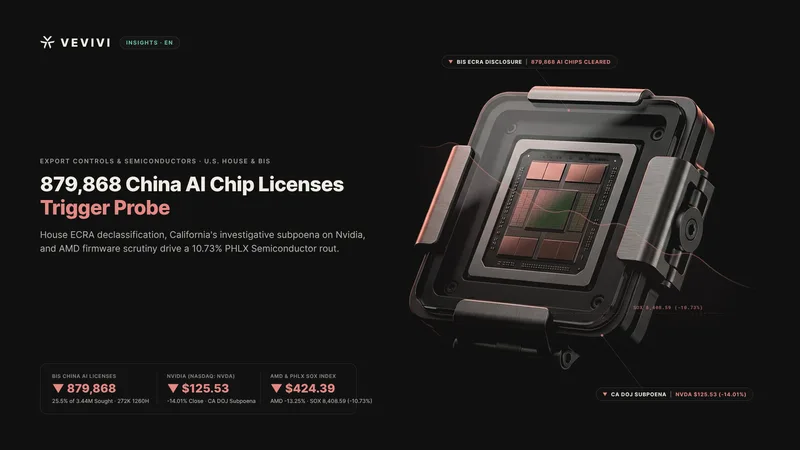
China AI chip export licenses sit at the center of a sharp institutional repricing across global semiconductor equities after U.S. lawmakers declassified confidential Commerce Department licensing records. On November 19, 2026, U.S. House Foreign Affairs Committee Chairman Brian Mast invoked statutory disclosure powers under the enacted Export Control Reform Act of 2018 to release Bureau of Industry and Security data covering applications submitted through May 11, 2026. The documents revealed that Chinese-tied buyers sought 3,444,160 advanced artificial intelligence processors and secured regulatory clearance for 879,868 units across 21 applications, representing 25.55% of total requested volume. Within 24 hours, that federal oversight shock converged with a California Department of Justice investigative subpoena served on Nvidia and a short-seller firmware report targeting Advanced Micro Devices. By the November 20, 2026 U.S. market close, Nvidia fell 14.01% to $125.53, Advanced Micro Devices slid 13.25% to $424.39, and the PHLX Semiconductor Sector Index tumbled 10.73% to 8,408.59.
China AI chip export licenses and the 879,868-unit BIS disclosure
The congressional release marks the most granular public disclosure of semiconductor licensing activity in the history of the Export Control Reform Act of 2018. According to the committee summary, the 3,444,160 requested units and 879,868 approved units specifically covered Nvidia H200 accelerators and Advanced Micro Devices Instinct MI325X processors. Those approvals stemmed from a Bureau of Industry and Security final rule published in the Federal Register on January 15, 2026 under citation 91 FR 1684. That final rule shifted export applications for computing commodities operating below a total processing performance threshold of 21,000 and total DRAM bandwidth below 6,500 gigabytes per second from a presumption of denial to case-by-case review for end users in China and Macau.
To qualify under the January 15, 2026 final rule, exporters had to certify that cumulative shipments to China and Macau would not exceed 50% of aggregate processing performance delivered to commercial customers inside the United States, that global foundry capacity would not be diverted away from U.S. orders, and that every batch would pass verification by an independent U.S.-headquartered testing laboratory. Despite those formal guardrails, bipartisan lawmakers including Ranking Member Gregory Meeks questioned how 21 high-volume applications cleared interagency review while standard export filings faced prolonged administrative backlogs.
Pentagon Section 1260H allocations and unshipped status
Institutional risk desks focused immediately on the counterparty breakdown inside the Bureau of Industry and Security ledger. Exactly 272,000 approved processors, or 30.91% of all cleared units, went to four corporations listed on the Department of Defense Section 1260H roster of Chinese military companies as of the June 10, 2026 Federal Register update. Tencent and its affiliates received clearance for 150,000 chips, matching 100% of that batch request alongside a separate December 19, 2025 filing seeking 445,000 H200 units. Alibaba and its subsidiaries were approved for 75,000 chips out of 948,950 requested, an approval rate of 7.90%, while Baidu received 43,000 chips and automaker BYD received 4,000 H200 units prior to its June 2026 military-company designation.
Crucially for revenue modeling, licensing authorization did not equate to physical delivery. Every approved entry displayed in the May 11, 2026 status table, including 75,000-unit tranches for Alibaba Group, ByteDance, VNET, and a Tencent subsidiary, carried the official administrative designation Approved, not shipped. Separate applications seeking 203,000 processors for Alibaba Cloud in Malaysia and 203,000 processors for a ByteDance unit in Indonesia were returned without action.
Third-country remote-compute curbs and halted H200 deliveries
The committee disclosure also highlighted intermediary installation risks, noting that all but two Nvidia applications listed Maginfra, Beijing New Matrix, ZTE Kangxun, or Lenovo as potential data center system installers while rating diversion risk as low. Lawmakers characterized certain intermediaries as suspected smuggling fronts, a legislative allegation rather than an adjudicated finding. Meanwhile, following the November 16, 2026 Bureau of Industry and Security emergency rule requiring export licenses for remote cloud access across Singapore, Malaysia, Thailand, Indonesia, and Brazil, Nvidia Interim Chief Executive Officer Colette Kress and company spokespeople confirmed through November 20, 2026 that Nvidia has completely halted shipping licensed H200 Hopper data center processors to China.
California investigative subpoena and Nvidia disclosure scrutiny
Parallel to federal oversight in Washington, state-level securities enforcement entered the semiconductor narrative on November 19, 2026. California Attorney General Rob Bonta served an official investigative subpoena on Nvidia following the November 12 resignation of former Chief Executive Officer Jensen Huang amid scrutiny over interactions with an executive at Singapore-based cloud operator Megaspeed International. From a strict legal-stage standpoint, an investigative subpoena is an administrative fact-finding instrument rather than a formal civil complaint or settled enforcement order, meaning zero statutory violations have been established to date.
Nevertheless, the California Department of Justice inquiry targets two core corporate securities questions: whether advanced processors or confidential technical information reached China through offshore channels, and whether Nvidia misled institutional and retail shareholders regarding the materiality of China diversion exposure. Equity markets reacted aggressively to the dual legal overhang on November 20, 2026, driving Nvidia down 14.01%, or $20.45 per share, to close at $125.53 after touching an intraday 52-week low of $124.50. At a closing market capitalization of $3.03 trillion, Nvidia stands 48.42% below its 52-week peak of $243.37, even though corporate forward guidance already assumes zero data center compute revenue from mainland China.
AMD firmware allegations and geographic billing divergence
Regulatory contagion spread simultaneously to Nvidia's primary accelerator rival after investigative outlet Hunterbrook Media, affiliated with hedge fund Hunterbrook Capital, published a short-seller report targeting Advanced Micro Devices on November 19, 2026. The report documented that Chinese server manufacturer IEIT Systems, formerly Inspur's server division and placed on the Commerce Department Entity List in March 2025, published at least 6 server BIOS updates containing newer Advanced Micro Devices startup firmware through October 19, 2026. Three server vendors with reported commercial ties to IEIT Systems, namely Aivres, Kaytus, and Maginfra, distributed firmware packages measuring 99.94% identical.
Objective due diligence requires separating short-seller hypotheses from verified compliance status. Hunterbrook Capital held a disclosed short position in Advanced Micro Devices, acknowledged that its technical review does not prove an export-control violation or establish whether a license covered the firmware, and made no claim that Instinct AI accelerators were illegally diverted. Advanced Micro Devices formally rejected the report, stating that it misrepresents corporate relationships and affirming strict compliance with U.S. export laws. Yet portfolio managers sold the stock down 7.72% on November 19 to $489.19 and another 13.25% on November 20 to $424.39, compressing its market capitalization to $696.04 billion. The selloff reflects valuation sensitivity: Advanced Micro Devices billed 22.4% of its fiscal 2025 revenue, or $7.75 billion, to China and Hong Kong customers—nearly 2.5 times Nvidia's 9.1% share—alongside $4.28 billion billed in Singapore, while trading at roughly three times Nvidia's forward earnings multiple.
Executive-legislative policy split and institutional risk scenarios
What makes the current semiconductor drawdown structurally complex is an open policy rift between the executive branch and Capitol Hill. On November 20, 2026, U.S. Treasury Secretary Scott Bessent stated that existing export controls and the November 16 remote-access restrictions have effectively curtailed unauthorized Chinese compute access, arguing that no additional curbs on older Nvidia processors are warranted. President Donald Trump similarly voiced continued confidence in Commerce Secretary Howard Lutnick despite prior cabinet friction over the pace of Megaspeed International restrictions.
Congressional committees, however, are moving in the opposite direction ahead of early-December testimony by Jensen Huang before a closed House panel and an open Senate hearing. Lawmakers are pushing committee-advanced pending legislation—including the AI OVERWATCH Act and the MATCH Act package such as H.R. 8284 and H.R. 8036—to grant State, Defense, and Energy officials stronger veto leverage and tighten congressional oversight over Bureau of Industry and Security licensing. None of these bills is enacted federal law yet, leaving institutional allocators to price two conditional paths: a stabilization scenario if White House restraint holds and U.S. hyperscaler demand absorbs halted export supply, versus a deeper multiple-compression scenario if year-end National Defense Authorization Act amendments codify broader x86 server, firmware, and Southeast Asian hub restrictions.
Institutional Investor Q&A
Did the 879,868 BIS-approved AI processors physically ship to Chinese buyers?
Not as of the May 11, 2026 licensing cutoff disclosed by the House Foreign Affairs Committee. Every approved entry in the Bureau of Industry and Security status table—including 75,000-chip allocations for Alibaba Group, ByteDance, VNET, and a Tencent subsidiary—was recorded as Approved, not shipped, and Nvidia confirmed in November 2026 that it has ceased shipping licensed H200 processors to China entirely.
Do the California subpoena or the Hunterbrook report prove legal violations by Nvidia or AMD?
No. California Attorney General Rob Bonta's action against Nvidia is an administrative investigative subpoena seeking documents on potential diversion and investor disclosures, with zero formal charges filed. Likewise, Hunterbrook Capital is an active short seller that explicitly noted it could not verify whether a license covered the IEIT Systems server firmware, and Advanced Micro Devices has formally affirmed full compliance with U.S. export regulations.
Which catalysts will govern semiconductor institutional positioning next?
Institutional desks are tracking three concrete milestones: early-December congressional hearings featuring former Nvidia leadership and Commerce Department officials, potential attachment of pending export-licensing bills to year-end defense legislation, and whether the Bureau of Industry and Security initiates formal administrative inquiries into third-party server firmware distribution across China and Singapore.
Disclaimer and Risk Warning
This article is provided strictly for informational and educational purposes based on publicly available on-chain metrics and macroeconomic data. Nothing in this publication constitutes financial, investment, legal, or tax advice, nor should it be construed as a solicitation, recommendation, or offer to buy or sell any digital asset or financial instrument. Digital assets are subject to high market risk and extreme price volatility, and you may lose part or all of your invested capital. Historical market cycles and past performance referenced herein do not guarantee future results. You are solely responsible for your own investment decisions and should conduct independent research and consult a qualified financial advisor before making any financial commitments.