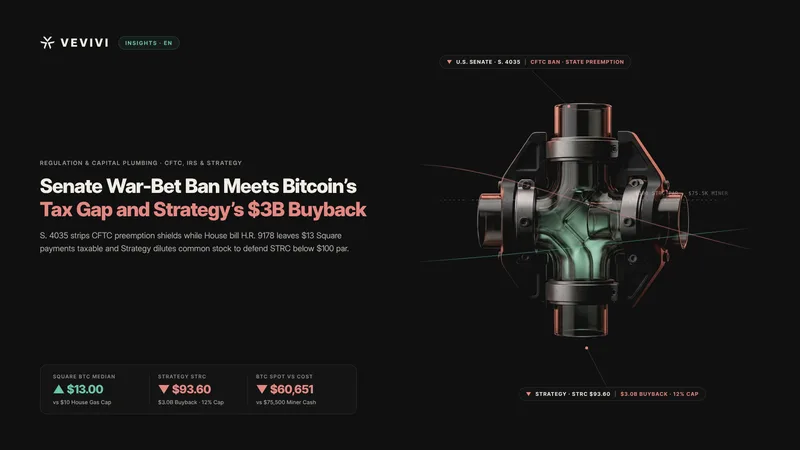
The U.S. Senate prediction market ban passed by voice vote on November 19, 2026 exposes a three-layered institutional bottleneck across federal derivatives law, retail tax accounting, and corporate Bitcoin balance sheets while spot Bitcoin trades near $60,651 on November 22. Rather than facing a single macro shock, digital asset liquidity is simultaneously constrained by statutory limits on event contracts, an unresolved capital-gains reporting burden on everyday Lightning Network commerce, and tightening credit conditions forcing leveraged treasury issuers to shrink preferred liabilities instead of accumulating coins. Dissecting the actual legislative text, merchant payment distributions, and weekly corporate filings reveals why headline adoption milestones have yet to translate into sustained spot buying power.
Statutory Architecture of the Senate prediction market ban Under S. 4035
On November 19, 2026, the U.S. Senate adopted a bipartisan substitute amendment by unanimous consent and passed S. 4035, formally titled the Discouraging Exploitative Assassination, Tragedy, and Harm Betting in Event Trading Systems Act (DEATH BETS Act), by voice vote, sending the measure to the House of Representatives alongside companion bill H.R. 7942. Co-sponsored by Senators Adam Schiff and John Curtis, the bill remains pending House approval and presidential signature rather than enacted statute, yet it marks the first standalone prediction-market restriction ever cleared by either chamber of Congress. Lawmakers drafted the measure after six offshore Polymarket accounts reportedly netted roughly $1 million wagering on the timing of U.S. military strikes against Iran hours before explosions became public, crystallizing bipartisan national-security concerns over monetizing classified operational intelligence.
Under Section 2 of S. 4035, Section 5c of the Commodity Exchange Act (7 U.S.C. 7a-2) is amended by adding subsection (d), which strictly prohibits any CFTC-registered entity—such as designated contract markets like Kalshi—from listing or clearing agreements, contracts, or swaps tied to war, terrorism, assassination, U.S. military operations, or outcomes reasonably expected at listing to settle primarily on an individual's death. The bill also grants the Commodity Futures Trading Commission affirmative authority to designate analogous public-harm contracts, eliminating exchange self-certification workarounds for geopolitical conflict markets.
How the Rule of Construction Strips Federal CFTC Preemption Shields
The most consequential fine print inside S. 4035 sits not in the war-bet prohibition itself, but in the Curtis-Schiff substitute amendment's Rule of Construction referencing 7 U.S.C. 7a-2(c)(5)(C)(i). Regulated prediction platforms had feared—or quietly hoped—that explicitly banning only war and death contracts might allow lawyers to argue implied congressional authorization (expressio unius) for lucrative sports-betting and casino-style event contracts. By inserting a statutory Rule of Construction stating that nothing in the Act alters the permissibility of other gaming contracts under existing law, the Senate deliberately stripped domestic exchanges of a federal CFTC preemption shield in state-level anti-gambling litigation. Paired with Schiff and Curtis's separate Prediction Markets Are Gambling Act, this clause creates a clear second-order divergence: restricting onshore CFTC-regulated venues without equivalent offshore enforcement risks pushing event-driven speculative liquidity back toward unpermissioned stablecoin protocols outside U.S. jurisdiction.
Block’s $13 Square Payment Reality Versus the $10 House Gas-Fee Carve-Out
While Senate lawmakers tighten event-contract boundaries, empirical merchant data from Block, Inc.'s November 2026 report, The State of Bitcoin Payments, demonstrates that real-world U.S. Bitcoin spending already functions as high-frequency small-ticket commerce rather than large asset settlements. Analyzing completed U.S. Square Bitcoin transactions greater than $1 between November 1, 2025 and October 15, 2026, Block documented a median payment of $13 and an average ticket of $29. Food and beverage merchants generated 72.3% of all Bitcoin transactions ($12 category median), led by coffee shops and fast-food counters where the median checkout stood at $9.10, while grocery runs averaged $60.73. Cumulatively, 42.4% of payments fell under $10 (7.9% of dollar value), 65.1% landed under $20 (19.1% of value), and 89.0% cleared below $50 (43.4% of value).
Crucially, this retail velocity extends well beyond a single closed-loop app. External Lightning-enabled wallets—including Strike, Wallet of Satoshi, Phoenix, and Coinbase—accounted for 56.6% of Square payment count and 66% of total dollar value, compared with 43.4% of transactions originating inside Cash App. Among Cash App customer-merchant pairs with repeat usage, 44% of Bitcoin payments were repeat visits, 86% occurred within 30 days, 15.8% happened the same day, and the median interval between purchases was just 3 days. Although Block extended 0% Bitcoin processing fees for Square sellers through December 31, 2027, its commissioned Morning Consult survey (8,669 Bitcoin-aware U.S. adults, including 1,415 business decision-makers) revealed that 23.6% of non-accepting businesses and 27% of considering merchants cite tax and accounting complexity as a primary barrier.
That friction stems directly from IRS Notice 2014-21 and upcoming Form 1099-DA broker reporting rules, which classify Bitcoin as capital property and force consumers to compute cost basis and capital gains on every $9.10 coffee. Yet on Capitol Hill, House Ways and Means bill H.R. 9178 (Less Tax Paperwork for Digital Asset Owners Act) excludes only blockchain network gas fees up to $10 per transaction (capped at 5,000 annual transactions after December 31, 2027) alongside a 99.5% to 100.5% redemption-value safe harbor for dollar stablecoins—delivering $0 in capital-gains relief for spending Bitcoin on goods or services. Meanwhile, Senator Cynthia Lummis's broader S. 2207, which would exempt up to $300 per consumer purchase and $5,000 annually, remains stalled in the Senate Finance Committee ahead of Lummis's retirement and January 2027 committee gavel shifts, while bipartisan House bill H.R. 8899 (Digital Asset PARITY Act) merely orders a one-year Treasury study.
Strategy’s $3 Billion STRC Reverse Buybacks and Dilution Plumbing
Parallel to legislative tax friction, corporate Bitcoin treasury plumbing has shifted from aggressive balance-sheet expansion into defensive liability management. On Friday, November 20, 2026, Strategy Inc. Class A common stock (NASDAQ: MSTR) closed down 9.67% at $77.80 ($33.47 billion market capitalization, roughly 85.7% below its $543 cycle peak), while its Variable Rate Series A Perpetual Stretch Preferred Stock (NASDAQ: STRC) closed at $93.60 (-1.02%), trading well below its $100.00 stated par value at a 12.82% effective yield across $7,765.2 million in notional value ($7,268.2 million market cap). After issuing roughly $10.5 billion of STRC ($2.5 billion initial offering plus $8.0 billion at-the-market sales) during credit-market optimism in the first half of 2026, tightening macro liquidity pushed STRC below par and forced Strategy to reverse course.
Over the past five to six months, Strategy has repurchased nearly $3.0 billion of STRC—settling $2.67 billion between July and mid-November, including over $400 million across two recent weeks, leaving $332.2 million under its $3.0 billion preferred repurchase authorization and shrinking outstanding notional value toward the $7.5 billion to $7.77 billion band. According to Strategy's November 16, 2026 SEC Form 8-K covering November 9 through November 15, the company spent $228.1 million retiring 2,282,510 STRC shares at an average price near $99.93, funding roughly 90% ($206.3 million) by issuing 2.09 million diluted MSTR common shares ($244.7 million net proceeds) and $21.8 million from interest income, while allocating only $33.4 million to acquire 485 Bitcoin (after directing $193.1 million and $204.9 million to STRC in mid-to-late October and selling $431.8 million of Bitcoin earlier in 2026).
Why Management Locked the STRC Dividend Ceiling at 12.00% Against a 10.5% Hurdle Rate
With 10-year U.S. Treasury yields hovering near 5.01%, institutional desks pricing in another December Federal Reserve rate hike, and S&P Global Ratings assigning Strategy a sub-investment-grade B- rating, credit investors questioned why management capped STRC's December annualized variable dividend at 12.00% instead of raising it to 14% or 18% to force an immediate return to $100 par. Strategy's capital-structure math explains the ceiling: the company holds 850,849 Bitcoin (4.05% of total 21 million supply), acquired for $64.20 billion at an average cost of $75,452 per coin—leaving the reserve roughly 19.6% underwater at $60,651—backed by $4.90 billion in total U.S. dollar liquidity ($4.75 billion dedicated dividend/interest reserve plus $151.2 million unrestricted cash, providing 3.4 years of coverage against $6.7 billion in convertible debt and $12.7 billion in total preferred equity). Management estimates its internal Bitcoin hurdle rate at 10.5%. Lifting perpetual preferred coupons to 14%–18% would invert the long-term carry spread over that 10.5% hurdle, erode cash coverage ratios, and replicate the balance-sheet fragility of 2022, when debt obligations exceeded collateral value.
Two-Sided Hypothesis Test, Miner Breakevens, and Invalidation Thresholds
Evaluating whether these three bottlenecks mark a stabilizing structural floor or a deeper liquidity drain requires testing competing institutional hypotheses side by side. Under the constructive capital-defense hypothesis, S. 4035's targeted ban cleanses regulated U.S. prediction markets of national-security scandals without impairing macro rate or election contracts, while Strategy's $4.90 billion cash buffer (3.4-year duration) eliminates near-term bankruptcy risk and retiring STRC below $100 permanently extinguishes $12.00 per share in annual dividend liabilities ($27.4 million saved annually from the November 9–15 tranche alone) while keeping weekly net Bitcoin per share accretive.
Under the bearish liquidity-drain hypothesis, non-linear second-order pressures reinforce one another across retail, mining, and passive equity channels. Leaving $13 Bitcoin retail payments fully taxable stalls Lightning merchant onboarding while stablecoins capture H.R. 9178's safe harbor. Simultaneously, with transaction fees compressed below 0.7% of the 3.125 BTC block reward under FASB ASU 2023-08 accounting, CoinShares' benchmark puts listed-miner weighted-average cash production cost near $75,500 per Bitcoin (with Riot's Q3 all-in cost at $78,805 and JPMorgan's industry all-in estimate near $85,000), leaving average miners roughly $14,849 per coin underwater on direct cash margins at $60,651 and accelerating treasury coin sales to fund artificial-intelligence data-center pivots. Compounding that supply overhang, MSCI confirmed in its November 2026 Index Review (applying its October 15 non-operating company screen for issuers with under 50% operating assets) that MSTR and Tokyo-listed Metaplanet will exit the MSCI USA, MSCI World, and MSCI ACWI benchmarks after the market close on Monday, November 30, 2026—forcing passive trackers holding roughly 13 million MSTR shares (3.1% of basic shares outstanding) into an estimated $2.8 billion sell program (up to $8.8 billion if rival index providers follow, per JPMorgan estimates), thinning the common-equity bid Strategy relies upon to fund STRC buybacks.
Traders should anchor positioning around explicit, falsifiable numeric thresholds rather than premature bottom calls. Key watch metrics include STRC's secondary price ($93.60 vs. $100.00 par), MSTR closing-auction absorption on November 30, and lame-duck House Ways and Means tax markups. The bearish bottleneck thesis is invalidated if STRC reclaims its $100.00 par value alongside spot Bitcoin breaking decisively above the $75,500 miner cash breakeven ($75,452 Strategy cost basis), or if lawmakers formally insert S. 2207's $300 consumer payment exemption into year-end tax legislation. Conversely, if Bitcoin breaks below its $58,000 cycle support while post-November 30 passive outflows compress MSTR liquidity once the remaining $332.2 million preferred buyback authorization expires, credit stress could test whether Strategy taps additional balance-sheet Bitcoin sales.
Frequently Asked Questions on Prediction Market Rules, Crypto Taxes, and STRC
Does the Senate DEATH BETS Act ban all CFTC prediction markets in the United States?
No; S. 4035 passed the Senate on November 19, 2026 and must still clear the House of Representatives and receive presidential signature before becoming federal law. The bill specifically prohibits CFTC-registered exchanges from listing or clearing contracts tied to war, terrorism, assassination, U.S. military operations, and individual death, while its Rule of Construction prevents sports and gaming contracts from claiming federal preemption over state gambling laws.
Why does House bill H.R. 9178 leave a $13 Square Bitcoin payment subject to capital-gains tax?
Under IRS Notice 2014-21, Bitcoin is taxed as property, requiring a cost-basis gain or loss calculation on every retail purchase regardless of dollar size. House Ways and Means draft H.R. 9178 only exempts blockchain network gas fees up to $10 per transaction and dollar-pegged stablecoins trading within 99.5% to 100.5% of redemption value, omitting Senator Lummis's S. 2207 proposal to exclude up to $300 per consumer goods-and-services transaction.
How do Strategy’s STRC preferred buybacks and the November 30 MSCI deletion impact MSTR shareholders?
Repurchasing STRC below its $100.00 stated par value extinguishes Strategy's 12.00% annual preferred dividend obligation at a discount, strengthening long-term credit coverage. However, funding roughly 90% of recent buybacks through at-the-market MSTR common-share issuance dilutes existing equity holders right ahead of November 30, when passive funds tracking MSCI USA and MSCI World must liquidate roughly 13 million MSTR shares (an estimated $2.8 billion outflow).
Primary Sources and Official Filings
U.S. Congress 119th Session Engrossed Senate Bill S. 4035 (DEATH BETS Act amending 7 U.S.C. 7a-2, passed Senate November 19, 2026) and House Companion H.R. 7942; Joint Floor Substitute Amendment Statement of Senators John Curtis and Adam Schiff (November 19–20, 2026); Block, Inc. Square Empirical Study The State of Bitcoin Payments (November 1, 2025–October 15, 2026 dataset) and Morning Consult Bitcoin Brands Tracker Wave 1 (August 13–21, 2026); IRS Notice 2014-21, Senate Finance Bill S. 2207, and House Ways and Means Bills H.R. 9178 and H.R. 8899; Strategy Inc. SEC Form 8-K (filed November 16, 2026) and Official STRC and Bitcoin Treasury Ledgers (updated November 20–21, 2026); CoinShares and JPMorgan Q2/Q3 2026 Bitcoin Mining Cost Benchmarks under FASB ASU 2023-08; MSCI November 2026 Global Investable Market Indexes Review (effective November 30, 2026 close).
Disclaimer and Risk Warning
This article is provided strictly for informational and educational purposes based on publicly available on-chain metrics and macroeconomic data. Nothing in this publication constitutes financial, investment, legal, or tax advice, nor should it be construed as a solicitation, recommendation, or offer to buy or sell any digital asset or financial instrument. Digital assets are subject to high market risk and extreme price volatility, and you may lose part or all of your invested capital. Historical market cycles and past performance referenced herein do not guarantee future results. You are solely responsible for your own investment decisions and should conduct independent research and consult a qualified financial advisor before making any financial commitments.