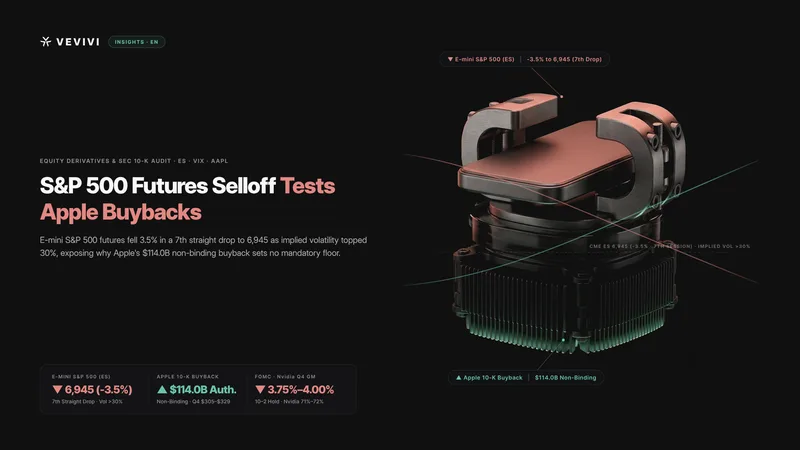
The seven-session S&P 500 futures selloff to 6,945 on November 20, 2026 has exposed a critical legal and microstructure gap between cap-weighted derivatives liquidation and discretionary corporate share repurchases. According to official market data on the CME Group E-mini S&P 500 Futures Contract Specifications, front-month E-mini S&P 500 futures (product code ES, valued at $50 times the S&P 500 Index) dropped 3.5% on November 20 to 6,945, extending a seventh consecutive losing session one day after implied volatility topped 30%. Under the Cboe Volatility Index Methodology v6.0, 30-day expected volatility weights out-of-the-money SPX and Weeklys SPXW option prices inversely to the square of each strike price (1/K^2), accelerating implied variance whenever institutions bid up downside puts. While equity desks frequently treat mega-cap buyback authorizations as an automatic shock absorber during futures drawdowns, primary SEC filings confirm that those authorizations impose zero mandatory purchasing floor when passive baskets de-risk.
S&P 500 Futures Selloff Microstructure: Cap-Weighted Transmission and Cboe 1/K^2 Convexity
Understanding why futures-led drawdowns pressure defensive mega-cap holdings requires examining how liquidity moves between CME index futures and Cboe option books. CME Group specifications document that E-mini S&P 500 futures trade 8 times the dollar value of all S&P 500 ETFs combined—including SPY, IVV, and VOO—while providing 60 times the buying power of cash equities and saving institutional hedgers 8.9 to 13.3 basis points ($80 to $119 over a one-day holding period) relative to ETF execution. Because the underlying S&P 500 is a capitalization-weighted index of 500 large U.S. companies, arbitrage desks executing Basis Trade at Index Close (BTIC) and Trade Marker at Close (TMAC) orders transmit futures selling across cash constituents strictly in proportion to market capitalization.
Simultaneously, Cboe's VIX methodology explains why spot implied volatility surges past 30% faster than VIX futures reprice. Spot VIX is calculated every 15 seconds on Cboe Options Exchange (C1) across standard AM-settled SPX and PM-settled SPXW contracts—subject to a 0.50 volatility-point, 2-minute quote filter—and truncates each wing only when two consecutive out-of-the-money strikes register zero bid prices. As downside puts wake up with non-zero bids during a seven-session slide, the 1/K^2 weighting magnifies deep out-of-the-money put premiums immediately, whereas VIX futures settle on Wednesday mornings via a Special Opening Quotation (SOQ) derived from opening trade prices in a single expiration 30 calendar days ahead.
Fine-Print SEC 10-K Audit: Why Apple's $114.0 Billion Buyback Is Discretionary, Not Mandatory
Across institutional portfolios, Apple represents a primary liquidity reservoir backed by massive recurring cash generation, yet a clause-by-clause reading of Apple Inc.'s FY2026 Form 10-K Annual Report separates cash capacity from legal obligation. In fiscal 2026 ended September 26, 2026, Apple generated $478,834 million ($478.8 billion) in total net sales—up 15% year over year, led by $254,098 million in iPhone sales (+21%) and $123,301 million in Services (+13% at a 76.2% Services gross margin versus 39.3% on Products, for a 48.8% total gross margin)—producing $132,175 million in net income ($8.98 diluted EPS) and $145,097 million ($145.1 billion) in operating cash flow. Over the fiscal year, Apple paid $86,390 million ($86.4 billion) in cash to repurchase common stock and $15,721 million ($15.7 billion) in dividends, reducing common shares outstanding to 14,532,182,000 as of October 23, 2026.
Item 5 of Form 10-K details that during the fourth quarter (June 28 to September 26, 2026), Apple repurchased 81,767 thousand shares across open-market and accelerated share repurchase (ASR) tranches: 27,594 thousand shares at $317.45 (June 28–August 1), 6,288 thousand final ASR shares at an average $305.29 price (completing May 2026 ASRs of $10.0 billion covering 33 million total shares), 26,820 thousand shares at $309.66 (August 2–August 29), and 21,065 thousand shares at $329.22 (August 30–September 26). While $114,004 million ($114.0 billion) remained available as of September 26, 2026—comprising $14.0 billion from the May 2025 $100 billion plan plus the April 30, 2026 $100 billion authorization—both Item 1A and Item 5 explicitly stipulate that Apple's share repurchase programs do not obligate the company to acquire a minimum amount of shares.
Furthermore, Apple Inc.'s Q4 FY2026 Form 8-K Financial Results Release discloses that Q4 revenue of $114.5 billion (+12% year over year, with $28 billion in quarterly operating cash flow, $28 billion returned to shareholders, and a $0.27 quarterly dividend) achieved a 47.9% gross margin and $2.10 diluted EPS that included an approximate 1 percentage point margin tailwind ($0.05 per share) from tariff refunds after the February 20, 2026 Supreme Court ruling on IEEPA tariffs. Meanwhile, Form 10-K warns of ongoing Section 301 tariffs, the Commerce Department's Section 232 semiconductor investigation, and intensifying memory and advanced semiconductor cost pressures—reflected in inventories jumping from $5,718 million to $14,541 million (with component inventories rising from $2,124 million to $10,447 million) alongside $89.7 billion in manufacturing purchase obligations ($82.7 billion payable within 12 months), $78.7 billion in fixed-rate notes ($2.0 billion commercial paper), and $136.9 billion in cash and marketable securities carrying a $2,608 million fair-value loss sensitivity per 100 basis point interest-rate increase.
Two-Sided Hypothesis Test: AI Cash-Flow Velocity Versus Working-Capital and FOMC Rigidity
Assessing whether 6,945 on E-mini S&P 500 futures marks a tactical inflection or precedes broader passive de-grossing requires weighing corporate cash-flow strength against balance-sheet and monetary headwinds.
The constructive stabilization hypothesis rests on verified earnings power and macro growth. CME Group's November 20 commentary notes 3.4% third-quarter U.S. GDP growth, while Apple's five-year total shareholder return turned $100 in September 2021 into $238 by September 2026 (ahead of $187 for the S&P 500 Index and alongside $256 for the Dow Jones U.S. Technology Index). On the AI infrastructure front, Nvidia's Q3 Fiscal 2027 Financial Results Release reports revenue up 103% year over year to $115.8 billion ($107.6 billion in Data Center, up 110% as Vera Rubin NVL72 shipped), $48,253 million ($48.3 billion) in operating cash flow, $28.1 billion returned to shareholders ($22,122 million in Q3 buybacks plus $6,026 million in dividends), $227.3 billion in remaining repurchase authorization, and Q4 revenue guidance of $130.0 billion (±3%) assuming zero China Data Center compute revenue.
Conversely, the bearish second-leg hypothesis centers on margin compression, working-capital lockup, and hawkish Federal Reserve dissent. Nvidia's same release guides Q4 GAAP and non-GAAP gross margins down from 74.8% and 74.9% in Q3 to 71.0% and 72.0%, while accounts receivable expanded from $38,466 million in January 2026 to $81,033 million ($81.0 billion) and inventories climbed from $21,403 million to $39,724 million ($39.7 billion). At the monetary anchor, the Federal Reserve October 28, 2026 FOMC Statement held the federal funds target range at 3.75% to 4.00% (3-3/4 to 4 percent) on a 10–2 vote, noting elevated inflation and robust capital investment. As verified by the Federal Open Market Committee 2026 Membership Roster, the two officials dissenting in favor of an immediate 25 basis point (1/4 percentage point) rate hike were Federal Reserve Board Governor Lisa D. Cook and Federal Reserve Bank of Cleveland President Beth M. Hammack—confirming hawkish resistance across both the Board of Governors and rotating regional Reserve Bank leadership.
Second-Order Effects and Conditional Watch-Levels
The second-order risk for multi-asset portfolios is asynchronous liquidity withdrawal: if futures volatility stays above 30% into a holiday-shortened week featuring October PCE data while corporate Rule 10b5-1 grids refrain from stepping up discretionary bids, cap-weighted ES arbitrage mechanically sells mega-cap holdings regardless of trailing cash flow. What current public filings cannot determine in advance is how swiftly hyperscaler customers convert Nvidia's $81.0 billion receivables balance into cash or whether holiday iPhone 18 Pro demand offsets Apple's memory cost headwinds without additional tariff shocks.
Traders can anchor risk discipline to three source-verified benchmarks rather than directional guesswork. First, reclaiming and holding the 6,945 November 20 E-mini S&P 500 futures level alongside implied volatility compressing back below 30% supports short-horizon dealer vega normalization, whereas sustained trade below 6,945 with implied volatility above 30% invalidates immediate stabilization. Second, on mega-cap execution, Apple's Q4 FY2026 actual repurchase band of $305.29 to $329.22 per share defines the proven price zone where treasury bids previously deployed capital; failure to stabilize within that historical execution corridor during passive ETF outflows signals discretionary buyer restraint. Third, if futures hold above 6,945 with implied volatility under 30% while Nvidia sustains its 71.0%–72.0% Q4 gross-margin corridor, the secondary cap-weighted de-grossing hypothesis is invalidated.
Does Apple's $114.0 billion buyback authorization guarantee a floor during an S&P 500 selloff?
No. Item 1A and Item 5 of Apple's FY2026 Form 10-K explicitly state that its share repurchase programs do not obligate the company to acquire a minimum amount of shares, making the $114,004 million remaining authorization a discretionary ceiling rather than a binding price commitment.
Why does Cboe VIX implied volatility exceed 30% faster than VIX futures reprice?
Spot VIX updates every 15 seconds using SPX and SPXW out-of-the-money options weighted inversely to the square of strike prices (1/K^2) until two consecutive zero-bid strikes appear, whereas VIX futures price a single Wednesday morning Special Opening Quotation (SOQ) 30 calendar days ahead.
Who dissented at the October 28, 2026 FOMC meeting, and why do their roles matter?
Federal Reserve Board Governor Lisa D. Cook and Federal Reserve Bank of Cleveland President Beth M. Hammack dissented against holding the federal funds rate at 3.75%–4.00%, preferring a 25 basis point hike and signaling hawkish vigilance across both Board and regional Bank voters.
Sources
- E-mini S&P 500 Futures Contract Specifications — CME Group, 2026-11-20
- Cboe Volatility Index (VIX) Methodology v6.0 — Cboe Global Indices, 2026-02-26
- Form 10-K Annual Report for FY2026 — U.S. Securities and Exchange Commission (Apple Inc.), 2026-11-02
- Form 8-K Exhibit 99.1 Q4 FY2026 Financial Results — U.S. Securities and Exchange Commission (Apple Inc.), 2026-11-02
- Nvidia Third Quarter Fiscal 2027 Financial Results — Nvidia Investor Relations, 2026-11-17
- Federal Open Market Committee Monetary Policy Statement — Board of Governors of the Federal Reserve System, 2026-10-28
- Federal Open Market Committee Structure and 2026 Members — Board of Governors of the Federal Reserve System, 2026-11-18
Disclaimer and Risk Warning
This article is provided strictly for informational and educational purposes based on publicly available on-chain metrics and macroeconomic data. Nothing in this publication constitutes financial, investment, legal, or tax advice, nor should it be construed as a solicitation, recommendation, or offer to buy or sell any digital asset or financial instrument. Digital assets are subject to high market risk and extreme price volatility, and you may lose part or all of your invested capital. Historical market cycles and past performance referenced herein do not guarantee future results. You are solely responsible for your own investment decisions and should conduct independent research and consult a qualified financial advisor before making any financial commitments.