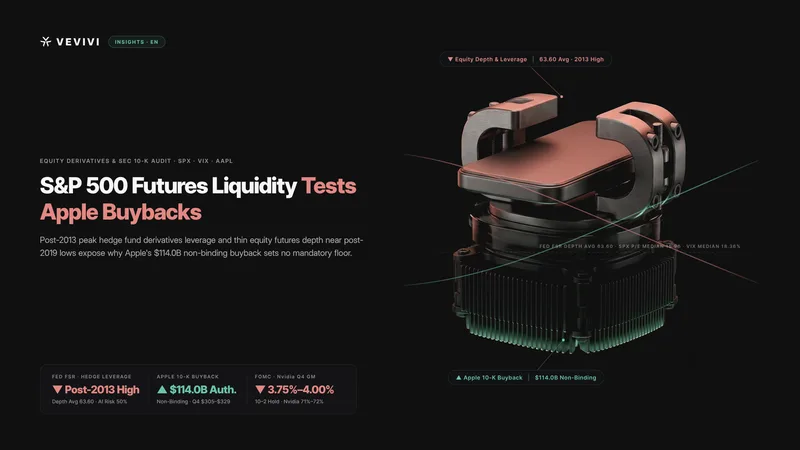
Thinning S&P 500 futures liquidity combined with fourteen-year peak hedge fund leverage has exposed a structural gap between systematic derivatives de-risking and discretionary corporate share repurchases. According to the Federal Reserve November 2026 Financial Stability Report, leverage at hedge funds has reached its highest level since data collection began in 2013—concentrated in large multi-strategy books trading Treasury securities, interest rate derivatives, and equities—while equity futures market depth remains near the lower end of its post-2019 distribution against a historical average of 63.60 contracts. Under the Cboe Volatility Index Methodology v6.0, 30-day expected volatility weights out-of-the-money SPX and Weeklys SPXW option prices inversely to the square of each strike price (1/K^2), amplifying implied variance whenever thin futures order books force institutions into downside put protection. Although equity desks routinely treat mega-cap buyback authorizations as an automatic shock absorber during volatility spikes, primary SEC filings confirm that those authorizations impose zero mandatory purchasing floor.
S&P 500 Futures Liquidity Mechanics: Leverage Concentration and Cboe 1/K^2 Convexity
Understanding why derivatives unwinds pressure defensive mega-cap weights requires examining how order-book depth interacts with non-linear option pricing across the $93,608 billion U.S. public equity market (+25.3% year over year through Q2 2026, versus a 9.5% annual average since 1998). The Federal Reserve's November 2026 assessment notes that S&P 500 forward price-to-earnings multiples remain well above their 15.96 historical median while the equity risk premium sits near the bottom of its historical distribution relative to a 4.54 percentage-point median, leaving minimal valuation cushion when liquidity providers widen quotes. In the Fed's Fall 2026 Survey of Salient Risks, 50% of market contacts cited artificial intelligence (after 87% in Spring 2026) and 35% cited a risk asset correction (52% in Spring 2026) as top systemic threats, alongside 30% citing private credit and 20% each flagging higher long-term rates and fiscal debt sustainability.
When leveraged equity and rate-derivative books de-risk into shallow futures depth, Cboe's VIX formula explains why spot implied volatility reprices faster than VIX futures contracts. Calculated every 15 seconds on Cboe Options Exchange (C1) with a 0.50 volatility-point, 2-minute stability filter, spot VIX incorporates successive out-of-the-money SPX and SPXW strikes until two consecutive options register zero bid prices. As downside put bids awaken above the VIX's 18.36% historical option-implied median documented by the Federal Reserve, the 1/K^2 strike weighting magnifies tail-risk premiums immediately, whereas VIX futures and options settle on Wednesday mornings via a Special Opening Quotation (SOQ) derived from opening trades in a single expiration 30 calendar days ahead.
Fine-Print SEC 10-K Audit: Why Apple's $114.0 Billion Buyback Is Discretionary, Not Mandatory
Across institutional portfolios, Apple serves as a flagship liquidity reservoir backed by recurring cash generation, yet a clause-by-clause audit of Apple Inc.'s FY2026 Form 10-K Annual Report separates cash capacity from legal obligation. In fiscal 2026 ended September 26, 2026, Apple generated $478,834 million ($478.8 billion) in total net sales—up 15% year over year, driven by $254,098 million in iPhone sales (+21%) and $123,301 million in Services (+13% at a 76.2% Services gross margin versus 39.3% on Products, for a 48.8% total gross margin)—producing $132,175 million in net income ($8.98 diluted EPS) and $145,097 million ($145.1 billion) in operating cash flow. During fiscal 2026, Apple paid $86,390 million ($86.4 billion) in cash to repurchase common stock and $15,721 million ($15.7 billion) in dividends, bringing shares outstanding to 14,532,182,000 as of October 23, 2026.
Item 5 of Form 10-K shows that during the fourth quarter (June 28 to September 26, 2026), Apple repurchased 81,767 thousand shares across open-market and accelerated share repurchase (ASR) tranches: 27,594 thousand shares at $317.45 (June 28–August 1), 6,288 thousand final ASR shares at an average $305.29 price (completing May 2026 ASRs of $10.0 billion covering 33 million total shares), 26,820 thousand shares at $309.66 (August 2–August 29), and 21,065 thousand shares at $329.22 (August 30–September 26). While $114,004 million ($114.0 billion) remained authorized as of September 26, 2026—comprising $14.0 billion under the May 2025 $100 billion plan plus the April 30, 2026 $100 billion program—both Item 1A and Item 5 explicitly stipulate that Apple's share repurchase programs do not obligate the company to acquire a minimum amount of shares.
Moreover, Apple Inc.'s Q4 FY2026 Form 8-K Financial Results Release discloses that Q4 revenue of $114.5 billion (+12% year over year, with $28 billion in quarterly operating cash flow, $28 billion returned to shareholders, and a $0.27 quarterly dividend) achieved a 47.9% gross margin and $2.10 diluted EPS that included an approximate 1 percentage point margin tailwind ($0.05 per share) from tariff refunds following the February 20, 2026 Supreme Court ruling on IEEPA tariffs. Meanwhile, Form 10-K highlights ongoing Section 301 tariffs, the Commerce Department's Section 232 semiconductor investigation, and rising memory and advanced semiconductor costs—evidenced by inventories jumping from $5,718 million to $14,541 million (components rising from $2,124 million to $10,447 million) alongside $89.7 billion in manufacturing purchase obligations ($82.7 billion due within 12 months), $78.7 billion in fixed-rate notes ($2.0 billion commercial paper), and $136.9 billion in cash and securities facing a $2,608 million fair-value decline per 100 basis point interest-rate rise.
Two-Sided Hypothesis Test: AI Cash-Flow Velocity Versus Debt Supply and FOMC Rigidity
Evaluating whether derivatives volatility triggers a brief positioning reset or deeper institutional de-grossing requires testing corporate cash generation against balance-sheet and monetary constraints.
The constructive stabilization hypothesis rests on verified earnings expansion and capital return scale. Apple's five-year total shareholder return turned $100 invested in September 2021 into $238 by September 2026 (outpacing $187 for the S&P 500 Index alongside $256 for the Dow Jones U.S. Technology Index). Simultaneously, Nvidia's Q3 Fiscal 2027 Financial Results Release reports revenue up 103% year over year to $115.8 billion ($107.6 billion in Data Center, up 110% as Vera Rubin NVL72 shipped), $48,253 million ($48.3 billion) in operating cash flow, $28.1 billion returned to shareholders ($22,122 million in Q3 buybacks plus $6,026 million in dividends), $227.3 billion in remaining buyback authorization, and Q4 revenue guidance of $130.0 billion (±3%) assuming zero China Data Center compute revenue.
Conversely, the cautious second-leg hypothesis highlights margin compression, AI infrastructure debt supply, and hawkish Federal Reserve dissent. The Fed's Financial Stability Report notes that year-to-date corporate bond issuance by the largest investment-grade data-center operators has already surpassed $150 billion while nominal Treasury term premiums climbed above their 0.55 percentage-point historical median and swaption rate volatility rose above its 81.82 basis-point median. Inside Nvidia's balance sheet, Q4 GAAP and non-GAAP gross margins are guided down from 74.8% and 74.9% to 71.0% and 72.0%, while accounts receivable surged from $38,466 million in January 2026 to $81,033 million ($81.0 billion) and inventories rose from $21,403 million to $39,724 million ($39.7 billion). At the monetary anchor, the Federal Reserve October 28, 2026 FOMC Statement held the federal funds target range at 3.75% to 4.00% (3-3/4 to 4 percent) on a 10–2 vote amid elevated inflation and robust capital investment. As verified by the Federal Open Market Committee 2026 Membership Roster, the two officials dissenting for an immediate 25 basis point (1/4 percentage point) rate hike were Federal Reserve Board Governor Lisa D. Cook and Federal Reserve Bank of Cleveland President Beth M. Hammack—confirming hawkish vigilance across both the Board of Governors and rotating regional Reserve Bank leadership.
Second-Order Positioning Effects and Conditional Watch-Levels
The second-order hazard for derivatives traders is liquidity procyclicality: as the Federal Reserve's report warns, low order-book depth amplifies initial price shocks and causes market makers to pull quotes further while corporate Rule 10b5-1 grids face zero obligation to accelerate discretionary bids. What current filings cannot resolve in advance is how rapidly hyperscaler customers convert Nvidia's $81.0 billion receivables balance into cash or whether holiday iPhone 18 Pro demand absorbs Apple's $82.7 billion near-term purchase commitments without new tariff friction.
Disciplined positioning therefore relies on three source-documented thresholds. First, equity futures market depth rebuilding toward its 63.60-contract historical average while Cboe VIX implied volatility mean-reverts toward its 18.36% long-run median signals dealer balance-sheet normalization, whereas persistent sub-average depth alongside widening 1/K^2 put skew warns of ongoing hedge fund de-grossing. Second, Apple's Q4 FY2026 actual repurchase band of $305.29 to $329.22 per share defines the verified price corridor where treasury bids deployed capital; failure to hold that execution band during passive outflows indicates discretionary buyer restraint. Third, if VIX term structure stabilizes toward its 18.36% median while Nvidia preserves its 71.0%–72.0% Q4 gross-margin corridor, the secondary mega-cap de-risking thesis is invalidated.
Does Apple's $114.0 billion buyback authorization guarantee a floor during an S&P 500 futures unwind?
No. Item 1A and Item 5 of Apple's FY2026 Form 10-K explicitly state that its share repurchase programs do not obligate the company to acquire a minimum amount of shares, making the $114,004 million authorization a discretionary ceiling rather than a binding floor.
Why does thin S&P 500 futures depth accelerate Cboe VIX spikes?
The Fed's November 2026 Financial Stability Report notes equity futures depth sits near post-2019 lows (versus a 63.60-contract average) while hedge fund leverage stands at a post-2013 high; resulting downside put demand is weighted by 1/K^2 every 15 seconds in spot VIX ahead of Wednesday SOQ futures settlement.
Who dissented at the October 28, 2026 FOMC meeting, and why do their titles matter?
Federal Reserve Board Governor Lisa D. Cook and Federal Reserve Bank of Cleveland President Beth M. Hammack dissented against holding the federal funds rate at 3.75%–4.00%, preferring a 25 basis point hike and signaling hawkish resistance across both Board and regional Bank voters.
Sources
- Financial Stability Report November 2026 — Board of Governors of the Federal Reserve System, 2026-11-13
- Cboe Volatility Index (VIX) Methodology v6.0 — Cboe Global Indices, 2026-02-26
- Form 10-K Annual Report for FY2026 — U.S. Securities and Exchange Commission (Apple Inc.), 2026-11-02
- Form 8-K Exhibit 99.1 Q4 FY2026 Financial Results — U.S. Securities and Exchange Commission (Apple Inc.), 2026-11-02
- Nvidia Third Quarter Fiscal 2027 Financial Results — Nvidia Investor Relations, 2026-11-17
- Federal Open Market Committee Monetary Policy Statement — Board of Governors of the Federal Reserve System, 2026-10-28
- Federal Open Market Committee Structure and 2026 Members — Board of Governors of the Federal Reserve System, 2026-11-18
Disclaimer and Risk Warning
This article is provided strictly for informational and educational purposes based on publicly available on-chain metrics and macroeconomic data. Nothing in this publication constitutes financial, investment, legal, or tax advice, nor should it be construed as a solicitation, recommendation, or offer to buy or sell any digital asset or financial instrument. Digital assets are subject to high market risk and extreme price volatility, and you may lose part or all of your invested capital. Historical market cycles and past performance referenced herein do not guarantee future results. You are solely responsible for your own investment decisions and should conduct independent research and consult a qualified financial advisor before making any financial commitments.