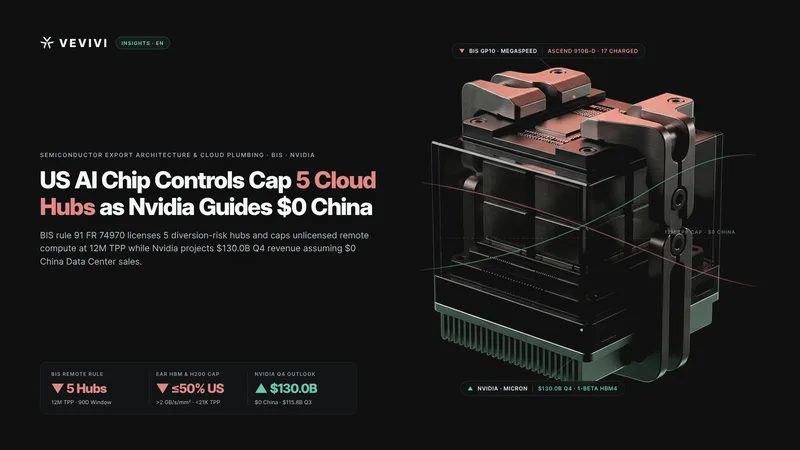
US AI chip export controls entered an extraterritorial cloud phase on November 19, 2026, when the U.S. Federal Register Interim Final Rule Addressing Remote Access to Advanced Semiconductors (91 FR 74970) imposed export, reexport, and in-country transfer licenses across five diversion-sensitive destinations—Indonesia, Malaysia, Singapore, Thailand, and Brazil—while prohibiting overseas data centers worldwide from providing more than 12,000,000 aggregate total processing performance (TPP) of unlicensed remote compute to entities headquartered in Macau or Country Group D:5 after a 90-day compliance window. Two days earlier, Nvidia's Q3 Fiscal 2027 Financial Results reported $115.8 billion in quarterly revenue (up 20% sequentially and 103% year-over-year, led by $107.6 billion in Data Center revenue) and projected $130.0 billion (plus or minus 3%) for Q4 FY27 while explicitly assuming $0 in Data Center compute revenue from China.
Inside US AI Chip Export Controls Across HBM Stacks, GP10 Guidance, and H200 Caps
Pricing regulatory risk in semiconductor supply chains requires separating binding Export Administration Regulations (EAR) rules from non-binding agency guidance rather than treating every Washington publication as an identical legal prohibition. On the binding side, the December 2, 2024 U.S. BIS Semiconductor Equipment and High-Bandwidth Memory Package imposed controls across 24 categories of semiconductor manufacturing equipment, 3 software tool categories (including ECAD and TCAD design software), and both U.S.-origin and foreign-produced high-bandwidth memory (HBM) under the advanced computing Foreign Direct Product (FDP) rule, while adding 140 entities and 14 modifications to the Entity List alongside zero-threshold de minimis SME FDP jurisdiction over foreign tools containing any U.S.-origin integrated circuits.
In the February 14, 2025 Federal Register ECCN 3A090 Rule (90 FR 9604), BIS codified technical parameters under ECCN 3A090.c restricting HBM packages with a memory bandwidth density greater than 2 gigabytes per second per square millimeter, alongside ECCN 3A090.a logic thresholds at 4,800 TPP (or 1,600 TPP with performance density of 5.92 or more). Note 1 to 3A090.a further established a binding presumption for front-end fabricators and outsourced semiconductor assembly and test (OSAT) facilities unless chips packaged outside Macau or Country Group D:5 remain below 30 billion transistors, or contain zero HBM and stay below 35 billion transistors in 2027 and 40 billion transistors in 2029 and beyond.
By contrast, the May 13, 2025 BIS General Prohibition 10 (GP10) Industry Guidance on PRC 3A090 Integrated Circuits operates as non-binding advisory guidance rather than a standalone new statutory ban: it alerts companies worldwide to a rebuttable presumption that PRC-designed 3A090 processors—specifically listing Huawei Ascend 910B, Huawei Ascend 910C, and Huawei Ascend 910D—were likely developed or fabricated using EAR-controlled software or equipment without authorization under 15 C.F.R. § 736.2(b)(10), while clarifying that BIS will not pursue enforcement against parties obtaining a PRC 3A090 chip solely for technical analysis or evaluation. Similarly, when Washington issued the binding January 15, 2026 Federal Register Final Rule on Advanced Computing Commodities (91 FR 1684), it shifted direct U.S. exports to China and Macau of accelerators below 21,000 TPP and 6,500 GB/s total DRAM bandwidth (explicitly naming the Nvidia H200 and AMD MI325X) from a presumption of denial to case-by-case review, yet locked eligibility behind strict Supplement No. 2 to Part 748 certifications: aggregate TPP shipped to China and Macau cannot exceed 50% of aggregate TPP shipped to U.S. customers for U.S. end-use, U.S. orders and global foundry capacity cannot be delayed or diverted, Infrastructure-as-a-Service (IaaS) remote end-users across eight listed destinations (Belarus, China, Cuba, Iran, Macau, North Korea, Russia, and Venezuela) must be disclosed, unauthorized model-weight transfers are prohibited, and every shipment batch must pass pre-export verification at an independent U.S.-headquartered testing laboratory, while reexports and offshore D:5-parented buyers remain under a presumption of denial.
Frontier Hardware Supply Plumbing Across Micron 1-Beta HBM4 and ASML Lithography
Export licensing perimeters interact directly with physical capacity ceilings in high-density DRAM stacking and extreme ultraviolet (EUV) lithography. According to Micron Technology's Q3 Fiscal 2026 Financial Release for the quarter ended May 28, 2026, revenue reached $41.46 billion (compared with $23.86 billion in FQ2-26 and $9.30 billion a year earlier) at an 84.6% GAAP gross margin and $28.24 billion in GAAP net income, including $13,769 million from its Cloud Memory Business Unit at an 83% gross margin. Micron guided FQ4-26 revenue to $50.0 billion (plus or minus $1.0 billion) at an approximately 86% gross margin, confirming that HBM4 built on 1-beta DRAM technology is already in high-volume shipments for its lead customer's platform while 1-gamma HBM4E advances toward calendar 2027 volume production.
Wafer lithography capacity exhibits a parallel multi-year supply constraint. In ASML Holding's Q3 2026 Financial Results, quarterly total net sales reached €11.7 billion (€11,662 million, including €3.3 billion in Installed Base Management upgrades) across 113 new and 8 used lithography systems sold, generating a 57.5% gross margin and €5.0 billion in net income. ASML guided Q4 2026 net sales between €14.2 billion and €15.2 billion (around 57% gross margin) and full-year 2026 net sales between €44 billion and €45 billion (around 56% gross margin), noting customer order interest extending into 2029 and 2030 and warning that currently planned supply for both 2027 and 2028 will not fully meet customer demand even with its planned 30% capacity expansion in 2027 across low-NA EUV and DUV immersion systems.
Symmetric Two-Sided Institutional Thesis: Compliance Insulation vs. Five-Hub Cloud Friction
Evaluating semiconductor cash-flow durability requires testing two opposing institutional hypotheses anchored strictly in primary filings.
The constructive backlog-insulation hypothesis rests on verified law-enforcement timelines, board-level compliance governance, and zero-China guidance baselines. In the November 16, 2026 Commerce and DOJ Joint Statement on the Megaspeed Investigation, federal authorities disclosed that Commerce initiated its inquiry into Singaporean company Megaspeed in 2024, requested sales records from Nvidia in May 2025, and confirmed that Nvidia placed Megaspeed on its corporate no-sell list in June 2025 alongside a joint on-site end-use inspection by BIS agents and Singaporean law enforcement that interviewed CEO Alice Huang, before DOJ assumed lead responsibility for the criminal probe within a broader enforcement campaign that has charged 17 defendants across 6 smuggling investigations and raised Commerce monetary penalties 18-fold over the prior administration. On November 17, 2026, Nvidia's Board National Security and Export Control Oversight Committee Release established a standing board committee chaired by director Suzanne Nora Johnson alongside Stephen C. Neal and John O. Dabiri—meeting at least quarterly with direct reporting from Nvidia's National Security and Global Trade Compliance teams and Interim CEO Colette Kress—while Q3 FY27 operating results ($43,777 million in free cash flow, Vera Rubin NVL72 rack shipments, $28.1 billion in Q3 shareholder returns, and $227.3 billion in remaining buyback authorization) demonstrated that Nvidia's $130.0 billion Q4 FY27 revenue outlook already embeds $0 from China Data Center compute.
The countervailing margin-and-deployment friction hypothesis focuses on second-order compliance bottlenecks in third-country clouds and gross-margin compression during architectural transitions. While 91 FR 74970 formally rescinded the unenforced January 15, 2025 AI Diffusion Rule (90 FR 4544) and exempted consignees headquartered (or ultimate-parent-headquartered) in the United States subject to new § 743.10 reporting—as well as compute used exclusively for commercial recommender systems—non-U.S. cloud operators across Indonesia, Malaysia, Singapore, Thailand, and Brazil now face case-by-case export licensing, worldwide digitally or physically linked data centers are aggregated together under the 12,000,000 TPP cap for Macau and Country Group D:5 customers, de minimis safe harbors are disapplied where prohibited end-use knowledge exists, and BIS explicitly warned of country-status downgrades or Entity List designations if evasion is tolerated. Simultaneously, Nvidia's Q4 FY27 GAAP gross margin outlook steps down to 71.0%–72.0% from 74.8% in Q3 FY27 as Vera Rubin ramps, following the $4.3 billion in net H20 charges Nvidia absorbed during the first nine months of fiscal 2026.
Epistemic Boundaries and Numeric If-Then-Invalidate Checkpoints
Disciplined institutional analysis separates verified regulatory text from unresolved outcomes: DOJ's criminal investigation into Megaspeed remains ongoing, and BIS's public comment period on Interim Final Rule 91 FR 74970 remains open through January 19, 2027. Positioning desks can track two concrete numerical invalidation thresholds derived directly from current filings.
First, monitor the January 19, 2027 BIS comment deadline and the 90-day overseas data-center license compliance cutoff falling on February 17, 2027 (90 calendar days from the November 19, 2026 effective date) alongside Nvidia's Q4 FY27 delivery. If licensing delays across non-U.S. data centers in Indonesia, Malaysia, Singapore, Thailand, and Brazil defer rack acceptances enough to push Nvidia's realized Q4 FY27 revenue below its $130.0 billion (± 3%) guidance band—an implied $126.1 billion lower bound—or compress GAAP gross margin below 71.0%, the thesis that U.S. hyperscaler Vera Rubin demand fully absorbs regional export friction is invalidated.
Second, track upstream HBM4 and lithography execution against Micron's FQ4-26 guidance of $50.0 billion (± $1.0 billion) in revenue at an approximately 86% gross margin and ASML's Q4 2026 net sales target of €14.2 billion to €15.2 billion (within its €44 billion to €45 billion full-year 2026 range). Conversely, if BIS processes case-by-case licenses across the five designated hubs without disrupting regional cloud buildouts while Nvidia sustains GAAP gross margins at or above 71.0% and delivers within or above its $130.0 billion (± 3%) Q4 revenue band, the near-term export-friction compression hypothesis is invalidated.
Frequently Asked Questions on US AI Chip and Remote Compute Rules
What does the November 2026 BIS remote-access rule (91 FR 74970) require for overseas data centers?
Effective November 19, 2026, BIS Rule 91 FR 74970 requires case-by-case export, reexport, and transfer licenses for advanced semiconductors shipped to non-U.S.-headquartered consignees in Indonesia, Malaysia, Singapore, Thailand, and Brazil, formally rescinds the AI Diffusion Rule, and requires a BIS license whenever a foreign data center (or linked data centers) provides above 12,000,000 aggregate TPP of non-recommender compute to Macau or Country Group D:5 entities, granting existing facilities 90 days to obtain authorization.
How do BIS's May 2025 Huawei Ascend GP10 release and the January 2026 H200 rule differ in legal force?
BIS's May 13, 2025 document is non-binding industry guidance alerting companies to a rebuttable presumption that Huawei Ascend 910B, 910C, and 910D chips implicate existing General Prohibition 10 rules (excluding technical testing), whereas the January 15, 2026 Federal Register publication (91 FR 1684) is a binding Final Rule allowing case-by-case review for direct U.S. exports below 21,000 TPP and 6,500 GB/s DRAM bandwidth only when China and Macau shipments stay at or below 50% of U.S. volume and pass independent U.S. lab testing.
How does Nvidia treat China Data Center revenue in its Q4 Fiscal 2027 outlook?
In its November 17, 2026 financial release, Nvidia projected Q4 FY27 total revenue of $130.0 billion (± 3%) and GAAP gross margins of 71.0% to 72.0% while explicitly stating that it assumes zero Data Center compute revenue from China in that outlook.
Sources
- Addressing Remote Access to Advanced Semiconductors (91 FR 74970) — U.S. Federal Register / Bureau of Industry and Security, 2026-11-19
- Nvidia Announces Financial Results for Third Quarter Fiscal 2027 — Nvidia Corporation, 2026-11-17
- Commerce Strengthens Export Controls to Restrict China's Capability to Produce Advanced Semiconductors for Military Applications — U.S. Department of Commerce (BIS), 2024-12-02
- Implementation of Additional Due Diligence Measures for Advanced Computing Integrated Circuits; Correction (90 FR 9604) — U.S. Federal Register / BIS, 2025-02-14
- Guidance on Application of General Prohibition 10 (GP10) to PRC Advanced-Computing Integrated Circuits — U.S. Department of Commerce (BIS), 2025-05-13
- Revision to License Review Policy for Advanced Computing Commodities (91 FR 1684) — U.S. Federal Register / BIS, 2026-01-15
- Micron Technology Reports Record Results for the Third Quarter of Fiscal 2026 — Micron Technology Investor Relations, 2026-06-24
- ASML Reports €11.7 Billion Total Net Sales and €5.0 Billion Net Income in Q3 2026 — ASML Holding N.V., 2026-10-14
- Joint Statement from Department of Commerce and Department of Justice On Megaspeed Investigation — U.S. Department of Commerce, 2026-11-16
- Nvidia Board of Directors Establishes National Security and Export Control Oversight Committee — Nvidia Corporation, 2026-11-17
Disclaimer and Risk Warning
This article is provided strictly for informational and educational purposes based on publicly available on-chain metrics and macroeconomic data. Nothing in this publication constitutes financial, investment, legal, or tax advice, nor should it be construed as a solicitation, recommendation, or offer to buy or sell any digital asset or financial instrument. Digital assets are subject to high market risk and extreme price volatility, and you may lose part or all of your invested capital. Historical market cycles and past performance referenced herein do not guarantee future results. You are solely responsible for your own investment decisions and should conduct independent research and consult a qualified financial advisor before making any financial commitments.