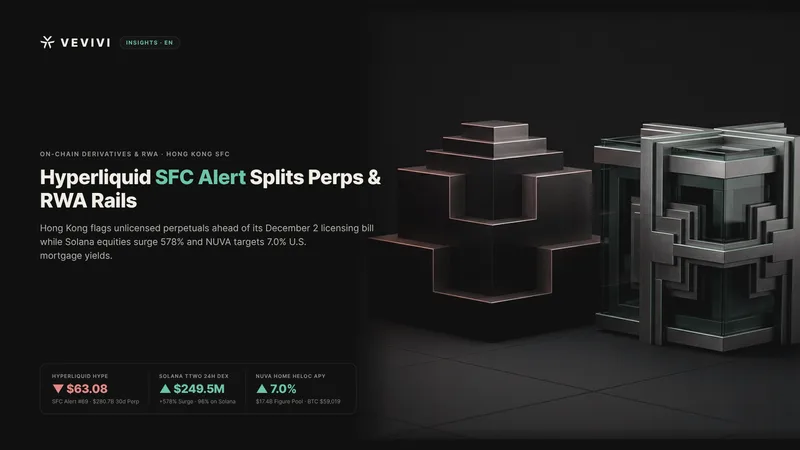
The Hyperliquid SFC alert issued in Hong Kong marks a structural inflection point between offshore perpetual futures venues and regulated real-world asset infrastructure. On November 18, 2026, the Hong Kong Securities and Futures Commission placed Hyperliquid and Hyperliquid Hong Kong on its Suspicious Virtual Asset Trading Platforms Alert List, raising the tally of flagged platforms to 69 alongside 13 fully licensed virtual asset trading platforms. While global crypto markets digested a sharp macro deleveraging wave that pushed Bitcoin to $59,018.80 (-4.67% over 24 hours), Ethereum to $1,619.54 (-7.76%), Solana to $69.25 (-6.08% with a $40.97 billion market capitalization), and Hyperliquid's native token to $63.08 (-35.6% below its September 23, 2026 all-time high of $97.96), institutional capital allocation is splitting cleanly along licensing lines. Unlicensed offshore leverage protocols face tightening supervisory cordons across major financial centers, whereas regulated stablecoin issuers, tokenized equity venues, and curated credit vaults are capturing durable institutional balance-sheet demand.
Why the Hyperliquid SFC Alert Signals a Global Licensing Perimeter
Regulatory scrutiny directed at Hyperliquid reflects a coordinated supervisory doctrine rather than an isolated municipal notice. Formally, the November 18 notice published by the Hong Kong Securities and Futures Commission constitutes an investor licensing warning rather than a fraud finding, asset freeze, trading suspension, or internet service provider block. The commission flagged Hyperliquid's primary trading interface on suspicion of operating or marketing an unlicensed virtual asset trading platform to Hong Kong residents outside statutory custody and investor-protection safeguards under the Anti-Money Laundering and Counter-Terrorist Financing Ordinance. Investors transacting on unauthorized venues fall outside local supervisory recourse if a smart contract or operator suffers an exploit or insolvency.
Hong Kong's warning follows two prior actions by tier-1 financial watchdogs in 2026: Singapore's Monetary Authority added Hyperliquid to its Investor Alert List on January 27, 2026 (with follow-up notices in June), and the United Kingdom's Financial Conduct Authority published an unauthorized-firm warning against Hyperliquid and the Hyper Foundation on May 21, 2026, updated on June 7, 2026. More importantly, two days after flagging Hyperliquid, the Hong Kong Special Administrative Region Government officially gazetted the Virtual Asset Services Legislation (Amendment) Bill 2026 on November 20, 2026. As an introduced bill awaiting its First Reading before the Legislative Council on December 2, 2026—and therefore pending legislation rather than enacted statute—the measure proposes to extend mandatory Securities and Futures Commission licensing across four new categories: virtual asset dealing (modeled on Type 1 securities dealing), advisory services including artificial intelligence trading signals (Type 4), discretionary portfolio management (Type 9), and standalone cryptographic key custody, with no announced transitional grace period for over-the-counter dealers or custodians.
By contrast, United States derivatives regulators have articulated a conditional registration pathway rather than an outright ban on blockchain settlement rails. On November 19, 2026, Commodity Futures Trading Commission Chairman Michael Selig stated that decentralized perpetual futures venues such as Hyperliquid can legally serve United States retail traders only by registering directly as a Designated Contract Market and Derivatives Clearing Organization or by partnering with an already registered exchange. Selig cited Backpack, which secured Commodity Futures Trading Commission approval for a Designated Contract Market and Derivatives Clearing Organization on November 16 and National Futures Association registration as a Futures Commission Merchant on November 18, as the compliant blueprint for bringing leveraged perpetual contracts onshore.
Perpetual DEX Liquidity Stickiness Versus Solana's Supermassive Challenger
Despite mounting regulatory warnings in Asia and Europe, dislodging an incumbent derivatives order book remains one of the hardest challenges in market microstructure. Speaking on institutional market dynamics, Animoca Brands Co-Founder and Executive Chairman Yat Siu emphasized that depth of liquidity is the single stickiest network effect in global finance: traders systematically route size to the venue offering the tightest spreads and deepest margin buffers rather than migrating purely for underlying chain speed.
Hyperliquid's $280.7B Monthly Volume Moat and On-Chain Revenue Mechanics
Primary protocol data from DefiLlama as of November 20, 2026 illustrates the scale of Hyperliquid's entrenched order-book moat. Across Hyperliquid Layer 1, cumulative perpetual futures volume has reached $5.839 trillion, with trailing 30-day perpetual volume standing at $280.73 billion ($280.7B), 24-hour perpetual volume at $13.75 billion, open interest at $5.48 billion, and Total Value Locked at $7.21 billion. Over the past 30 days, the protocol generated $96.37 million in gross fees and $73.39 million in net protocol revenue (an annualized run rate of $894.23 million in fees and $679.86 million in revenue), routing 99% of net perpetual and spot trading fees to its Assistance Fund to execute programmatic open-market repurchases of its native token, which carries a $15.00 billion circulating market capitalization at $63.08. Benchmark figures cited during Solana Breakpoint London further underscore this gap: over the prior annual measurement window, Hyperliquid processed $2.93 trillion in perpetual volume compared with $450 billion across all Solana perpetual protocols combined and $27 trillion on centralized leader Binance.
Temporal's Net-Risk Portfolio Margin Architecture on Solana
To close that $2.48 trillion annual derivatives gap between Solana and Hyperliquid, Solana research and infrastructure firm Temporal unveiled Supermassive on November 17, 2026 at Breakpoint London. Scheduled for a 2027 launch with a waitlist currently open, Supermassive is designed not as an isolated exchange walled garden, but as a unified clearing and margin layer connecting spot markets, perpetual futures, and options under a single net-risk portfolio margin account. By offsetting hedged exposures—such as long spot Solana against a short perpetual contract—net-risk margining reduces collateral lockups while routing flow across proprietary automated market makers. Temporal brings substantial execution credibility: its proprietary automated market maker HumidiFi already captures up to 60% of Solana spot volume, while its Harmonic block-building infrastructure serves validators representing roughly 30% of staked Solana and more than $1.5 billion in staked assets. Nevertheless, Yat Siu cautions that because Hyperliquid operates as an agile, founder-led protocol rather than a slow legacy conglomerate, competing venues face an intense bootstrapping battle to pull leveraged liquidity away from an established order book while simultaneously navigating global derivatives licensing rules.
Selective Stablecoin Licensing and 24/7 Tokenized Equity Price Discovery
While unregulated perpetual venues confront supervisory friction, regulated stablecoin and tokenized equity rails are demonstrating rapid institutional adoption. In Hong Kong, the divergence between unlicensed alerts and bank-grade approvals is sharpest under the Stablecoins Ordinance (Cap. 656). Out of 36 first-round institutional applications submitted by the September 30, 2025 deadline, the Hong Kong Monetary Authority granted only 2 stablecoin issuer licenses on April 10, 2026—a 5.6% approval rate—selecting Anchorpoint Financial Limited (a joint venture uniting Standard Chartered Bank Hong Kong, HKT Limited, and Animoca Brands) alongside HSBC. Both licensees were chosen for verifiable fiat reserve custody, real-time anti-money-laundering analytics, and concrete settlement utility across cross-border trade and tokenized asset markets, where Hong Kong has already authorized 17 retail investment products with tokenized share classes totaling approximately $1.3 billion in assets under management.
Continuous 24/7 settlement is also transforming equity price discovery around major corporate catalysts and holiday or weekend macro shocks. On November 18, 2026, coinciding with the console release of Grand Theft Auto VI, trading volume in tokenized shares of publisher Take-Two Interactive surged 578% from $36.8 million to $249.5 million ($249.5M) across decentralized exchanges, capturing 42% of all $590.7 million in daily decentralized tokenized equity volume and nearly tripling tokenized Nvidia's $88.1 million single-day turnover. Crucially, 96% of Take-Two's on-chain volume—approximately $239 million—executed on Solana through 1:1 custodied tokens issued by Backpack Securities, while underlying Nasdaq shares rose 6.2% to $216.61.
In private capital markets, pre-IPO secondary equity tokenization is following a similarly regulated path rather than relying on unvetted decentralized pools. Clarifying conversational market speculation around year-end pilots, Republic officially launched tokenized ordinary shares of Animoca Brands on Solana on May 5, 2026, backed by book-entry share custody at Office of the Comptroller of the Currency-regulated BitGo Bank & Trust and traded exclusively by eligible investors on INX Securities' SEC-registered Alternative Trading System ahead of Animoca Brands' proposed Nasdaq reverse merger with Currenc Group (structured for existing Animoca shareholders to hold roughly 95% of the combined entity). As Yat Siu notes, tokenizing private and public equity not only accelerates secondary liquidity alongside traditional listings, but also prepares corporate cap tables for autonomous artificial intelligence agents that can only allocate capital programmatically to assets represented on-chain.
Curated U.S. Mortgage RWA Vaults and Cash-Flow Tokenomics
The maturation of tokenized equities and regulated credit vaults is fundamentally resetting valuation standards across the broader digital asset market. During the prior regulatory cycle, restrictive enforcement discouraged transparent revenue sharing and inadvertently fueled speculative memecoins. Today, altcoins without verifiable cash flows must compete directly against on-chain equities with audited profit-and-loss statements and institutional real-world asset vaults delivering transparent credit yields.
NUVA's 7.0% Target U.S. HELOC Vaults and SEC Token Buyback Staff Guidance
A concrete blueprint for disintermediated credit yield is NUVA, the non-custodial real-world asset marketplace co-created by Animoca Brands and Nuva Labs (formerly Provenance Blockchain Labs) and deployed on Ethereum Mainnet on May 13, 2026 to connect Provenance Blockchain's $23 billion-plus real-world asset ecosystem to public decentralized finance. Through its partnership with Figure Technology Solutions, NUVA introduced nvYLDS (backed by SEC-registered short-dated Treasury and bank-deposit instruments) and nvPRIME, providing composable exposure to Figure's $17.4 billion ($17.4B) pool of natively on-chain United States prime Home Equity Lines of Credit within a $460 billion national HELOC market. Expanding non-U.S. investor access on October 8, 2026 with a 1 USDC minimum entry, NUVA's HOME token targets a variable 7.0% annual yield recalculated monthly—substantially above the 3% to 4% deposit rates typically passed through by legacy commercial banks. Primary vault documentation confirms strict institutional underwriting and redemption terms: underlying borrowers carry a minimum average FICO score of 735, a maximum 69% combined loan-to-value cap, and a 40% debt-to-income ceiling, supported by a 5% first-loss equity buffer and a 5% liquid reserve, while standard redemptions settle over approximately 2 United States business days rather than instantaneous bank-free withdrawals and exclude residents of the United States, the United Kingdom, Hong Kong, and Mainland China.
Simultaneously, protocol tokenomics have gained narrower regulatory clarity in Washington despite legislative gridlock following the United States Senate's 49-50 procedural cloture failure on the CLARITY Act on September 15, 2026. On September 17, 2026, the Securities and Exchange Commission issued a 5-year Innovation Exemption (running through September 17, 2031) allowing permissioned Tokenized Securities Venues to trade National Market System equities via automated market makers. In late September 2026, the SEC Division of Corporation Finance published staff FAQ guidance—representing non-binding staff guidance rather than enacted federal law or a formal Commission final rule—clarifying that open-market token buybacks for treasury management or supply reduction on functional networks without a central managerial party do not automatically transform a non-security token into a security. Allium Labs data shows crypto protocols executed a record $638 million in token buybacks year-to-date through late August 2026 (nearly 90% concentrated in Hyperliquid and Pump.fun), while ecosystem issuers such as Open Campus activated transparent EDU token buybacks—confirming that verifiable yield and cash-flow attribution now separate institutional-grade digital assets from speculative relics.
Frequently Asked Questions for Institutional Allocators
Does the Hong Kong SFC alert shut down Hyperliquid or freeze user funds?
No. The November 18, 2026 listing on the Hong Kong Securities and Futures Commission Suspicious Virtual Asset Trading Platforms Alert List (entry #69) is a public licensing warning, not a fraud indictment, asset freeze, or mandatory network block. However, Hong Kong residents using unlicensed platforms have zero statutory investor-protection coverage, and Hong Kong's newly gazetted Virtual Asset Services Legislation (Amendment) Bill 2026 (scheduled for Legislative Council First Reading on December 2, 2026) aims to close remaining licensing gaps across dealing, advisory, management, and custody.
Can Solana's Supermassive protocol immediately overtake Hyperliquid in perpetual futures?
Not immediately. Supermassive, unveiled by Temporal on November 17, 2026 at Breakpoint London, is currently in waitlist phase targeting a 2027 launch. While its unified net-risk portfolio margin and HumidiFi's 60% Solana spot market share offer compelling capital efficiency, Hyperliquid commands $280.73 billion in 30-day perpetual volume, $5.48 billion in open interest, and $7.21 billion in Total Value Locked, giving it formidable liquidity stickiness alongside the shared challenge of meeting global derivatives licensing rules.
How does NUVA generate a 7.0% target yield on tokenized U.S. home equity loans, and what are the risks?
NUVA bridges prime Home Equity Lines of Credit originated on Figure Technology Solutions' $17.4 billion on-chain pool directly into ERC-20 vaults such as HOME (minimum 1 USDC for eligible non-U.S. investors), compressing traditional banking intermediation spreads to target a variable 7.0% annual yield reset monthly. Risks include borrower default, real estate valuation drawdowns beyond the 5% first-loss equity buffer, variable interest-rate shifts, strict jurisdictional exclusions, and a standard settlement window of roughly 2 United States business days that could lengthen if redemptions exceed the 5% liquid reserve.
Disclaimer and Risk Warning
This article is provided strictly for informational and educational purposes based on publicly available on-chain metrics and macroeconomic data. Nothing in this publication constitutes financial, investment, legal, or tax advice, nor should it be construed as a solicitation, recommendation, or offer to buy or sell any digital asset or financial instrument. Digital assets are subject to high market risk and extreme price volatility, and you may lose part or all of your invested capital. Historical market cycles and past performance referenced herein do not guarantee future results. You are solely responsible for your own investment decisions and should conduct independent research and consult a qualified financial advisor before making any financial commitments.