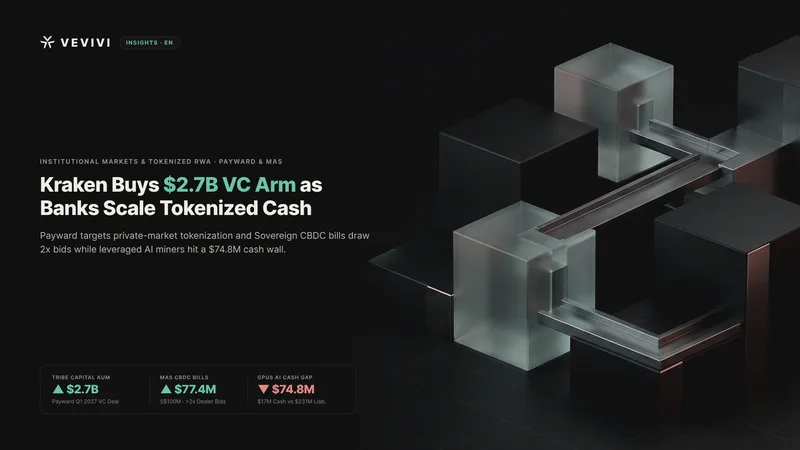
The Kraken Tribe Capital deal anchors a $2.7 billion institutional pivot toward private-market origination, accredited spot credit, and regulated tokenized money rails even as Bitcoin consolidates at $61,852.70 and Ethereum trades at $1,750.14. While secondary digital asset volumes face cyclical headwinds from elevated sovereign yields and mega-cap equity offerings, market infrastructure operators and global banks are systematically replacing single-asset spot reliance with multi-asset collateral, venture underwriting, and programmable cash settlement. At the same time, regulatory filings from capital-intensive infrastructure operators expose a widening credit divide between capitalized financial platforms and underfunded Bitcoin miners attempting leveraged artificial intelligence data center conversions.
Kraken Tribe Capital Deal and Private-Market Tokenization Architecture
Payward, Inc., the parent infrastructure company behind Kraken, announced on November 18, 2026, that it has entered into a definitive agreement to acquire Menlo Park venture capital and asset management firm Tribe Capital Management, Inc. Currently in the signed definitive agreement stage awaiting customary closing conditions and regulatory consents, the transaction is scheduled to close in the first quarter of 2027 with financial terms undisclosed. Founded in 2018, Tribe Capital manages $2.7 billion in assets under management across pooled funds and co-investment vehicles backing early- and late-stage private companies including SpaceX, Applied Intuition, Shiprocket, and Apollo.io.
The acquisition directly addresses fee compression in pure-play spot trading. In its third-quarter 2026 financial results released on November 13, Payward reported Total Platform Margin of $487 million, up 12% quarter over quarter but down 12% year over year, while Adjusted EBITDA stood at $60 million—recovering from $23 million in the second quarter yet remaining 66% below prior-year levels for a 12% margin. Crucially, asset-based and access-based revenues rose to 52% of Total Platform Margin across $353 billion in quarterly transaction volume, $43 billion in average Assets on Platform, 7.1 million funded accounts, and 1.5 million billable accounts, alongside 66 million derivatives contracts traded.
By folding Tribe Capital into Payward Asset Management, Kraken aims to link venture deal sourcing and quantitative underwriting directly to its xStocks tokenized equity suite—which surpassed $1 billion in assets under management in October across more than 700 listed equities—and its planned xPO on-chain primary offering framework. Subject to regulatory approval, xPO is designed to let private issuers raise primary capital and establish immediate secondary liquidity on shared custody and margin rails. Institutional allocators nonetheless note a governance sensitivity: Arjun Sethi, appointed Kraken co-CEO in October 2024, co-founded and continues to chair Tribe Capital, and Payward's initial announcement did not specify board recusal procedures for the related-party transaction.
Coinbase Gates 10x U.S. Spot Margin to $10 Million Accredited Accounts
As Kraken expands vertically into venture origination, Coinbase Global, Inc.—whose shares closed November 19 at $108.87 for a $28.82 billion market capitalization—moved on November 18 to deepen institutional balance-sheet velocity by launching U.S. spot crypto margin trading with up to 10x leverage on major markets and up to 5x on additional supported assets. Unlike perpetual futures derivatives that track synthetic index funding rates, spot margin executes direct purchases and sales of underlying digital assets against more than 15 collateral types held inside a segregated margin portfolio.
Access inside the United States carries a strict statutory perimeter. Beyond residing in an eligible U.S. state, domestic clients must verify status as an Eligible Contract Participant under Section 1a(18) of the U.S. Commodity Exchange Act—a threshold that generally requires individuals to hold at least $10 million in discretionary investable assets, structurally excluding U.S. retail traders. Coinbase divides operational responsibilities across three distinct corporate entities: NYDFS-licensed Coinbase, Inc. handles spot execution and custody, while Coinbase Credit, Inc. extends the underlying margin loans.
Under the facility's credit terms, traders establish leveraged long exposure by borrowing USD Coin and initiate short positions by borrowing underlying digital assets for immediate spot sale. Interest accrues hourly in kind on principal balances and capitalizes into the loan every 6 hours without intra-period compounding. If adverse price swings push an account's maintenance margin ratio to 100%, Coinbase's risk engine initiates incremental forced collateral liquidations and levies a 1% liquidation fee across the total liquidated notional value.
HSBC RedCoin Funds and Singapore Wholesale CBDC Bills Advance Regulated Cash Rails
Parallel to U.S. exchange consolidation, major Asian financial hubs moved tokenized money market instruments and sovereign short-term debt from conceptual sandboxes into live regulated distribution on November 19, 2026, revealing two distinct architectural models for institutional and retail settlement.
HSBC Ethereum Money Market Shares Pair Stablecoin Entry With Off-Chain Legal Registers
In Hong Kong, HSBC opened retail subscriptions on November 19 for Class SD, a newly launched tokenized unit class of HSBC Global Money Funds – Hong Kong Dollar, accessible through the HSBC HK mobile banking app starting at 100 RedCoin—equivalent to HK$100 or $12.75. That entry threshold represents a 99% reduction from the standard HK$10,000 ($1,275) initial minimum stated in the fund's prospectus. Subscriptions and redemptions settle exclusively in HSBC RedCoin, the Hong Kong dollar stablecoin licensed by the Hong Kong Monetary Authority under license FRS02 and introduced on October 23 across PayMe's 3.3 million users. Reserve disclosures as of November 18 show HK$591.46 million ($75.4 million) of RedCoin outstanding backed by HK$592.46 million ($75.6 million) in cash reserves.
Beneath the retail interface, the structure remains tightly permissioned under Securities and Futures Commission collective investment rules. While unit records are inscribed on the Ethereum blockchain and the portfolio keeps at least 70% of net assets in short-term Hong Kong dollar deposits and high-grade money market instruments with a 60-day maximum weighted average maturity, legal ownership resides off-chain in the book-entry register maintained by HSBC Institutional Trust Services (Asia). Tokens can sit only inside whitelisted wallets operated by licensed distributors, with zero peer-to-peer transfers or secondary market trading permitted. Class SD carries 0.38% in annual ongoing charges—including up to 0.30% in management fees and 0.03% in trustee fees—alongside a tokenization agent maintenance charge of up to $1,000 per month ($12,000 annually), creating an asset scale break-even near $3.2 million before fixed ledger fees stop dominating the class cost ratio.
Monetary Authority of Singapore Settles $77.4 Million in Native Wholesale CBDC Bills
Whereas HSBC wrapped an existing retail fund with off-chain finality, the Monetary Authority of Singapore confirmed on November 19 at the Singapore FinTech Festival that it executed a fully native on-ledger sovereign debt issuance on November 6, 2026. Singapore's central bank issued S$100 million—worth $77.4 million at current exchange rates and roughly $77.5 million at auction—in four-week tokenized MAS Bills maturing on December 4, 2026, recorded solely on the Singapore Dollar Test Network and settled atomically in wholesale central bank digital currency.
Five approved Primary Dealers—DBS Bank, HSBC Singapore Branch, Oversea-Chinese Banking Corporation, Standard Chartered Bank Singapore, and United Overseas Bank—submitted competitive auction bids exceeding 2x (over 200%) the issuance size. Because both the debt security and the central bank settlement asset reside natively on the same distributed ledger—which Managing Director Chia Der Jiun confirmed will be renamed SG Digital Ledger—the design removes post-trade reconciliation layers entirely and positions tokenized central bank bills for repo and secured institutional collateral trials across 2027.
Hyperscale Data Liquidates 1,113 Bitcoin Yet Confronts a $74.8 Million AI Cash Shortfall
The capital discipline required to build institutional infrastructure stands in stark contrast to the balance-sheet distress emerging among smaller Bitcoin miners racing to retrofit facilities for artificial intelligence compute. Hyperscale Data, Inc., trading on NYSE American at $0.1519 with a $38.84 million market capitalization, disclosed in its third-quarter regulatory update on November 19 that it faces a $74.8 million funding shortfall between November 2026 and March 2027 to finish its 20-megawatt AI data center in Dowagiac, Michigan.
That deficit persists even after the company liquidated its entire corporate Bitcoin treasury. Between late July and November 8, 2026, Hyperscale Data sold approximately 1,113 Bitcoin for $74.4 million in gross proceeds—including its final 211.56 Bitcoin for roughly $16.0 million—to pare debt and finance construction. Through October, the company had paid $47.3 million toward the Michigan facility's $122.1 million total construction and equipment budget, targeting an initial 10 megawatts in December and the remaining 10 megawatts by March 2027.
Although management has highlighted a customer agreement potentially worth up to $1.2 billion, filings confirm that figure assumes on-time infrastructure delivery plus the customer exercising two separate 5-year renewal options beyond the initial 10-year base term. With unrestricted cash dropping from $36.8 million in June to $17.0 million as of September 30 against $231.0 million in current liabilities—producing a $128.0 million working capital deficit, a $62.0 million nine-month net loss, and a suspended at-the-market equity program—management formally reiterated substantial doubt regarding the company's ability to continue as a going concern.
Key Institutional Takeaways and Market Structure Q&A
Why are digital asset exchanges acquiring private-market managers while Bitcoin trades near $61,852.70?
Spot transaction revenues remain vulnerable to macro rate cycles and basis-trade compression whenever risk-free Treasury yields exceed crypto futures carry. Integrating $2.7 billion in venture assets under management allows Payward to generate recurring management fees and originate pre-IPO deal flow that can eventually trade on 24/7 tokenized rails, lifting non-transaction margin above its current 52% share.
How do HSBC's Ethereum money fund and Singapore's wholesale CBDC bills differ in settlement risk?
HSBC uses Ethereum as a client distribution record funded by bank-issued RedCoin ($75.4 million circulating), but retains legal title and cash finality off-chain under securities custody rules with no secondary market. Singapore's S$100 million ($77.4 million) MAS Bills achieve true atomic delivery-versus-payment inside a permissioned central bank walled garden using wholesale CBDC, prioritizing institutional collateral finality over public-chain composability.
What does Hyperscale Data's $74.8 million cash gap reveal about Bitcoin miner AI pivots?
Owning industrial power sites or signing headline multi-decade compute contracts does not substitute for upfront project equity. When Bitcoin retraces toward $61,852.70, miners carrying heavy short-term liabilities ($231.0 million against $17.0 million in cash) can exhaust their entire digital asset reserves ($74.4 million from 1,113 Bitcoin) well before completing capital-intensive GPU data center retrofits.
Disclaimer and Risk Warning
This article is provided strictly for informational and educational purposes based on publicly available on-chain metrics and macroeconomic data. Nothing in this publication constitutes financial, investment, legal, or tax advice, nor should it be construed as a solicitation, recommendation, or offer to buy or sell any digital asset or financial instrument. Digital assets are subject to high market risk and extreme price volatility, and you may lose part or all of your invested capital. Historical market cycles and past performance referenced herein do not guarantee future results. You are solely responsible for your own investment decisions and should conduct independent research and consult a qualified financial advisor before making any financial commitments.