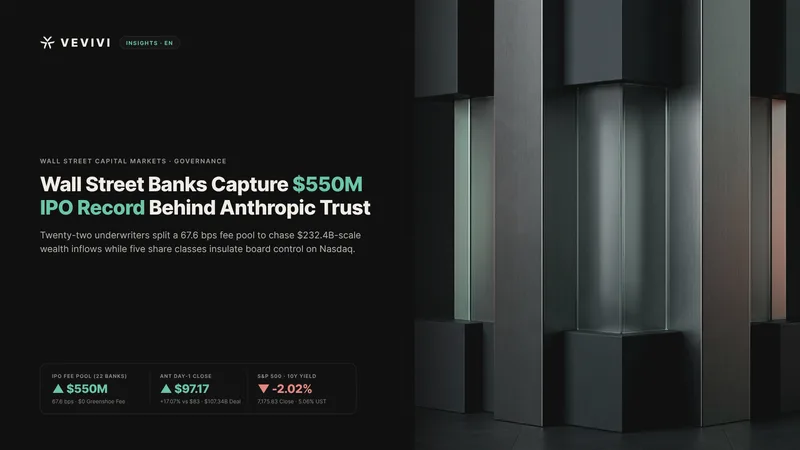
Wall Street IPO fees reached an all-time record of $550 million as Anthropic completed its $107.34 billion Nasdaq debut on November 19, 2026, eclipsing the $500 million underwriting payout set by SpaceX in June 2026. According to the final Form 424(b)(4) prospectus filed with the U.S. Securities and Exchange Commission on November 18, Anthropic sold 980 million Class A shares—comprising 956.35 million primary shares and 23.65 million secondary shares—at $83.00 per share, above its marketed $70 to $78 range after orders reached six to seven times available supply. Combined with a concurrent $26.0 billion private placement of non-voting Class N shares to seven strategic semiconductor and cloud partners, the transaction ranks as the largest initial equity capital event in global market history, climbing to $119.54 billion if underwriters exercise their 30-day option on 147 million additional shares.
Beneath the headline fundraising milestone lies a profound structural shift in equity capital markets and corporate law. Twenty-two investment banks led by Goldman Sachs and Morgan Stanley accepted an underwriting discount of $0.56122 per share—just 0.676%, or 67.6 basis points, of the $81.34 billion base offering—and agreed to zero commissions on both the $12.20 billion greenshoe option and the $26.0 billion private placement. At the same time, public buyers who pushed Anthropic shares to an opening print of $111.50 (+34.34%), an intraday range of $92.72 to $115.10, and a closing price of $97.17 (+17.07%) on record volume of more than 846 million shares acquired an implied diluted valuation exceeding $1.6 trillion ($1.27 trillion basic market capitalization) with virtually zero governance leverage. Enacted Delaware Public Benefit Corporation law and a five-class share architecture place majority board control inside a non-economic trust while guaranteeing co-founders 50.1% of general voting power.
Wall Street IPO Fees at 67.6 Basis Points and the Wealth Management Flywheel
Conventional initial public offerings raising under $1 billion typically pay investment banks underwriting spreads between 4% and 7% of gross proceeds. Across the two defining mega-listings of 2026, however, frontier technology issuers have permanently compressed bulge-bracket economics below 70 basis points. In June 2026, SpaceX paid $500 million on a $75.0 billion base offering (66.7 basis points, expanding to $86.2 billion with overallotment shares at zero incremental fee), delivering roughly $100 million apiece to lead bookrunners Goldman Sachs and Morgan Stanley. Anthropic replicated that exact cost-saving blueprint in its SEC Form 424(b)(4) schedule, capping total underwriting compensation at $550 million across 22 institutions—led by Goldman Sachs, Morgan Stanley, J.P. Morgan, Citigroup, Barclays, Wells Fargo Securities, and BofA Securities—while paying $0 in fees on the 147 million-share greenshoe and $0 on the $26.0 billion Class N placement taken by Advanced Micro Devices, Broadcom, Google LLC, Micron Technology, Microsoft, NVIDIA ($10 billion commitment), and TSMC Partners.
Private Wealth Capture Behind Sub-70 Basis Point Underwriting
For lead Wall Street banks, a $550 million syndicate pool represents league-table prestige and an entry ticket into a much larger, recurring fee stream: private banking, tax structuring, margin lending, and estate management for newly liquid insiders. Equity ownership records and Wall Street estimates indicate that Anthropic's listing creates between 3,000 and 5,000 employee millionaires holding stakes above $1 million, alongside 400 to 600 centi-millionaires holding more than $100 million and an average employee equity position approaching $20 million.
Morgan Stanley's third-quarter 2026 financial disclosures illustrate the scale of this downstream conversion engine. In the quarter ended September 30, 2026, Morgan Stanley generated $20.3 billion in firmwide net revenue and attracted a record $232.4 billion ($232 billion rounded) in net new Wealth Management assets—more than half originating directly from IPO-linked workplace equity channels—driving Wealth Management quarterly revenue to a record $9.1 billion at a 30.4% pretax margin and lifting total client assets to $10.5 trillion. Even though shares of Goldman Sachs closed down 2.94% at $847.53 and Morgan Stanley slid 3.42% to $174.98 during the broader November 19 market pullback, capturing workplace share-plan administration converts compressed 67.6 basis point primary underwriting into multi-decade asset-based advisory annuities.
Five Share Classes and the Long-Term Benefit Trust Anti-Takeover Architecture
Institutional allocators examining Anthropic's charter confront the most insulated governance framework ever brought to a trillion-dollar public debut. Anthropic authorized five distinct classes of common stock—Class A, Class N, Class T, Class F, and Class E—of which only Class A and Class N carry economic rights to dividends and pro rata liquidation proceeds, whereas Class T, Class F, and Class E receive only $0.00001 par value upon liquidation. Public investors purchase one-vote Class A shares, while strategic partners in the $26.0 billion private placement and Amazon's converted notes hold non-voting Class N shares that convert into Class A only upon transfer to unaffiliated buyers holding 9.99% or less.
Actual corporate control resides in two single non-economic shares. First, the Long-Term Benefit Trust—a Delaware noncharitable purpose trust governed by five financially disinterested trustees barred from holding Anthropic securities—owns the sole Class T share. That single Class T share empowers the trust to elect and remove four of Anthropic's seven authorized directors, constituting a permanent board majority and qualifying Anthropic as a controlled company under Nasdaq listing rules (an exemption used for its nominating committee chaired by President Daniela Amodei). Amending or terminating Class T authority over trustee objection requires either an 80% supermajority of both the board and the trustees, or stringent multi-class approvals including 85% of outstanding Class A shares once Class F sunsets. Second, Founder LLC—controlled by Chief Executive Officer Dario Amodei, Daniela Amodei, and the five other co-founders—holds the sole Class F share, which locks in a fixed 50.1% of general stockholder voting power regardless of future equity dilution, capping aggregate Class A voting power at 49.9% until fewer than three continuing founders remain for 90 consecutive days, triggering a 450-day transition.
Delaware Public Benefit Corporation Liability Shield Under Section 365
Combined with Class E employee shares carrying narrow protective votes on specified governance changes, this dual-lock structure renders Anthropic impervious to hostile takeovers or activist proxy campaigns—even from sovereign wealth funds or mega-cap peers. Crucially, Anthropic is incorporated under enacted state statute—Subchapter XV of the Delaware General Corporation Law (8 Del. C. Sections 361 through 368)—as a Public Benefit Corporation chartered for the responsible development of advanced artificial intelligence.
Under Delaware General Corporation Law Section 365(b), directors satisfy their fiduciary duties when balancing stockholder pecuniary interests, materially affected stakeholders, and the stated public benefit, provided decisions are informed, disinterested, and rational. When Anthropic withheld immediate public commercialization of its Mythos-class cyber capabilities under Project Glasswing to prioritize defensive verification over short-term revenue maximization, Section 365(b) legally insulated the board from traditional shareholder wealth-maximization liability. Furthermore, Section 367 restricts derivative lawsuits enforcing that balancing mandate to stockholders owning at least 2% of outstanding shares or shares worth at least $2.0 million (whichever is less), while Section 366(b) requires qualitative benefit reporting every two years without mandating external benchmarks.
Post-IPO Cash Fortress Versus $900.9 Billion in Multi-Year Compute Commitments
From a balance-sheet perspective, Anthropic emerges from its listing with roughly $232 billion in cash and short-term investments, combining $131.8 billion held on September 30, 2026 with net offering and private placement proceeds. Chief Financial Officer Krishna Rao highlighted an operational inflection from zero commercial revenue in the first quarter of 2023 to $17.0 billion in third-quarter 2026 revenue and $81 billion in annualized run-rate revenue as of October 31, 2026. Over the first nine months of 2026, gross margin expanded to 85% from 29% a year earlier alongside a 12% adjusted operating margin, supported by 11,900 enterprise customers spending at least $100,000 annually (including half of the Fortune 500, where Claude spend remains below 0.1% of corporate operating expenses) and a 900% net revenue retention rate.
Yet that liquidity fortress buffers extraordinary fixed obligations. Anthropic disclosed $900.9 billion in total purchase and lease commitments for compute and data center infrastructure, including $70.7 billion due within the next 12 months, $451.6 billion scheduled through December 31, 2030, and roughly $45 billion tied to Nscale infrastructure in West Virginia. While allocating 75% of current compute capacity to research, safety, and training across four accelerator platforms—Amazon Trainium, Google TPUs, NVIDIA GPUs, and AMD GPUs—gives management a lever to shift capacity toward higher-margin inference if needed, pay-as-you-go token pricing exposes margins if open-weight or rival frontier models compress enterprise switching costs.
Staggered Lockup Releases, Single-Stock Leveraged ETFs, and Index Mechanics
Secondary market microstructure will test valuation durability immediately. Unlike conventional 180-day lockups, Anthropic's release schedule permits non-founder directors, officers, and employees to sell up to 10% of locked shares—roughly 315 million shares—on day one, followed by staggered tranches of up to 6% at days 27 and 48 and up to 7% at days 62 and 76. In parallel, SEC-registered single-stock leveraged funds are set to amplify daily flows starting Monday, November 23, 2026, led by the Tradr 2X Long and 2X Short Anthropic Daily ETFs on Cboe (ANTT and ANTZ, carrying a 1.49% annual expense ratio) and the Defiance 2X Long and 2X Short Daily ETFs on Nasdaq (ANTC and ANTQ, at a 0.71% expense ratio). Meanwhile, multi-class voting restrictions exclude Anthropic from S&P 500 eligibility, concentrating passive institutional inflows around anticipated December 11 fast-track additions to the Nasdaq-100 and Russell 1000.
Macro Rate Headwinds, Equity Dispersion, and Cross-Asset Liquidity Absorption
Anthropic's debut exposed sharp cross-asset dispersion across global markets. While Anthropic closed at $97.17 (+17.07%), the broader equity tape reversed an early futures rally into a sell-the-news drawdown: the S&P 500 fell 2.02% to 7,175.83 for its sixth consecutive daily loss, NVIDIA declined 3.30% to $145.98, and SpaceX slipped 3.53% to $138.43. Across digital assets, Bitcoin consolidated near $61,832 as institutional and retail allocators liquidated liquid holdings to fund oversubscribed IPO commitments against a $1.6 trillion diluted benchmark.
Macroeconomic rate pressure remains the primary valuation constraint heading into 2027. The 10-year U.S. Treasury yield held at 5.06% on November 19 following hawkish minutes from the October 27–28 Federal Open Market Committee meeting (where policymakers held the federal funds target range at 3.75% to 4.00% while signaling openness to further tightening), alongside broad weakness in cyclical industrial metals including copper, nickel, and aluminum. In a bull-case scenario, Anthropic's $232 billion cash reserve and multi-chip efficiency allow it to self-fund compute through high-rate tightening while capturing enterprise agent budgets; in a bear-case scenario, 5% long-end yields, token price deflation, and staggered insider unlocks compress valuation multiples once initial retail momentum fades.
Institutional Investor Frequently Asked Questions
Why did Wall Street banks accept a 67.6 basis point fee rate on Anthropic's IPO?
Lead bookrunners Goldman Sachs and Morgan Stanley traded traditional 4% to 7% IPO spreads for a record $550 million nominal fee pool, top equity league-table credit, and direct access to thousands of newly liquid Anthropic executives and employees, replicating the workplace-to-wealth pipeline that drove Morgan Stanley's record $232.4 billion in third-quarter 2026 net new assets.
How do Class T and Class F shares prevent hostile takeovers and shareholder lawsuits?
The Long-Term Benefit Trust's single non-economic Class T share elects four of seven board directors, Founder LLC's single Class F share fixes 50.1% of general voting power, and enacted Delaware Public Benefit Corporation Section 365(b) legally mandates balancing stockholder returns against AI safety, shielding directors who delay high-risk model deployments.
What post-debut catalysts and macro risks govern institutional positioning into 2027?
Portfolio managers are tracking staggered employee share unlocks at days 27 through 76, single-stock 2x ETF launches on November 23, expected December 11 Nasdaq-100 and Russell 1000 index inclusion, quarterly token margin retention against $70.7 billion in near-term compute bills, and whether 5.06% 10-year Treasury yields cap frontier AI multiples.
Disclaimer and Risk Warning
This article is provided strictly for informational and educational purposes based on publicly available on-chain metrics and macroeconomic data. Nothing in this publication constitutes financial, investment, legal, or tax advice, nor should it be construed as a solicitation, recommendation, or offer to buy or sell any digital asset or financial instrument. Digital assets are subject to high market risk and extreme price volatility, and you may lose part or all of your invested capital. Historical market cycles and past performance referenced herein do not guarantee future results. You are solely responsible for your own investment decisions and should conduct independent research and consult a qualified financial advisor before making any financial commitments.