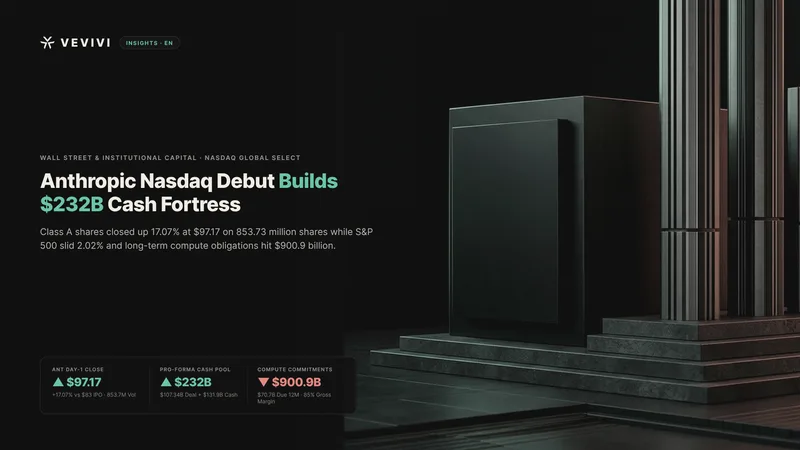
The Anthropic Nasdaq debut closed its first regular trading session at $97.17 on November 19, 2026, securing a 17.07% gain above its $83.00 offering price on historical turnover of more than 846 million Class A shares. Trading on the Nasdaq Global Select Market under the symbol ANT opened at $111.50 at 11:48 a.m. Eastern Time, briefly establishing a 34.34% premium and an implied fully diluted valuation near $2.0 trillion before touching an intraday peak of $115.10 and a session low of $92.72. By the 4:00 p.m. closing cross, Anthropic held a basic market capitalization of $1.272 trillion and a fully diluted valuation of roughly $1.75 trillion, surpassing the 522 million shares traded during SpaceX's June listing.
According to the final Form 424(b)(4) prospectus and Rule 433 free writing prospectus filed with the U.S. Securities and Exchange Commission under Registration Nos. 333-299633 and 333-300148, with T+1 settlement occurring on November 20, 2026, Anthropic priced 980 million Class A shares at $83.00 per share to generate $81.34 billion in gross initial public offering proceeds. Within that base offering, Anthropic issued 956.35 million primary shares for $78.84 billion in company proceeds before expenses, while existing stockholders sold 23.65 million secondary shares and a 22-bank syndicate led by Goldman Sachs and Morgan Stanley collected $550 million in underwriting discounts ($82.43878 net per base share). Simultaneously, seven strategic semiconductor and cloud counterparties—Advanced Micro Devices, Broadcom, Alphabet, Micron, Microsoft, Nvidia, and TSMC Partners—subscribed to 313.25 million Class N shares for $26.0 billion at $83.00, lifting combined gross proceeds to $107.34 billion, or up to $119.54 billion if the zero-commission 147 million-share primary greenshoe option is exercised in full.
Anthropic Nasdaq debut mechanics and cross-asset market divergence
Order-book execution during the inaugural session highlighted disciplined institutional absorption rather than speculative retail chasing. Nasdaq President Nelson Griggs confirmed that institutional demand approached seven times oversubscription, while retail allocation settled near 13% of base shares—well below the 20% prospectus ceiling and half the 25% retail share seen in SpaceX's June debut. With this offering, Nasdaq captured 91% of all U.S. operating-company initial public offering proceeds recorded in 2026, even as average 2026 listings traded roughly 16% above issue price.
Yet the late-afternoon pullback from $111.50 to $97.17 mirrored an abrupt risk-off reversal across broader U.S. benchmarks. Whereas equity indices traded nearly flat during Anthropic's late-morning price discovery, heavy afternoon selling pushed the S&P 500 down 2.02% to close at 7,175.83, marking its sixth consecutive losing session and longest slide since April 2024. The Nasdaq Composite dropped 2.25% to 23,879.20, and the Dow Jones Industrial Average shed 1,101.11 points, or 2.19%, to 49,097.06. Semiconductor and artificial intelligence infrastructure equities bore acute pressure: Nvidia reversed early post-earnings strength to close down 3.30% at $145.98, Advanced Micro Devices fell 7.72% to $489.19 amid short-seller scrutiny, and leveraged neocloud operators Nebius and CoreWeave declined 9.39% and 6.11%, respectively. Meanwhile, the U.S. 10-year Treasury yield finished at 5.05% alongside a 4.81% two-year yield following hawkish October 27–28 Federal Open Market Committee minutes, while Bitcoin traded at $61,852.70 (-1.79%) and Ethereum at $1,749.52 (-1.42%) as of November 20, 2026.
Inside the $232 billion liquidity fortress and $900.9 billion compute ledger
Multi-silicon procurement and Anthropic Direct leasing discipline
Anthropic enters public markets with an unprecedented sovereign-scale balance sheet designed around what Chief Financial Officer Krishna Rao characterizes as the frontier compute cone of uncertainty. As of September 30, 2026, the company already held $95.56 billion in cash and cash equivalents plus $36.28 billion in short-term investments, totaling $131.8 billion. Adding primary IPO proceeds and the $26.0 billion Class N private placement elevates pro-forma cash and short-term investments to roughly $232 billion.
That cash buffer directly counterbalances $900.9 billion in non-cancellable contractual purchase and lease commitments disclosed in Form 424(b)(4), including $70.7 billion payable within 12 months of September 30, 2026 and $451.6 billion scheduled before December 31, 2030. Having deployed nearly $14 billion into compute infrastructure during the first nine months of 2026 while dedicating roughly 75% of total compute capacity to frontier research and alignment, Anthropic distributes workloads fungibly across four distinct accelerator architectures. Beyond cloud partner capacity, management has expanded its Anthropic Direct model—separately leasing physical data-center shells and accelerator silicon, exemplified by infrastructure agreements of up to $45 billion with Nscale—positioning the balance sheet to acquire distressed neocloud or power assets opportunistically if credit conditions tighten further.
Gross margin inflection and enterprise diffusion economics
Financial disclosures in the prospectus explain why institutional growth funds underwrote a $1.5 trillion offering valuation despite tightening macro liquidity. Third-quarter 2026 revenue surged 1,127% year over year to $17.0 billion, nine-month 2026 revenue climbed 1,200% to $33.24 billion, and annualized run-rate revenue surpassed $81 billion in October 2026—less than four years after recording its first revenue dollar in the first quarter of 2023. Crucially, compute and infrastructure expenses compressed from 10 times revenue in 2023 to 55% of revenue in the first half of 2026, tracking toward management's 45% to 50% steady-state target. Gross margin reached 85% across the first nine months of 2026 as inference cost-to-serve fell from roughly $2.00 per dollar of revenue in 2024 to $0.14, underpinning management's long-term adjusted operating margin target above 35%.
Commercial traction remains overwhelmingly enterprise-led rather than consumer-subsidized. As of September 30, 2026, more than 11,900 enterprise accounts generated at least $100,000 in trailing 12-month revenue, over 1,900 exceeded $1 million, and roughly 250 surpassed $10 million. Although more than 50% of Fortune 500 corporations deploy Claude across software engineering, cybersecurity patching, underwriting, and drug discovery, Anthropic captures less than 0.1% of aggregate Fortune 500 technology expenditure. While Melius Research ($155 price target) and Needham ($150 price target) initiated Buy ratings on enterprise diffusion upside, Altimeter partner Pauline Yang noted that institutional models prudently assume top-line expansion moderates from historical 10x to 45x surges toward roughly 2.5x growth in 2027, with quarterly volatility tied to discrete model-release cycles and lumpy compute deliveries.
Delaware public benefit governance and dual-lock voting control
How Class T trust directors and Class F founder shares constrain public holders
From a corporate governance standpoint, Anthropic listed not as a conventional corporation maximizing short-term earnings per share, but as an active Delaware public benefit corporation governed by an SEC-effective multi-class charter. Under this enacted corporate charter, public investors hold Class A common stock with standard economic participation, strategic private-placement counterparties receive non-voting or restricted Class N shares, and board control is locked behind two non-economic mechanisms.
Specifically, Anthropic's independent Long-Term Benefit Trust holds Class T shares empowered to elect and remove Class T directors constituting a majority of the authorized board without holding economic equity. Concurrently, a single Class F share held by the seven co-founders' Founder LLC carries 50.1% of general voting power with zero economic rights. Acting together, the Long-Term Benefit Trust and Founder LLC control all board seats, preventing hostile takeovers and providing statutory fiduciary protection under Delaware public benefit corporation law if management withholds or delays commercial deployment of a frontier model due to catastrophic safety thresholds. Public equity allocators must also price supply overhang mechanics: select employee shares were eligible for immediate day-one sale, while the seven co-founders may transfer up to 29% of their holdings after 180 days and the remainder after one year.
Cross-asset liquidity absorption, AI credit bifurcation, and digital assets
Anthropic's $107.34 billion capital absorption arrives at an inflection point for global liquidity. Across fixed income and equities, FOMC minutes from the October 27–28 meeting revealed broad policymaker support for additional rate hikes above the 3.75% to 4.00% federal funds target range, keeping the 10-year Treasury yield anchored above 5.05% ahead of the December 8–9 FOMC decision. In that high-rate regime, Anthropic's $232 billion cash reserve creates a stark credit bifurcation: tier-one frontier labs funded via equity and strategic silicon placements can self-finance multi-year compute, whereas leveraged neoclouds lacking investment-grade balance sheets face widening private-credit spreads.
For digital asset markets, the pre-IPO drawdown in Bitcoin toward $61,852.70 and Ethereum to $1,749.52 closely echoes the cross-asset liquidity drain observed ahead of SpaceX's $75 billion June listing, when institutional multi-strategy desks trimmed liquid crypto and equity holdings to fund primary allocations. With T+1 IPO settlement completing on November 20 and passive index fast-entry into the Nasdaq-100 and Russell 1000 projected for December 11—while S&P 500 inclusion remains gated by trailing GAAP profitability and seasoning rules—institutional desks will monitor whether post-settlement cash recycling stabilizes high-beta tech and digital asset liquidity or yields to December Federal Reserve tightening.
Key institutional questions on the listing
Why did Anthropic close at $97.17 after opening at $111.50?
Opening cross demand pushed Class A shares up 34.34% to $111.50, briefly implying a $2.0 trillion diluted valuation, before broad afternoon de-risking dragged the S&P 500 down 2.02% and prompted profit-taking across more than 846 million traded shares, settling ANT 17.07% above its $83.00 offer price.
How does the $232 billion cash position compare with $900.9 billion in compute commitments?
Combining $131.8 billion in September 30 cash and short-term investments with net proceeds from the $107.34 billion transaction yields roughly $232 billion, covering more than three years of near-term obligations ($70.7 billion due in 12 months), while remaining $900.9 billion commitments through 2045 depend on sustained 85% gross margins and enterprise revenue conversion.
What governance rights do Class A public shareholders hold under the Delaware PBC charter?
Class A shareholders hold economic ownership but cannot override board composition or safety pauses, as the Long-Term Benefit Trust elects a board majority via Class T shares and Founder LLC retains 50.1% general voting power through Class F.
Why did Nvidia, chipmakers, and Bitcoin decline alongside a record AI IPO?
Investors rotated cash out of liquid winners and high-beta assets to fund the $107.34 billion offering while repricing 5.05% 10-year Treasury yields, Circular AI financing scrutiny, Nvidia's 3.30% pullback to $145.98, and Bitcoin's consolidation at $61,852.70.
Which post-listing dates matter most for institutional positioning?
Key catalysts include T+1 settlement on November 20, single-stock leveraged ETF launches on November 23, the December 8–9 FOMC rate decision, anticipated Nasdaq-100 and Russell 1000 fast-entry on December 11, and the 180-day founder lock-up tier.
Disclaimer and Risk Warning
This article is provided strictly for informational and educational purposes based on publicly available on-chain metrics and macroeconomic data. Nothing in this publication constitutes financial, investment, legal, or tax advice, nor should it be construed as a solicitation, recommendation, or offer to buy or sell any digital asset or financial instrument. Digital assets are subject to high market risk and extreme price volatility, and you may lose part or all of your invested capital. Historical market cycles and past performance referenced herein do not guarantee future results. You are solely responsible for your own investment decisions and should conduct independent research and consult a qualified financial advisor before making any financial commitments.