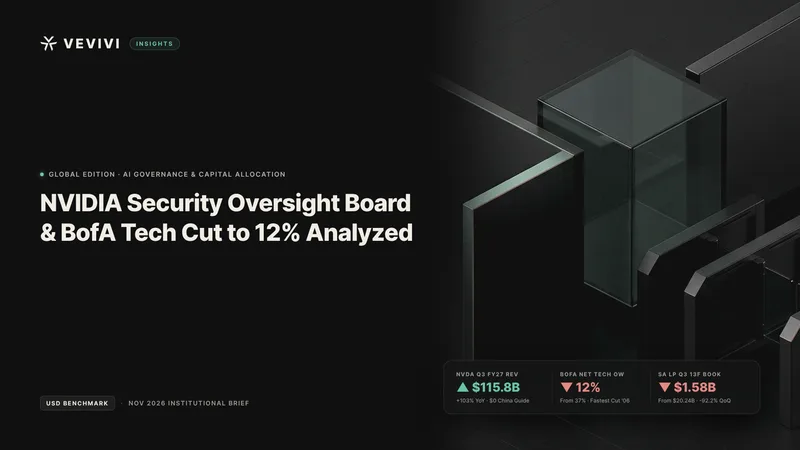
Global artificial intelligence infrastructure markets have entered a decisive structural inflection where explosive silicon revenue growth now collides directly with boardroom governance reform, extraterritorial export enforcement, and institutional capital expenditure discipline. After absorbing a record $573 billion weekly market capitalization wipeout and an abrupt chief executive transition, NVIDIA Corporation (NVDA) announced on November 17, 2026 that its Board of Directors established a standing National Security and Export Control Oversight Committee, just hours before posting $115.8 billion in third-quarter fiscal 2027 revenue—up 103% year-over-year. Yet the simultaneous rollout of a U.S. Bureau of Industry and Security (BIS) interim final rule targeting third-country cloud access, alongside Bank of America's November Global Fund Manager Survey showing the steepest monthly reduction in technology overweight positioning since June 2006, signals that institutional allocators are replacing blind momentum with rigorous scrutiny of cash conversion, credit risk, and sovereign compliance.
NVIDIA Establishes Board-Level National Security Oversight Amid Post-Founder Earnings Test
When founder-centric governance collided with escalating geopolitical scrutiny, NVIDIA's Board of Directors opted to institutionalize trade and security compliance at the highest fiduciary level. Announced five days after Jensen Huang stepped down as chief executive on November 12, 2026, the creation of a permanent board oversight body formally acknowledges that frontier accelerated computing clusters operate as regulated national security assets rather than ordinary commercial semiconductors.
Independent Fiduciary Architecture Under Nora Johnson and Interim CEO Colette Kress
According to NVIDIA's official board release, the National Security and Export Control Oversight Committee is chaired by director Suzanne Nora Johnson, former Vice Chair of Goldman Sachs, alongside directors Stephen C. Neal, former Chairman and CEO of law firm Cooley LLP, and California Institute of Technology professor John O. Dabiri. Meeting at least quarterly—including mandatory executive sessions—the committee holds direct authority to retain independent outside legal, national security, and global trade compliance specialists. Crucially, NVIDIA's internal National Security Team and Global Trade Compliance Team now report directly to the board committee as well as to Interim CEO and Chief Financial Officer Colette Kress on daily operations. Paired with the independent board inquiry led by former Acting U.S. Attorney for the Southern District of New York Joon H. Kim of Wachtell, Lipton, Rosen & Katz, the new charter aims to insulate NVIDIA's product roadmap from executive key-person and regulatory governance discounts.
Record $115.8 Billion Q3 Revenue Beat and $130.0 Billion Zero-China Guidance
Financial results for the third quarter of fiscal 2027 (ended October 25, 2026), released after the U.S. closing bell on November 17, underscored the sharp divergence between underlying compute demand and recent equity multiple compression. Quarterly revenue reached $115.8 billion, up 20% sequentially and 103% year-over-year, handily surpassing management's $108.0 billion guidance midpoint. Data Center revenue climbed 110% year-over-year to $107.6 billion as Vera Rubin NVL72 rack systems began shipping across hyperscale partners, delivering a 74.8% GAAP gross margin and $2.70 in diluted GAAP earnings per share while returning $28.1 billion to shareholders and preserving $227.3 billion in remaining buyback authorization. For the fourth quarter—which includes an extra fiscal week—management guided revenue to $130.0 billion plus or minus 3% at 71.0% to 72.0% gross margins, explicitly assuming zero Data Center compute revenue from China. Having closed regular trading on November 17 at $155.46—a $3.75 trillion market capitalization representing a 36.1% drawdown from its $243.37 52-week peak—shares rebounded toward $159.35 in after-hours trading as $390 billion in supply-chain purchase commitments reassured markets of non-China demand durability.
DOJ and Commerce Unveil Megaspeed Probe Timeline Alongside BIS Remote Compute Controls
NVIDIA's governance overhaul arrived against an extraordinary regulatory backdrop in Washington, as federal enforcement agencies moved to seal both physical diversion channels and cross-border cloud rental loopholes less than 48 hours before high-stakes U.S.–China diplomatic talks in Shenzhen. By pairing criminal transparency with new extraterritorial licensing rules, U.S. authorities reshaped the compliance calculus for global data center operators.
Inside the 2024–2026 Megaspeed Investigation and Criminal Escalation
In a rare public update on an active investigation (Press Release 26-1365, issued November 17, 2026), the U.S. Department of Commerce and Department of Justice disclosed that Commerce initiated an export-control diversion probe into Singapore-based cloud provider Megaspeed in 2024 after proactive monitoring flagged suspicious semiconductor flows. Commerce investigators requested direct and indirect sales records from NVIDIA in May 2025, prompting NVIDIA to place Megaspeed on its internal no-sell list in June 2025. That same month, BIS enforcement agents and Singaporean law enforcement conducted an on-site, in-person end-use check at Megaspeed and interviewed CEO Alice Huang, after which the Department of Justice assumed lead criminal jurisdiction. Federal officials emphasized that 17 defendants across six separate investigations have already been charged over billions of dollars in alleged chip smuggling, while export-control monetary penalties have risen eighteen-fold compared with the prior administration.
Treasury-Directed BIS Interim Final Rule Targets Third-Country Cloud Loopholes
Complementing criminal enforcement, the Bureau of Industry and Security issued an Interim Final Rule on November 15, 2026—drafted by and at the direction of the U.S. Department of the Treasury and the National Security Council—governing remote access to American super intelligence chips and servers. Previously, restricted entities sought to bypass physical shipment bans by renting compute capacity inside third-country data centers located in hubs such as Singapore or Southeast Asia. By aligning protections on remote cloud access with physical Export Administration Regulations, the rule subjects large overseas server deployments and cross-border compute leasing to stringent licensing and end-user verification, directly affecting how NVIDIA executes its $32 billion in reported neocloud commitments.
Bank of America November Survey Signals Peak AI CapEx Euphoria and Infrastructure Strain
Despite NVIDIA's triple-digit top-line expansion, institutional portfolio positioning reflects the sharpest sentiment reset in two decades. Mounting skepticism over debt-funded capital intensity has converged with real-world operational outages across banking, aviation, and enterprise cloud networks, prompting asset managers to question both financial returns and engineering resilience.
Net Tech Overweight Plunges From 37% to 12% as 52% Expect Hyperscaler CapEx Cuts
According to Bank of America's November 2026 Global Fund Manager Survey—conducted November 6–12 across 193 institutional panelists managing $526 billion in assets (with 169 global respondents overseeing $461 billion)—net overweight allocation to technology equities plunged from 37% in October to 12% in November, marking a 25-percentage-point drop and the largest monthly cut since June 2006. Fully 52% of surveyed managers now expect an AI hyperscaler to announce a capital expenditure cut within six months, jumping from 30% a month earlier. A record net 38% state that corporations are overinvesting, whereas only 16% favor higher capital spending—the lowest reading since May 2020. With average cash dry powder dipping from 3.9% to 3.6% and long global semiconductors still viewed as the market's most crowded trade (39%), BofA strategist Michael Hartnett's team maintained a tactically risk-off stance.
Hyperscaler Bond Credit Risks Meet Legacy IT and AI Code Fragility
Survey respondents ranked an AI equity bubble (34%) and an AI hyperscaler credit event (31%) as the top global tail risks; among investors anticipating a credit event, 38% identified AI hyperscaler corporate bonds as the most probable catalyst, followed closely by private credit at 30%. Simultaneously, recent cascading service disruptions across major U.S. commercial bank branches and payment rails, a nationwide Federal Aviation Administration ground stop, airline dispatch outages, and enterprise software routing bugs triggered when legacy hardware interacted with newer equipment have spotlighted a deeper operational bottleneck. Integrating unannotated AI-generated code at breakneck speed atop 40-year-old core infrastructure while trimming baseline maintenance staff compounds systemic fragility, reinforcing institutional demands for measured deployment over reckless scale.
SEC Form 13F Hedge Fund Dispersion and Conditional Cross-Asset Pathways
Newly filed third-quarter 2026 SEC Form 13F disclosures confirm that elite hedge funds had already fractured into sharply opposing camps before October and November's equity drawdown. Evaluating these filings alongside mega-cap primary issuance and on-chain macro liquidity provides a disciplined framework for navigating year-end volatility.
Situational Awareness LP's 92.2% Contraction Versus Soros, Appaloosa, and Coatue Rotations
Across 22 major institutional investment managers tracked in Q3 Form 13F filings as of September 30, net selling across a 13-stock AI semiconductor and data-center basket totaled $8.65 billion. That aggregate figure was dominated by Leopold Aschenbrenner's Situational Awareness LP, whose reported 13F equity book contracted 92.2% from $20.24 billion on June 30 to $1.58 billion on September 30—generating $8.80 billion in net basket sales, led by a $5.14 billion Micron exit alongside full liquidations of TSMC, CoreWeave, and Applied Digital. Excluding Situational Awareness, the remaining 21 funds were modest net buyers of $149 million, albeit with stark internal rotation: Renaissance Technologies trimmed $1.61 billion in NVIDIA, and Soros Fund Management ($8.51 billion 13F portfolio) pared roughly 20% of its NVIDIA stake ($47.0 million) while adding $94 million in Meta Platforms. David Tepper's Appaloosa Management ($7.56 billion) exited AMD, Apple, Broadcom, and Qualcomm entirely while acquiring 3.7 million shares (roughly $520 million) of SpaceX alongside Micron (+$293 million) and Oracle, whereas Coatue Management (+$875 million), Viking Global (+$858 million), and Dan Loeb's Third Point (rebuilding 1.5 million NVIDIA shares worth $342.6 million) leaned into selective accumulation.
Anthropic's $895.4 Billion Compute Backlog, 13F Lag Limits, and Bull-Bear Scenarios
Institutional allocators must treat Form 13F data strictly as a lagging indicator: filings capture long U.S.-listed equity snapshots as of September 30 while omitting short positions, total-return swaps, and post-quarter deleveraging. Meanwhile, Anthropic's impending November 19 Nasdaq debut (ticker ANT)—expected to price near or above the top of its $70 to $78 range for an implied valuation around $1.4 trillion, still reflecting a $600 billion haircut from preliminary $2 trillion expectations three months ago—highlights the sector's immense capital absorption and fixed-cost commitments, with amended Form S-1/A disclosures detailing $895.4 billion in long-term compute and data-center obligations through 2045 ($69.8 billion due within 12 months). With the S&P 500 closing November 17 at 7,340.53 (-1.03%) and Bitcoin consolidating near $64,482, markets face two conditional pathways: a fundamental re-rating scenario where NVIDIA's Vera Rubin ramp, zero-China guidance conservatism, and $227.3 billion buyback buffer stabilize multiples, versus a credit-and-compliance tightening scenario where hyperscaler CapEx moderation, BIS cloud licensing friction, and sovereign debt costs compress leveraged AI infrastructure valuations further.
Institutional Investor Q&A
How does NVIDIA's new National Security Oversight Committee change its corporate governance?
Unlike internal compliance teams that previously reported solely up management chains, the new standing board committee receives direct reporting from NVIDIA's National Security and Global Trade Compliance teams, convenes independent executive sessions at least quarterly, and retains outside legal and national security counsel directly. This structure separates export-control assurance from chief executive discretion and establishes institutional accountability to federal regulators.
Why does the BIS remote-access rule matter if physical AI chip exports to China were already restricted?
Physical export controls left an indirect channel open whereby restricted entities rented compute capacity remotely from GPU clusters hosted in third countries such as Singapore. Drafted with the Treasury Department and National Security Council, the November 15 BIS Interim Final Rule aligns remote supercomputing access with physical shipment restrictions, imposing licensing and end-user verification across global cloud and neocloud data centers.
Do Q3 Form 13F sales prove that institutional hedge funds have abandoned the AI theme?
Not uniformly. While Situational Awareness LP liquidated $8.80 billion across core AI hardware names as its 13F book shrank 92.2% to $1.58 billion, the other 21 tracked mega-funds recorded $149 million in net basket purchases, and Form 13F remains a backward-looking September 30 snapshot excluding hedges and short exposure. Combined with BofA's survey showing net tech overweight down to 12% and 52% expecting hyperscaler CapEx cuts, the data points to disciplined balance-sheet selectivity rather than wholesale abandonment of accelerated computing.
Disclaimer and Risk Warning
This article is provided strictly for informational and educational purposes based on publicly available on-chain metrics and macroeconomic data. Nothing in this publication constitutes financial, investment, legal, or tax advice, nor should it be construed as a solicitation, recommendation, or offer to buy or sell any digital asset or financial instrument. Digital assets are subject to high market risk and extreme price volatility, and you may lose part or all of your invested capital. Historical market cycles and past performance referenced herein do not guarantee future results. You are solely responsible for your own investment decisions and should conduct independent research and consult a qualified financial advisor before making any financial commitments.