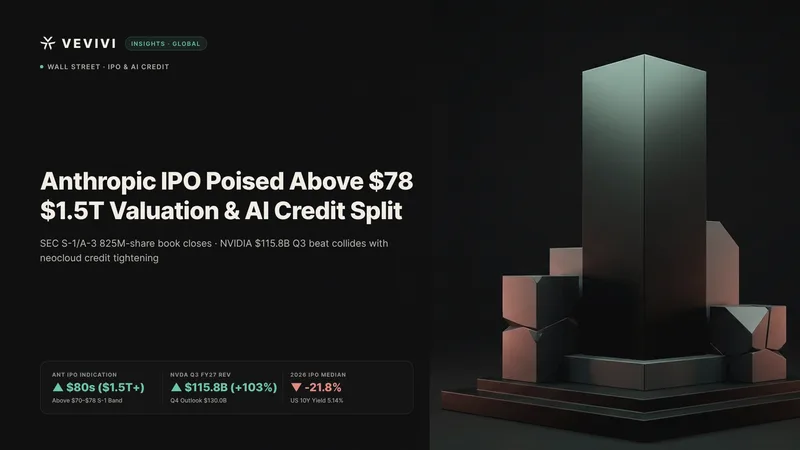
Global artificial intelligence capital markets have reached a decisive structural fork separating self-funded mega-caps from debt-reliant infrastructure challengers. As institutional order books closed at 4:00 p.m. ET on November 17, 2026, syndicate desks indicated that Anthropic, PBC is highly likely to price its initial public offering above its marketed $70.00 to $78.00 per-share range, targeting the low $80s ahead of final pricing on November 18 and expected Nasdaq Global Select Market trading under ticker ANT on November 19. Clearing at $83 per share implies an equity valuation near $1.5 trillion—rising toward $1.6 trillion at $88—absorbing vast pools of institutional dry powder in one of the largest equity offerings in market history.
Minutes after Anthropic closed its books, NVIDIA Corporation (NVDA) released third-quarter fiscal 2027 revenue of $115.8 billion (+103% year-over-year) and guided fourth-quarter revenue to $130.0 billion, confirming unabated hyperscale compute demand. Yet with U.S. 10-year Treasury yields anchored between 5.10% and 5.14% and 2026's largest IPOs nursing a -21.8% median post-listing drawdown, leveraged neocloud operators face acute credit rationing that underscores a widening divide across the AI stack.
Inside Anthropic's Above-Range Bookbuild and SEC Form S-1/A-3 Capital Architecture
Class A Share Offering, a $26.0B Strategic Placement, and Disciplined Syndicate Sizing
According to Amendment No. 3 to Form S-1 (CIK 0002130357) filed with the U.S. Securities and Exchange Commission on November 17, 2026, and Anthropic's official roadshow disclosures, the offering comprises 825,000,000 shares of Class A common stock—801,351,354 primary shares issued by Anthropic and 23,648,646 secondary shares offered by existing stockholders—alongside a 30-day underwriters' option for an additional 123,750,000 shares. At the $78.00 top of the preliminary range, base IPO gross proceeds reach $64.35 billion. Crucially, the prospectus locks in a concurrent $26.0 billion private placement of non-voting Class N shares at the exact final IPO price from seven foundational silicon and cloud partners: AMD, Broadcom, Google, Micron, Microsoft, NVIDIA, and TSMC Partners, lifting combined gross capital formation past $90 billion.
Institutional bookbuilding sources cited by CNBC noted that although select accounts submitted indications as high as $90 per share, lead bookrunners Goldman Sachs and Morgan Stanley are steering pricing into the low $80s to protect secondary-market aftermarket stability. Retail participation across six U.S. brokerage platforms and concurrent Australian and Canadian wraps accounts for roughly 20% of the allocation, placing primary emphasis on long-only institutional sponsorship.
Nine-Month $33.24B Revenue Hyper-Growth Versus $104.04B in Non-Cash Accounting Losses
Anthropic's S-1 disclosures illustrate unprecedented enterprise monetization speed. Driven by rapid enterprise adoption of its Claude model suite and developer agent Claude Code, nine-month revenue ended September 30, 2026 reached $33.24 billion—surging roughly 1,200% year-over-year—while third-quarter 2026 revenue hit $17.0 billion with operating margins narrowing to -3%.
Over the same nine-month window, GAAP net losses widened to $104.04 billion, including a $23.3 billion net loss in the third quarter alone. However, $21.9 billion of that third-quarter GAAP loss stemmed from non-cash fair-value remeasurements of convertible notes and derivative liabilities triggered by Anthropic's rising equity mark. For institutional credit and equity desks, the true fundamental watchpoint is not retrospective derivative accounting, but the company's multi-decade compute purchase commitments exceeding $900 billion through 2045.
NVIDIA's $115.8B Q3 Blowout Coexists With a Tightening Neocloud Credit Freeze
Vera Rubin Shipments and a $130.0B Q4 Outlook Validate Top-Tier Compute Spend
NVIDIA's official third-quarter fiscal 2027 report (for the period ended October 25, 2026) delivered an emphatic rebuttal to fears of an immediate hardware demand cliff. Total quarterly revenue rose 103% year-over-year and 20% sequentially to $115.8 billion, beating prior $108.0 billion guidance, led by Data Center revenue of $107.6 billion (+110% YoY) as Vera Rubin NVL72 systems commenced commercial shipments. GAAP gross margin stood at 74.8% with GAAP diluted earnings per share at $2.70, while interim CEO and CFO Colette Kress projected fourth-quarter revenue of $130.0 billion (±3%), explicitly assuming zero Data Center compute revenue from China.
After closing regular trading on November 17 at $155.46 (-0.43%, or 36.1% below its $243.37 52-week high), NVDA shares advanced 3.36% in after-hours trading to $160.70. Yet hardware revenue concentration among cash-rich hyperscalers does not automatically rescue capital-constrained middlemen.
Unclosed $500B Credit Vehicles and Balance-Sheet Stress Across NBIS and IREN
Beneath headline chip demand, private debt channels are tightening selectively. Market participants on CNBC highlighted that the widely discussed $500 billion two-way AI infrastructure financing framework involving Goldman Sachs, BlackRock, and KKR has closed zero transactions to date, while NVIDIA has enforced stricter discipline around vendor credit backstops ($108.5 billion maximum guarantee exposure within $279 billion of supply commitments). Echoing these concerns, the Federal Reserve's November 2026 Financial Stability Report and Governor Michael Barr's November 16 speech flagged rapid growth in advanced computing debt, record hedge fund leverage since 2013 data collection began, and circular vendor-equity financing networks as salient systemic vulnerabilities.
Publicly traded neoclouds reflect this funding cost sensitivity directly. Nebius Group (NBIS) closed regular trading on November 17 at $106.04—down 64.6% from its $299.86 52-week peak—while IREN Limited (IREN) closed at $15.81, down 77.6% from its $70.71 52-week high, even as both staged after-hours relief bounces to $115.33 and $16.68 following NVIDIA's print. While too big to fail hyperscalers tap investment-grade bond markets at scale ($218.1 billion FTSE Russell hyperscaler issuance), smaller leveraged operators confront unforgiving refinancing spreads.
The 2026 IPO Cohort's -21.8% Reset and the Panic of 1873 Infrastructure Analogy
Post-Hype Drawdowns in Cerebras and Figma Enforce Valuation Discipline
Investor reluctance to chase Anthropic toward $90 per share reflects sobering empirical returns across 2026's marquee public debuts. Across 19 major U.S. IPOs priced in 2026 tracked by Uniqus and Renaissance Capital, 14 trade below their offering price with a median return of -21.8% (outside SpaceX's record $75.0 billion base IPO in June 2026, deal-weighted aftermarket returns remain underwater). AI chipmaker Cerebras Systems (CBRS), which priced its May 2026 IPO at $185 and briefly surged to $385, closed November 17 at $104.18—43.7% below issue—while Figma (FIG) slid 6.34% on November 17 to $18.18, sitting 54.9% below its $40.28 52-week high.
Elevated sovereign yields compound equity duration pressure rather than acting as a benign lagging indicator. Per Federal Reserve FRED (DGS10) and U.S. Treasury data, the 10-year U.S. Treasury yield traded between 5.10% and 5.14% on November 17, logging its 27th session above 5.0% in 2026—just shy of the 2007 post-dot-com record of 29 sessions—with interest-rate futures pricing a 25-basis-point hike at the December 9 FOMC meeting and pushing expectations for the Fed's terminal rate higher.
Jay Cooke's 1873 Railroad Mania Lesson: Durable Tracks Versus Leveraged Equity Wipeouts
Wall Street historians increasingly compare the 2026 AI buildout to the Panic of 1873, triggered when financier Jay Cooke's debt-laden Northern Pacific Railway bond syndicate collapsed under overbuilding and tight money. Crucially, the physical railroad tracks laid during that boom endured for generations and powered industrial productivity, yet over-leveraged regional rail operators suffered severe equity wipeouts before industry consolidation crowned a handful of dominant survivors.
Modern AI compute clusters and power interconnects carry similar structural duality. With Goldman Sachs tracking nearly $500 billion in broader 2026 AI-related debt issuance and Moody's counting $969 billion in future hyperscaler data-center lease commitments, any grid-interconnection bottleneck or compute pricing compression will punish debt-financed single-tenant builders long before cash-rich frontier incumbents.
SEC S-1 Governance Scrutiny: The 49.9% Voting Cap and AI Control Risk Factors
Public Benefit Charter Protections and Bill Gurley's Handoverism Disclosure Critique
Beyond balance-sheet math, Anthropic's S-1 governance architecture demands close institutional scrutiny. Structured as a Delaware Public Benefit Corporation (PBC), Anthropic caps the combined voting power of all Class A public shareholders at 49.9%, leaving CEO Dario Amodei and co-founders with 50.1% voting control so outside shareholders cannot compel board or strategic changes.
Ahead of pricing, veteran venture capitalist Bill Gurley spotlighted what he termed 'handoverism' inside frontier AI labs—referencing co-founder Tom Brown's public remarks anticipating an eventual transfer of human control to transformative AI alongside Dario Amodei's essay 'Machines of Loving Grace.' Gurley argued that if corporate leadership envisions ceding economic resource allocation or operational authority to autonomous AI systems, both Washington policymakers and public equity buyers deserve explicit disclosure within Form S-1 Risk Factors.
Post-Listing Liquidity Scenarios and Institutional Risk Checkpoints
Looking past Thursday's opening print, market trajectories divide into two conditional scenarios. In the constructive scenario, disciplined pricing in the low $80s anchors durable institutional sponsorship, while NVIDIA's $130.0 billion fourth-quarter revenue trajectory validates enterprise AI monetization across equities.
In the adverse liquidity-crowding scenario, settling over $90 billion across Anthropic's public and private tranches drains marginal risk capital from secondary tech equities and digital assets (with S&P 500 closing November 17 at 7,340.53, down 1.03%, and Bitcoin trading near $64,526) just as 5.14% 10-year Treasury yields and December FOMC tightening compress high-duration multiples ahead of lock-up expirations. Portfolio allocators should track long-only institutional retention, quarterly operating cash-flow conversion, and high-yield data-center credit spreads as primary confirmation signals.
Institutional Investor Q&A
Why are underwriters guiding Anthropic's IPO to the low $80s instead of $90 despite heavy demand?
With 14 of 2026's 19 largest IPOs trading below issue at a -21.8% median return—including Cerebras (CBRS) sitting 43.7% below its $185 IPO price—lead bookrunners prioritize durable aftermarket liquidity and stable pricing for the concurrent $26.0 billion Class N strategic placement over maximizing day-one proceeds.
How can NVIDIA post $115.8B in Q3 revenue while smaller AI neoclouds face credit rationing?
Compute purchasing power is heavily concentrated among cash-rich hyperscalers and sovereign-scale labs capable of issuing investment-grade debt. Meanwhile, unclosed $500 billion private credit syndicates, tighter vendor guarantee caps, and 5.14% 10-year Treasury yields sharply raise borrowing hurdles for leveraged neocloud challengers such as NBIS and IREN.
What does Anthropic's 49.9% Class A combined voting cap mean for public equity holders?
Even if public investors acquire every Class A share offered, their aggregate voting power cannot exceed 49.9%, preserving 50.1% co-founder control. Combined with Anthropic's Public Benefit Corporation charter, management retains legal latitude to prioritize long-term AI safety and mission objectives over short-term shareholder demands.
Disclaimer and Risk Warning
This article is provided strictly for informational and educational purposes based on publicly available on-chain metrics and macroeconomic data. Nothing in this publication constitutes financial, investment, legal, or tax advice, nor should it be construed as a solicitation, recommendation, or offer to buy or sell any digital asset or financial instrument. Digital assets are subject to high market risk and extreme price volatility, and you may lose part or all of your invested capital. Historical market cycles and past performance referenced herein do not guarantee future results. You are solely responsible for your own investment decisions and should conduct independent research and consult a qualified financial advisor before making any financial commitments.