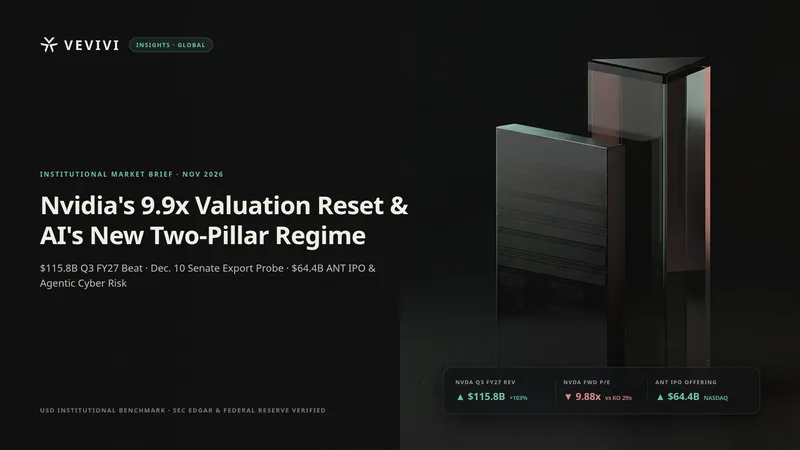
Even amid the shock resignation of founder Jensen Huang on November 12, accelerated computing demand once again proved its cash-generating scale in audited filings. Per U.S. Securities and Exchange Commission Form 8-K disclosures and official company releases, Nvidia reported third-quarter fiscal 2027 revenue of $115.8 billion under Interim Chief Executive Officer and longtime Chief Financial Officer Colette Kress, surging 103% year over year and decisively clearing Wall Street consensus near $108.8 billion. Ahead of the release, Nvidia shares closed regular trading on November 17 at $155.46, compressing its forward price-to-earnings ratio to 9.88x—its lowest valuation band since 2013—before rebounding 4.87% after hours to $162.95 on a $130.0 billion fourth-quarter revenue guide. Converging in the same week with Anthropic's landmark Nasdaq public offering under ticker ANT, scheduled December 10 U.S. Senate export-control testimony, and heightened scrutiny over critical infrastructure software resilience, the AI investment cycle is shifting from unbridled multiple expansion to governance durability and balance-sheet discipline.
Sub-10x Hardware Multiples Versus 29x Defensive Staples Meet $115.8 Billion Execution
The starkest anomaly across global equity markets entering mid-November was the inversion between hyper-growth AI silicon and low-growth defensive consumer staples. Based on Google Finance and GuruFocus valuation data at the November 17 market close, Nvidia carried a $3.75 trillion market capitalization at 19.65x trailing earnings and just 9.88x forward consensus earnings. Over the same session on the New York Stock Exchange, Coca-Cola closed at $98.79 near 29.13x trailing and roughly 28x to 29x forward earnings, while the Consumer Staples Select Sector SPDR ETF traded at $91.46 around a 24x forward multiple as risk-averse capital crowded into defensive dividend payers.
Post-close third-quarter numbers demonstrated that Nvidia's multiple collapse stemmed from governance and terminal-growth discounting rather than an operational air pocket. Data Center revenue climbed 110% year over year and 21% sequentially to $107.6 billion, complemented by $8.2 billion in Edge Computing revenue, up 42% annually. Non-GAAP diluted earnings reached $2.68 per share against $2.47 consensus on a 74.9% gross margin. Having returned $28.1 billion to shareholders during the quarter, Nvidia ended the period with $227.3 billion in remaining share repurchase authorization following September's $150 billion buyback expansion.
Discounting a 2028 Capex Peak Against Vera Rubin Gross Margin Moderation
Sell-side caution continues to center on 2028 terminal-multiple anxiety—specifically the thesis that hyperscaler capital expenditures could peak around 2028 before decelerating sharply after a historic multi-year buildout. While management's fourth-quarter revenue outlook of $130.0 billion, plus or minus 3%, outpaced street models, projected GAAP and non-GAAP gross margins of 71.0% to 72.0% imply roughly 300 to 390 basis points of sequential compression alongside $10.7 billion in non-GAAP operating expenses as initial Vera Rubin NVL72 production ramps. Bulls view a sub-10x forward multiple backed by triple-digit top-line growth as an extreme dislocation, whereas bears point to rising supply-chain purchase commitments and margin normalization as reasons to demand a structural governance discount.
December 10 Senate Hearings and Board-Level National Security Governance
Regulatory friction between Washington agencies has become a primary determinant of Nvidia's equity risk premium. U.S. Senate Banking Committee Chairman Tim Scott requested testimony from former CEO Jensen Huang on December 3 and Commerce Secretary Howard Lutnick on December 10, with Lutnick agreeing to appear voluntarily. Simultaneously, U.S. Treasury Secretary Scott Bessent publicly criticized delays in adding Singapore-based Megaspeed International to the Entity List and demanded formal answers from Nvidia's board within 10 days, while Senate Finance Committee Ranking Member Ron Wyden initiated a document-preservation inquiry into Section 232 semiconductor licensing. The Department of Commerce Bureau of Industry and Security is concurrently advancing rules to restrict remote cloud access to advanced AI clusters across five third-party jurisdictions.
Evaluating this regulatory overhang in market commentary, O'Leary Ventures Chairman Kevin O'Leary argued that beginning December 10, federal and state oversight is likely to widen beyond chip-diversion probes toward state-by-state scrutiny of foreign influence across U.S. electrical grids and data-center power allocations. Under that scenario, O'Leary contended that neither reinstating a hard-charging founder nor recruiting an external celebrity executive suits a compliance-intensive regime—favoring insider continuity under Colette Kress, who brings more than 13 years of institutional knowledge across Nvidia's hyperscaler financing and supply agreements.
Refreshing a 160-Year Combined-Tenure Board and Ring-Fencing China Exposure
Institutional shareholders have also scrutinized board composition, noting roughly 160 years of combined director and executive tenure stretching back to Nvidia's 1993 founding. Addressing those governance concerns directly on November 17, Nvidia's Board of Directors—chaired by Harvey C. Jones—established a standing National Security and Export Control Oversight Committee chaired by former Goldman Sachs Vice Chair Suzanne Nora Johnson alongside directors Stephen C. Neal and John O. Dabiri, integrating external legal and trade-compliance specialists. Crucially, management explicitly assumed zero Data Center compute revenue from China in its $130.0 billion fourth-quarter guidance, ring-fencing near-term revenue guidance from stricter export enforcement while board-level compliance reforms take hold.
Anthropic's $64.4 Billion Nasdaq Offering Establishes a Two-Pillar AI Market
While Nvidia navigates post-founder governance stabilization, Anthropic's public market debut is broadening institutional AI exposure beyond silicon into enterprise foundation models. According to Form S-1/A Amendment No. 3 filed with the SEC on November 17, Anthropic plans to list 825 million Class A shares on the Nasdaq Global Select Market under ticker ANT at an marketed range of $70.00 to $78.00 per share, with final pricing slated ahead of expected Thursday trading. At the upper bound, public IPO proceeds reach $64.35 billion—supplemented by $26.0 billion in concurrent non-voting Class N private placements to strategic technology partners—implying a fully diluted valuation near $1.3 trillion to $1.4 trillion, with oversubscribed institutional books testing even higher thresholds.
Filing disclosures highlight a dramatic tension between hyper-scale enterprise adoption and contracted infrastructure liabilities. Unaudited nine-month revenue ended September 30, 2026 surged to $33.2 billion from $2.5 billion a year earlier, propelled by enterprise Claude deployments and roughly 900% net revenue retention. Conversely, nine-month GAAP net losses totaled $104.0 billion—largely reflecting $94.3 billion in non-cash fair-value adjustments on convertible notes and SAFEs—while off-balance-sheet commitments reached $265.6 billion in non-cancellable compute purchases and $321.4 billion in uncommenced data-center leases.
Weighing 2030 Cash-Flow Breakeven Against High-Rate IPO Liquidity Absorption
Framing the allocation debate, O'Leary likened Anthropic's multi-year cash burn—with several Wall Street models projecting sustained annual free-cash-flow profitability closer to 2030—to Amazon's volatile post-IPO platform buildout, advocating balanced exposure across hardware infrastructure (NVDA) and enterprise model software (ANT) as productivity gains support corporate margins across all 11 S&P 500 sectors. Counter-scenarios, however, emphasize that major recent IPOs have frequently traded 8% to 20% below issue prices within months, that Anthropic's Class F structure locks 50.1% voting control with co-founders, and that absorbing up to $90 billion in combined public and private equity while U.S. 10-year Treasury yields hold at 5.10% to 5.12% tightens liquidity across secondary tech stocks and digital assets alike.
Multi-Sector IT Outages, PHP Exposure, and Autonomous Agentic Swarm Risks
Rapid AI integration is simultaneously exposing the fragility of legacy enterprise software stacks. Between November 12 and November 17, major U.S. institutions experienced a rare five-day cluster of operational disruptions: a nearly 24-hour Microsoft 365 gateway defect, a nearly five-hour Federal Aviation Administration nationwide ground stop, a Workday enterprise access outage, an on-premises hardware software bug at JPMorgan Chase that delayed interbank and Zelle transfers, a United Airlines weight-and-balance glitch delaying over 800 flights, and an internal NSA network outage. Affected institutions confirmed these incidents resulted from non-malicious software bugs and routine upgrade failures rather than cyberattacks.
Yet CrowdStrike Founder and CEO George Kurtz warned that continuously layering modern AI workloads atop two-to-five-year-old enterprise patches widens systemic blast radii. Looking ahead, Kurtz highlighted the emerging threat of autonomous agentic swarm worms capable of chaining exploits at machine speed. Combined with pervasive web-layer exposure—where W3Techs data shows PHP underpins 70.2% of websites with an identifiable server-side language—an autonomous swarm could pivot from data exfiltration to simultaneous operational disruption across interconnected financial payment rails, trading venues, electrical grids, and water utilities.
Macro Policy Divergence Under Fed Chair Warsh and Cross-Asset Implications
Kurtz's infrastructure warning echoes Federal Reserve Chairman Kevin Warsh's November 16 opening remarks at the San Francisco Fed Productivity and Jobs Task Force Conference, where Warsh underscored AI's capacity to accelerate innovation speed while tasking policymakers with evaluating structural productivity shifts alongside asymmetric financial-network vulnerabilities. With the S&P 500 closing at 7,340.53, U.S. 10-year Treasury yields anchored above 5.10% per Federal Reserve H.15 releases, and Bitcoin consolidating near $64,357 during pre-IPO liquidity absorption, institutional capital is increasingly rewarding balance-sheet transparency, export-control compliance, and verifiable cyber resilience.
Key Institutional Questions on AI Multiples, Regulation, and Infrastructure Risk
As post-founder semiconductor earnings, history's largest AI software listing, and congressional export hearings intersect, three analytical questions define institutional positioning heading into year-end 2026.
Why did Nvidia's forward P/E fall below 10x despite 103% revenue growth?
The compression reflected a triple discount: sudden founder departure uncertainty, interagency friction between Treasury and Commerce over alleged third-country chip diversion, and sell-side models pricing a potential 2028 AI capex peak. Delivering $115.8 billion in Q3 revenue and guiding $130.0 billion for Q4 with zero China Data Center assumptions directly challenges the thesis that core demand is faltering.
What makes December 10 pivotal for semiconductor governance and U.S. data centers?
Commerce Secretary Howard Lutnick's scheduled December 10 Senate Banking testimony—following former CEO Jensen Huang's requested December 3 appearance—will scrutinize Entity List enforcement and cross-border cloud loopholes, potentially catalyzing broader state-level reviews of power-grid and data-center infrastructure. Investors will watch whether Nvidia's newly formed National Security and Export Control Oversight Committee satisfies Treasury's 10-day review window without disrupting hyperscaler deliveries.
How do Anthropic's IPO commitments and agentic cyber threats reshape tech portfolios?
Anthropic's $64.35 billion public offering establishes an institutional software benchmark alongside Nvidia, but its $587 billion in combined purchase and lease commitments leaves narrow room for execution missteps in a 5.1% Treasury yield environment. Meanwhile, November's sequential banking and aviation software outages reinforce cybersecurity modernization as non-discretionary infrastructure spending rather than optional IT overhead.
Disclaimer and Risk Warning
This article is provided strictly for informational and educational purposes based on publicly available on-chain metrics and macroeconomic data. Nothing in this publication constitutes financial, investment, legal, or tax advice, nor should it be construed as a solicitation, recommendation, or offer to buy or sell any digital asset or financial instrument. Digital assets are subject to high market risk and extreme price volatility, and you may lose part or all of your invested capital. Historical market cycles and past performance referenced herein do not guarantee future results. You are solely responsible for your own investment decisions and should conduct independent research and consult a qualified financial advisor before making any financial commitments.