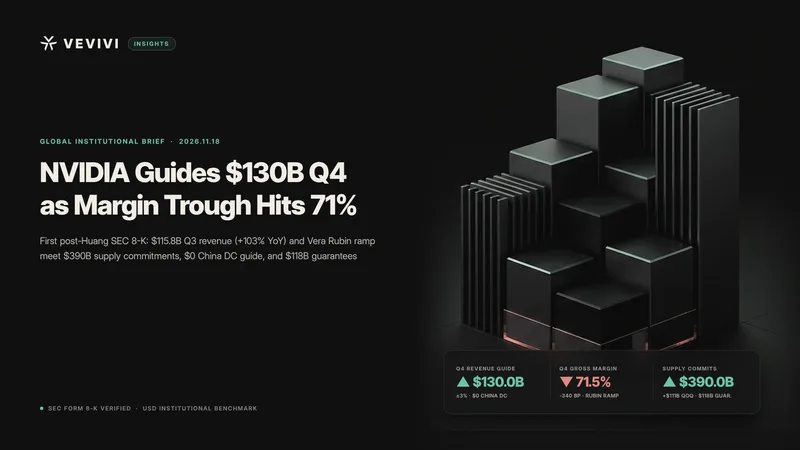
According to NVIDIA Corporation's Form 8-K furnished to the U.S. Securities and Exchange Commission (SEC) on November 17, 2026, third-quarter fiscal 2027 revenue for the period ended October 25, 2026 reached $115.84 billion, rising 103% year-over-year and 20% sequentially to clear Wall Street consensus ($109.33 billion) by roughly $6.5 billion. Delivered just five days after co-founder Jensen Huang resigned as President, Chief Executive Officer, and Board Director on November 12, the inaugural earnings release under Interim CEO and CFO Colette Kress and newly appointed Board Chair Harvey C. Jones projected fourth-quarter revenue of $130.0 billion (±3%, or $126.1 billion to $133.9 billion), comfortably topping the $125.25 billion institutional consensus.
Beneath the headline beat, however, institutional portfolio managers operating against a 5.12% U.S. 10-year Treasury yield benchmark (per Federal Reserve H.15 data) are dissecting a more nuanced trade-off between top-line velocity and capital intensity. While the fastest product ramp in company history for the next-generation Vera Rubin NVL72 platform supported an upward revision in fiscal 2028 revenue growth expectations to approximately 75%, management guided fourth-quarter gross margins down roughly 340 basis points to a 71.0%–72.0% trough, expanded supply commitments to $390 billion, and disclosed $118 billion in partner infrastructure guarantees alongside $81.03 billion in accounts receivable.
Post-Huang Governance Test and the $115.8B Q3 Earnings Beat
Per NVIDIA's SEC Form 8-K financial statements, Q3 FY27 marked the company's fifteenth consecutive quarterly revenue beat above the top end of street forecasts. Data Center revenue climbed 110% year-over-year and 21% quarter-over-quarter to $107.6 billion—representing 92.9% of consolidated revenue—with Data Center networking exceeding $21 billion in quarterly sales. Edge Computing contributed $8.2 billion, advancing 42% year-over-year and 14% sequentially on enterprise Blackwell workstations and physical AI deployments, even as elevated memory and system pricing weighed on consumer PC demand.
Operating leverage and cash conversion remained formidable at hyperscale volume. Third-quarter GAAP net income doubled (+105% YoY) to $65.29 billion ($2.70 diluted EPS), while Non-GAAP net income—which since Q1 FY27 no longer excludes stock-based compensation ($2.09 billion in Q3)—rose 109% year-over-year to $64.87 billion, or $2.68 per diluted share, beating the $2.47 consensus estimate by 8.5%. Operating cash flow reached $48.25 billion and free cash flow totaled $43.78 billion. Backed by the Board's historic $150 billion share repurchase authorization increase approved without expiration in September 2026, NVIDIA returned $28.1 billion to shareholders during Q3 ($22.12 billion in buybacks and $6.03 billion in cash dividends), retaining $227.3 billion in remaining buyback dry powder at quarter-end.
Vera Rubin NVL72 Volume Ramp and the Fiscal 2028 75% Growth Upgrade
Operational continuity through the executive transition rested squarely on early execution of the Vera Rubin architecture. Management confirmed that Vera Rubin NVL72 rack-scale systems—pairing 72 Rubin GPUs with 36 custom Vera data center CPUs—commenced volume shipments during Q3 in the fastest ramp in corporate history. Production racks are already running at CoreWeave, Google Cloud (with general availability of A5X instances), Microsoft Azure, Oracle Cloud Infrastructure, and Nebius, with SpaceXSI scheduled to come online shortly. Following the release and earnings call, NVIDIA shares closed extended trading up 4.87% at $162.95 (off a $155.46 regular close and ~$3.75 trillion market capitalization), while AI neocloud partners CoreWeave (+9.02% to $54.39) and Nebius (+11.21% to $117.99) rallied sharply after hours.
Crucially, Interim CEO Kress dispelled pre-call speculation that leadership turnover might prompt management to withdraw multi-year visibility, instead raising NVIDIA's fiscal 2028 revenue growth outlook from approximately 70% to roughly 75% year-over-year. With nine-month FY27 revenue already at $293.68 billion and the Q4 midpoint implying full-year FY27 revenue near $423.7 billion, a 75% expansion points toward an annualized FY28 revenue trajectory approaching $740 billion. Institutional analysts nonetheless note an important calendar adjustment in the Q4 $130.0 billion guide: fiscal Q4 includes a 14th week, meaning the normalized 13-week run-rate equates to roughly $121 billion, accompanied by higher Non-GAAP operating expenses of $10.7 billion (versus $9.99 billion consensus).
Gross Margin Compression to 71%–72% and the $390B Supply Lock-In
The primary focal point for semiconductor equity desks was the sequential step-down in gross profitability. After delivering a 74.9% Non-GAAP gross margin in Q3 (74.8% GAAP, beating 74.0% guidance), NVIDIA projected both GAAP and Non-GAAP gross margins to compress to 71.0%–72.0% in Q4—roughly 340 basis points lower at the midpoint. In semiconductor hardware cycles, gross margin inflection often serves as a leading indicator of component rent extraction versus pricing power.
Management characterized the Q4 71%–72% band explicitly as the cycle bottom before margins recover to a 72.0%–73.0% range in fiscal 2028. According to CFO commentary, two transient pressures converged: steep high-bandwidth memory (HBM) and DRAM cost inflation absorbed by NVIDIA while honoring earlier fixed-price customer purchase orders, alongside initial manufacturing and yield-scaling expenses on Vera Rubin NVL72 racks ahead of new fiscal-year pricing adjustments. To prevent memory bottlenecks from capping FY28 shipments, NVIDIA expanded total supply and capacity commitments by $111 billion in a single quarter—from $279 billion in Q2 to $390 billion in Q3—anchored by multi-year memory procurement and advanced packaging agreements.
Working Capital Expansion, $81B Receivables, and $118B Partner Guarantees
Granular balance-sheet inspection reveals how deeply NVIDIA's balance sheet is now underwriting the broader AI infrastructure buildout. Per the Q3 Form 8-K balance sheet, net accounts receivable rose $18.05 billion sequentially (and $42.57 billion over nine months) to $81.03 billion, stretching days sales outstanding (DSO) from 60 days to 64 days on late-quarter Rubin shipments and extended payment terms for large multi-quarter agreements. Inventories increased $8.15 billion sequentially to $39.72 billion, long-term debt stood at $32.37 billion (up from $7.47 billion at January 25, 2026), and non-marketable equity securities reached $65.53 billion even after booking a $1.8 billion Q3 impairment on private AI holdings.
Off-balance-sheet credit commitments expanded in tandem. Maximum partner guarantee exposure climbed from $108.5 billion in Q2 to $118 billion in Q3—including $105 billion backstopping SB Energy's 20-year OpenAI-leased Ohio data center campus and $32 billion in neocloud commitments, alongside $74 billion in uncommenced data center leases. Notably, Kress acknowledged that several frontier AI labs and emerging cloud providers are scaling compute capacity faster than their standalone balance sheets and credit profiles can support, pledging a selective underwriting stance. While NVIDIA has made zero guarantee payouts to date, sustaining $81 billion in receivables and $118 billion in guarantees in a 5.12% Treasury yield environment leaves valuation multiples sensitive to downstream customer cash conversion.
Zero China Data Center Assumption and Third-Country Cloud Controls
On export policy, NVIDIA ring-fenced its forward guidance against direct China disruption. After recognizing $2.4 billion in Q3 revenue from licensed prior-generation Hopper data center shipments to China, Kress confirmed that NVIDIA is no longer shipping licensed Hopper data center products to China and embedded zero China Data Center compute revenue inside its $130.0 billion Q4 outlook. Delivering a $4.75 billion top-line guidance beat even after stripping China compute down to zero underscores the breadth of North American, European, and sovereign AI backlog.
Regulatory risk has nevertheless shifted from direct mainland shipments toward extraterritorial cloud access and transshipment enforcement. Following tightened U.S. Commerce Department Bureau of Industry and Security (BIS) licensing rules governing remote access to large third-country GPU clusters (exceeding 12 million Total Processing Performance) and scheduled U.S. Senate Banking and House Foreign Affairs hearings into chip diversion and Singapore hub routing, institutional investors face ongoing compliance uncertainty. While NVIDIA maintains that its Singapore-hosted cloud deployments legally serve multinational enterprise workloads, tightening know-your-customer rules on overseas GPU clusters could alter delivery cadence across regional colocation partners.
Conditional Institutional Scenarios and Cross-Asset Implications
Trading ~36% below its October 52-week peak of $243.37 at roughly 19.7x trailing GAAP earnings, NVIDIA enters the final stretch of calendar 2026 with compressed valuation multiples relative to its triple-digit revenue growth. Separating verified SEC filing figures from management's forward projections highlights two distinct institutional paths across equities, credit, and digital liquidity markets.
Bullish Re-Rating Path Versus Margin Persistence and Credit Stress Risks
The constructive re-rating scenario hinges on two verifiable catalysts over the next two quarters: new FY28 contract pricing successfully lifting gross margins out of the 71%–72% Q4 trough back into the 72%–73% corridor, and the Board's executive search (led by Heidrick & Struggles) appointing a permanent CEO capable of navigating Washington export policy alongside silicon execution. With $43.8 billion in quarterly free cash flow funding ~$45 billion per quarter in potential share repurchases under the $227.3 billion remaining authorization, confirmed margin stabilization would reinforce hyperscaler and sovereign AI capex conviction.
Conversely, the bear-case risk centers on persistent memory rent extraction and custom ASIC substitution at hyperscale labs keeping gross margins pinned near 70%, coupled with credit market tightening. With the U.S. 10-year Treasury yield anchored near 5.12%, S&P 500 closing regular trading down 1.03% at 7,340.53, and Bitcoin consolidating near $64,357 amid tighter dollar liquidity, debt-financed AI infrastructure borrowers face elevated refinancing hurdles. Any further lengthening in NVIDIA's 64-day DSO or credit stress among guaranteed neocloud tenants would revive circular-financing discounts regardless of headline GPU shipment records.
Institutional Investor Q&A
Why did NVIDIA shares gain roughly 5% after hours rather than staging a larger breakout after beating Q3 revenue by $6.5B?
Sell-side and buy-side desks already modeled sold-out Blackwell and initial Rubin supply through year-end. Investors weighed the $130.0 billion Q4 guide against three offsetting variables: the ~340 bps Q4 gross margin step-down to 71.0%–72.0%, the 14th fiscal week contributing roughly $9 billion of sequential Q4 revenue, and unresolved governance and U.S. export-control inquiries following Jensen Huang's abrupt November 12 resignation.
Does the Q4 gross margin drop to 71%–72% signal structural pricing erosion or a temporary product-cycle trough?
Management attributes the compression to absorbing surging HBM memory costs on legacy-priced backlog and upfront Vera Rubin NVL72 manufacturing ramp costs, projecting a rebound to 72%–73% in FY28 once updated pricing takes effect. However, because frontier AI labs are simultaneously scaling internal custom ASICs to optimize inference cost per token, institutional desks will treat Q1 FY28 margin guidance as the definitive test of pricing power.
What do $390B in supply commitments and $118B in partner guarantees indicate for AI capital cycle durability?
Securing $390 billion in multi-year memory and wafer commitments provides tangible physical backing for management's upgraded ~75% FY28 revenue growth target. At the same time, $81.03 billion in accounts receivable and $118 billion in partner lease guarantees confirm that NVIDIA is deploying balance-sheet credit to bridge AI labs growing faster than their standalone financing capacity—making free-cash-flow conversion and DSO trajectory critical risk metrics in a 5%+ rate regime.
Disclaimer and Risk Warning
This article is provided strictly for informational and educational purposes based on publicly available on-chain metrics and macroeconomic data. Nothing in this publication constitutes financial, investment, legal, or tax advice, nor should it be construed as a solicitation, recommendation, or offer to buy or sell any digital asset or financial instrument. Digital assets are subject to high market risk and extreme price volatility, and you may lose part or all of your invested capital. Historical market cycles and past performance referenced herein do not guarantee future results. You are solely responsible for your own investment decisions and should conduct independent research and consult a qualified financial advisor before making any financial commitments.